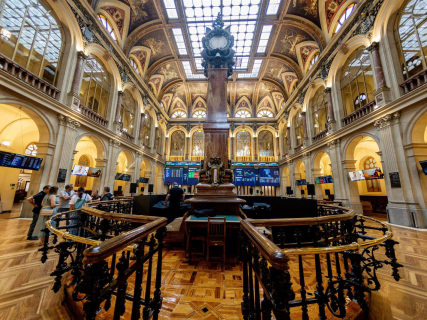

The Ibex 35 closed this Wednesday’s session with a drop of 1.28%, finishing at 19,373.30 points, in a session conditioned by the presentation of Nvidia’s third-quarter results in international markets.
The technology multinational recorded net profit of $65.287 billion (about €59.335 billion) in its fiscal third quarter, between the end of July and the end of October, which means more than doubling, by 105%, the earnings obtained a year earlier.
With these figures, the company beat analysts’ consensus forecasts in its first quarterly accounts without Jensen Huang at the top of the management board following the scandal stemming from his infidelities.
However, XTB analyst Javier Cabrera emphasizes that “relevant doubts persist due to the increase of more than 140% in accounts receivable, investigations by the SEC, and off-balance-sheet commitments that reach $668,000 million ahead of the arrival of the new chief executive officer.”
During this week, investors already have their eyes on how the market will react to the debut on the stock exchange of Anthropic, which aims to join the select group of companies with a market capitalization above one trillion dollars.
“It seems particularly relevant that it is the first company purely focused on artificial intelligence to access capital markets. It would not be surprising to observe a similar evolution to that of other major recent IPOs, with a strong initial rebound driven by the demand generated during the placement process,” state Charles Lilford, co-director of equity and co-manager of the Big Data strategy at Edmond de Rothschild AM, and Xiadong Bao, co-manager of the Bid Data strategy at the asset manager.
Meanwhile, the European Central Bank (ECB), whose chair is cleared up for the Spanish candidate, Pablo Hernández de Cos, has warned that high stock market valuations supported by high expectations about AI, along with fiscal imbalances derived from substantial indebtedness and greater financing needs in a scenario of geopolitical tensions, constitute the main risks to financial stability in the euro area.
In the United States, and also in the field of central banking, the president of the Federal Reserve Bank of New York, the head of the regional banks of the Fed system, John Williams, has emphasized that the latest data confirm the resilience of the country’s economy and labor market, as well as the obligation to keep working to bring inflation back to 2%, although he considers that it is not yet the time to apply shock measures.
In the corporate sphere, Enagás has stated that the Ciadi has again ruled in its favor in the legal disputes pending with Peru in the arbitration relating to its stake in the Peruvian companies Transportadora de Gas del Perú (TGP) and Compañía Operadora de Gas del Amazonas (COGA).
In detail, the ruling orders the Andean country to allow the energy company to repatriate dividends accrued, present and future, linked to its investment in TGP, as well as to return to it a guarantee of 65 million dollars (about 59.2 million euros).
On the Spanish trading floor, only two companies managed to escape the sell-offs and closed higher: IAG (+0.37%) and Redeia (+0.06%). On the other side, Repsol led the declines (-6.42%), followed by Indra (-4.19%), CaixaBank (-2.58%), Telefónica (-2.56%), and Unicaja (-2.11%).
In line with the correction of the Spanish benchmark index, the main European stock exchanges also ended with declines: the British FTSE 100 fell by 1.30%, the French Cac 40 by 0.85%, the German Dax by 1.19%, the Italian FTSE MIB by 1.32%, and the Euro Stoxx 50 by 0.93%.
On Wall Street, by the close of the European markets, the New York indexes also moved in negative territory: the Dow Jones fell by 1.08%, the S&P 500 by 0.60%, and the Nasdaq, focused on technology stocks, fell by 0.15%, with Nvidia retreating 2.44%.
As for commodities, the price of a barrel of Brent, the benchmark in Europe, stood at 91.26 dollars, which implies a decline of 2.02%, while the West Texas Intermediate (WTI), the benchmark in the United States, was at 83.60 dollars, 2.80% less.
In the debt market, the yield on the Spanish 10-year bond remained at 3.942%, with no change from the 3.942% recorded at the close on Tuesday, leaving the risk premium versus the German bond at 56.57 basis points.
In the foreign exchange market, the euro depreciated by 0.35% against the greenback, to an exchange rate of 1.0961 dollars per euro.
Regarding the assets considered safe havens in periods of high volatility, the price of an ounce of gold was down 2.99%, to $3,748, while the main cryptocurrency, bitcoin, fell back 1.47%, to $62,810.