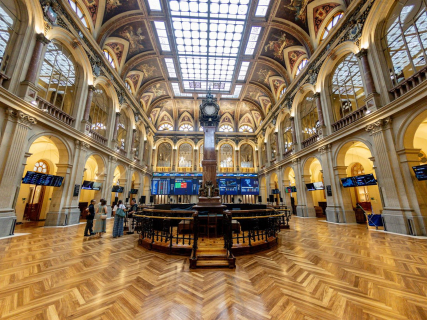

The Ibex 35 has fallen this Wednesday by 2.73% and has concluded the session close to the threshold of 19,100 points, after the President of the United States, Donald Trump, once again lashed out at Spain by announcing that he will "completely" halt bilateral trade due to the Government's refusal to increase military spending to 5% of Gross Domestic Product (GDP).
The main indicator of the Spanish Stock Market has finished at 19,104.3 points, marking its worst day since March 3, 2026, on which date it lost 4.55% coinciding with the outbreak of the war in Iran. On this occasion, the selective index has been pressured by both Trump's new trade threats and the resurgence of geopolitical tensions in the Middle East, which have once again driven the price of oil to the $80 per barrel range.
"Spain is a lost cause. By the way, we don't want to do any business with Spain anymore. I want you to cut it off. Spain is a terrible ally in NATO. They don't participate. They don't pay. I don't want to hear anything about Spain. Cut off all trade with Spain, please, including visits," Trump stated during a joint press conference with the Secretary General of the Alliance, Mark Rutte.
The US leader has shown his displeasure with several partners for their lack of commitment to NATO, although he has particularly targeted Spain, considering that "they are hostile," "they don't agree with anything," and "openly" state that they will not increase defense spending beyond 2%.
Simultaneously, the White House occupant has declared the ceasefire and the memorandum of understanding with Iran to be broken, describing its leaders as "scum" and "sick people" following the bombings carried out by the United States against the Middle Eastern country.
"As far as I'm concerned, it's over. I don't want to deal with them anymore. They are scum. Do you know what scum is? They are sick people. They are led by sick people. And they are vicious, violent people. And if they had a nuclear weapon, they would use it," he added.
The United States Army Central Command (CENTCOM) launched "strong" attacks against Iran on Tuesday night in response to Iranian "aggressions" against ships in the Strait of Hormuz. In parallel, the US Treasury Department has withdrawn authorization for Iran's crude oil exports.
As a counterattack, the Islamic Republic has attacked United States bases in Gulf countries. Various states in the area, including members of the Gulf Cooperation Council (GCC), have condemned this Wednesday the attacks perpetrated by Iran against Bahrain and Kuwait, without any victims having been reported so far in Bahraini or Kuwaiti territory.
In parallel, the International Monetary Fund (IMF) has warned that a new escalation of the crisis in the Middle East constitutes "the main downside risk" for the organization's growth forecasts.
In this scenario, Brent crude, a reference in Europe, rebounded at the close of the continent's markets by 8.28%, to 80.32 dollars, while West Texas Intermediate (WTI), a reference in the United States, advanced to 75.86 dollars (+7.72%).
For its part, the TTF natural gas contract, traded in the Netherlands and considered a reference for Europe, stood at 48.97 euros per megawatt hour after a 5.14% increase compared to Tuesday.
European stock markets, in negative
Within the Ibex 35, the most pronounced declines of the day corresponded to Amadeus (-5.44%), Banco Santander (-5.06%), Acerinox (-4.99%), IAG (-4.58%) and Arcelormittal (-4.45%). On the opposite side, only three values of the selective managed to close in green: Enagas (+0.24%), Naturgy (+1.24%) and Repsol (+5.13%), the latter driven by the rise in crude oil prices.
The rest of the major stock markets of the Old Continent also ended in red, although with more moderate falls than those of the Ibex 35. Milan's FTSE MIB fell 1.22%; London's FTSE 100, 1.66%; Paris's CAC 40, 2.18%; and Frankfurt's DAX 30, 2.23%.
Despite the declines, the general director of Swisscanto in Spain, Gonzalo Ramón-Borja, stated in declarations to Europa Press that the market is "accustomed to Trump's comings and goings since 'Liberation Day'".
Fixed income, currencies and refuge
In the currency market, the euro fell 0.16% against the dollar, to 1.1394 units, while the yield required on the Spanish ten-year bond rose to 3.579%, raising the risk premium —the differential with the German bond at the same term— to 48.15 basic points.
Among the assets considered safe havens in phases of geopolitical volatility and uncertainty, gold ceded 1.8% at the close of European stock markets, remaining around $4,000 per ounce. In turn, the main cryptocurrency, bitcoin, fell 3.5% this Wednesday and was trading around $61,600.