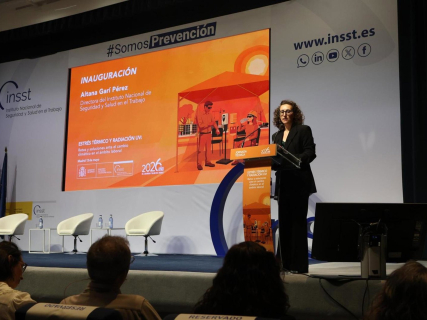

The National Institute for Safety and Health at Work (Insst) and the State Meteorological Agency (Aemet) have announced this Tuesday a joint research project aimed at strengthening the prevention of risks derived from high temperatures in outdoor activities.
In a scenario marked by the increase in extreme heat episodes associated with climate change, the proposal, in which the technical prevention bodies of the autonomous communities also collaborate, seeks to create a tool capable of anticipating indicators such as temperature, humidity, solar radiation, and air speed, in order to foresee occupational risks linked to heat.
The integration of these factors through the WBGT (Wet Bulb Globe Temperature) index will make it possible to have key information to avoid heatstroke and other effects of high temperatures on health, and to adjust work organization during episodes of intense heat.
During the project presentation, held at the technical conference "Thermal stress and UV radiation: challenges and solutions to climate change in the workplace", the director of Insst, Aitana Garí Pérez, warned that extreme heat no longer affects "only a few days a year" and that intense sun exposure is not an "anecdotal" phenomenon.
The Insst has indicated that workplace accidents increase by 17.4% during heat waves and has emphasized that, in outdoor jobs, environmental conditions can change even within the same workday. Therefore, it considers it essential to have detailed predictions that allow risks to be anticipated, beyond the specific measurements taken at the time.
Preventive measures against extreme heat
Among the preventive recommendations are the reorganization of shifts, the reduction of exposure to heat and solar radiation, and, in certain cases, the temporary suspension of tasks to safeguard the safety and health of workers.
According to estimates from the Daily Mortality Monitoring System (MoMo), between May 16 and September 30, 2025, 3,832 deaths linked to excess temperature were recorded in Spain in the general population, an 87.6% increase compared to 2024. Likewise, extreme heat episodes increased by 73% compared to the previous year.
The Insst has also pointed out that more than 5.5 million workers in Spain, 26% of the total, declare having been exposed to extreme heat both indoors and outdoors, a proportion higher than the European average, which is above 20%, according to the report "OSH Pulse 2025" by the European Agency for Safety and Health at Work.
In addition, some 3.8 million workers, 17% of the employed population, perform their work under intense solar radiation, compared to 12% of the European average. The most affected sectors are agriculture and fishing, construction, utilities, and mining.
The organization has emphasized the urgency of strengthening preventive tools against the risks associated with climate change and moving towards management models adapted to the new environmental conditions.
In this regard, he recalled that thermal stress does not depend solely on temperature, but also on humidity, solar radiation, air speed, the intensity of physical exertion, or work clothing, factors that determine the thermal load the body endures.
Impact on Health and Strategic Framework
According to joint estimates by the World Health Organization (WHO) and the International Labour Organization (ILO), prolonged exposure to the sun during the workday increases the risk of developing skin cancer by 60%, and one in three deaths from this type of cancer is related to work activity.
High temperatures can trigger heatstroke, sunstroke, exhaustion, and fatigue, in addition to being associated with pathologies such as kidney failure. They also impair cognitive abilities such as concentration, short-term memory, motor coordination, or visual perception, and influence emotional state, increasing psychosocial risks at work.
The technical conference of the Insst is integrated into the Spanish Strategy for Occupational Safety and Health 2023-2027, which foresees reinforcing protection against extreme climatic conditions and promoting specific tools to facilitate preventive management, especially in small and medium-sized enterprises.