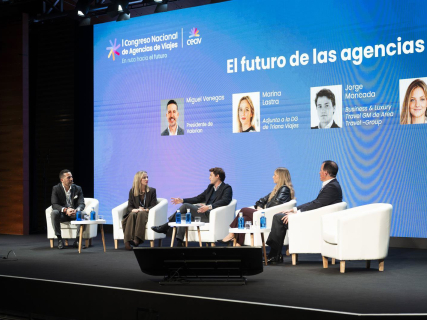

Travel agencies have highlighted expert advice, specialization, and close customer service as their great strengths in the face of the advance of artificial intelligence (AI) and the digital transformation of tourism. This was made clear at the I National Congress of Travel Agencies, promoted by the Confederación Española de Agencias de Viajes (CEAV), which brought together more than 300 industry professionals in Madrid.
During the event, attendees discussed how technology is reshaping the tourism business, the adaptation of agencies to this new scenario, and changes in travelers’ habits, who show a growing demand for tailor-made experiences and differentiated proposals.
One of the panels focused on the use of artificial intelligence in travel agencies. There, representatives from Microsoft, Juan Torres, and Amadeus, David Vidal, emphasized that this tool makes it possible to automate routine tasks, speed up the resolution of incidents, create personalized proposals, and raise companies’ operational efficiency.
The data presented indicate that 90% of large companies already use artificial intelligence, compared to 25% of medium-sized ones, placing Spain in sixth position worldwide for adoption of this technology.
However, specialists insisted that its rollout must be accompanied by specific training, human supervision, and guarantees regarding data protection. Along these lines, they argued that AI should be understood as a support tool for agents and not as a substitute, since it helps free up time to strengthen advice and care for travelers.
Specialization, key to compete
The future of the agencies’ business model was another of the central topics of the congress. The participants agreed that, despite the ease of comparing and booking trips online, users continue to value the security, trust, time savings, and professional guidance provided by these establishments.
They also highlighted the need to move toward the commercialization of complete experiences, integrate new technological solutions, attract young talent, and strengthen specialization as differentiating factors compared to other sales channels.
The transformation of travelers’ preferences has also taken up a good part of the debate. Speakers have pointed out that customers are increasingly demanding authentic experiences, small groups, and proposals aligned with their interests, in addition to showing a greater willingness to pay for services that provide clear added value.
In this context, industry representatives have emphasized the importance of knowing destinations firsthand, working with local suppliers, and offering information and recommendations based on accumulated professional experience.
The congress concluded with the shared conclusion that the future of travel agencies lies in combining technological innovation with deep knowledge of destinations, specialization, and personalized attention, in order to respond to travelers who are increasingly informed and demanding.