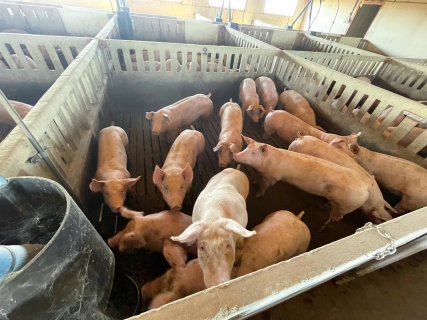

The professional agricultural organization UPA has received with "positive" valuation the new European Livestock Strategy presented yesterday by the European Commission, a package that incorporates various reform proposals for the rules that de facto govern livestock production in the entire Union, although it insists that "budgetary concreteness is lacking" to carry them out.
In a statement, UPA emphasizes that it is "important and positive" that the European Union places the future of its livestock and the supply of food for all citizens at its center.
The organization interprets this strategy "positively" as a "change of course" in the community institutions, which will prioritize incentives over the imposition of new obligations and set a goal of stopping the loss of livestock that most productive sectors are suffering.
According to UPA, the community plan will contribute to shielding European farms from unfair competition from third countries, promoting the implementation of mirror clauses in agreements with external countries and strengthening controls on meat imports.
The livestock farmers integrated into UPA demand, however, that the proposals outlined by Brussels be specified in regulations and directives adapted to the family farming model, with special attention to extensive and semi-extensive systems, which they consider to be those that require more intense support and protection.
The strategy sets goals in areas such as animal welfare, health, emission reduction, and sustainability as a whole, objectives that UPA claims to fully share, although it warns: "Europe cannot ignore that reforms have costs, and livestock farms cannot be the ones to bear them."
In this regard, the organization once again focuses on the absence of financial details. "Ambitious goals require adequate budgets. We cannot leave everything to the CAP, especially when cuts are being considered for it. We cannot demand a green transition from farms in the red," they have stated.
UPA also favorably assesses the presentation of a European Protein Action Plan that will reduce dependence on external raw materials, a demand that the sector has been making for years.
On the contrary, from the UPA pig sector, the proposal included in the strategy regarding the elimination of cages has been received "very negatively", since, as they warn, it would imply a "very high" cost for producers, forced to adapt facilities, expand farrowing areas, and, in numerous cases, enlarge farms.
"Many farms would have difficulties assuming this investment, especially in a context of increasing production costs. Many farms would have to close. And even more so, taking into account the current situation being experienced in Europe and Spain regarding ASF, which has caused prices not to cover production costs," they have explained.