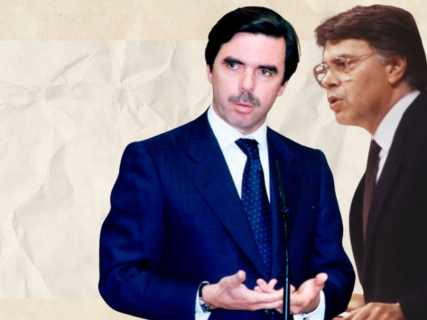

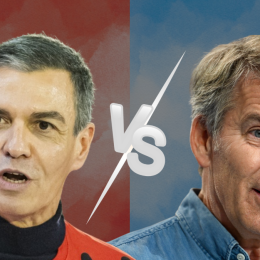
When Pedro Sánchez and Alberto Núñez Feijóo face the cameras this Thursday, at 22.00 hours, more than three decades will have passed since Felipe González and José María Aznar inaugurated televised election debates between candidates for the Presidency of the Government in Spain. Since that first meeting, held on May 24, 1993, face-to-face debates have left some of the most memorable episodes of election campaigns, although for fifteen years they disappeared completely from the political calendar.
The history of these clashes also reflects changes in the party system. During its first decades, PSOE and PP monopolized debates among aspirants for La Moncloa. The emergence of Podemos and Ciudadanos in 2015 opened the studios to four candidates and, four years later, the entry of Vox into the Congress made it possible to hold the first debate with five.
Among the episodes that have remained in the record, the revenge of González against Aznar in 1993 stands out, the famous “girl” of Mariano Rajoy in 2008, the accusations by Pedro Sánchez against the then prime minister in 2015, or the paving stone that Albert Rivera took to television in 2019.
Until the elections of July 23, 2023, 13 major televised debates had been held between candidates for the Presidency. The most watched continues to be the first meeting between José Luis Rodríguez Zapatero and Mariano Rajoy, which attracted more than 13 million viewers in February 2008.
1993: González and Aznar inaugurate election debates in Spain
On May 24, 1993, Felipe González and José María Aznar faced each other on Antena 3 in the first televised debate between aspiring to lead the Government of Spanish democracy. Moderated by Manuel Campo Vidal, that meeting opened up an unprecedented phase in election campaigns, then dominated by party rallies, interviews, and propaganda.
González had been in La Moncloa for more than ten years and sought a fourth consecutive victory, while Aznar aimed to put an end to socialist hegemony. The negotiation of the format was so meticulous that the teams discussed aspects such as the placement of the cameras, the temperature of the studio, the height of the chairs, and the shots that could be broadcast.
Aznar came out better from the first showdown according to a large part of the chronicles of the time, which highlighted his preparation against a González who was less comfortable than expected. The encounter brought together 9,625,000 viewers and obtained a 61.8% share of the screen.
A week later, on 31 May, the rematch arrived on Telecinco, with Luis Mariñas as moderator. González attended with a more offensive strategy and managed to change the perception that the first encounter had left. That second appointment brought together 10,526,000 viewers and obtained a 75.3% share, still one of the most extraordinary figures in Spanish television.
The PSOE ended up winning the elections of 6 June 1993, although it lost an absolute majority. The debates had demonstrated its ability to focus public attention, but the format did not have immediate continuity.
Fifteen years without a face-to-face: the 1996, 2000 and 2004 campaigns
Despite the audience success of 1993, Spaniards did not see another televised confrontation between the two main contenders for the Moncloa until 2008.
In 1996, there was no agreement to repeat the meetings between González and Aznar. Nor were debates held between candidates for the Presidency during the 2000 and 2004 campaigns, with José María Aznar in Government in the first of them and Mariano Rajoy as the PP candidate in the second.
During those fifteen years, the debates were subject to the will of the parties and to their campaign calculations, a characteristic that has accompanied their history even after the format was restored.
2008: Zapatero, Rajoy and the most famous girl of an election campaign
It had to wait until 25 February 2008 for two candidates for the Presidency to face each other again on television. José Luis Rodríguez Zapatero, president since 2004, and Mariano Rajoy, leader of the PP, starred in the first of the two debates organized by the Academia de Televisión.
The meeting, moderated by Manuel Campo Vidal, still is the most-watched election debate in the history of Spain, with 13,043,000 viewers on average and a 59.1% share of the screen.
The economy, immigration, terrorism, and the political situation dominated an exchange that was particularly tense. However, one of the most remembered moments came in the final minute, when Rajoy turned to the image of a girl born in Spain to explain the country he wanted to build.
The expression "the girl from Rajoy" immediately jumped to the headlines and became the subject of comments, imitations, and references for the rest of the campaign.
The second meeting, held on March 3 and moderated by Olga Viza, left another historic send-off. Zapatero concluded his remarks with a "Good night and good luck", a phrase associated with the American journalist Edward R. Murrow that went on to become part of the memory of those debates.
Nearly twelve million people followed that second appointment. Six days later, the PSOE won the elections and Zapatero secured his second term.
2011: Rubalcaba and Rajoy debate amid an economic crisis
With Spain mired in a deep economic crisis and José Luis Rodríguez Zapatero out of the election race, the debate of November 7, 2011 pitted Alfredo Pérez Rubalcaba, the PSOE candidate, and Mariano Rajoy, the PP contender, against each other.
The meeting, moderated once again by Manuel Campo Vidal, took place when unemployment, cuts, and economic difficulties occupied the center of political discussion. Rubalcaba tried to take Rajoy to the ground of the measures he would take if he reached Government, while the popular candidate directed his criticisms at the Socialist management of the crisis.
One of the characteristics of that debate was Rubalcaba’s insistence on demanding specificity about the PP’s plans, especially in relation to public services and social policies.
The broadcast brought together 12,005,000 viewers and achieved a 54.2% share of screen, becoming the second most-watched electoral debate in Spain. On November 20, the PP won the elections with an absolute majority and Rajoy arrived at the Moncloa for the first time.
2015: Bipartisanship loses the monopoly on debates
The campaign for the December 20, 2015 elections changed the rules for electoral debates. Podemos and Ciudadanos had burst onto national politics and their leaders, Pablo Iglesias and Albert Rivera, were calling for the chance to participate in the major televised events alongside the PP and the PSOE.
On December 7, Atresmedia organized a four-way debate with Pedro Sánchez, Pablo Iglesias, Albert Rivera and Soraya Sáenz de Santamaría, who attended on behalf of the PP because Mariano Rajoy refused to participate. The format, with political representatives standing and no lecterns, broke with the traditional staging of two-way confrontations.
A week later, on December 14, Rajoy and Sánchez starred in one of the most tense face-to-face encounters in democracy. The president of the Government went to defend his performance during the economic crisis, while the socialist leader tried to call into question his continuity at the head of the Executive.
Corruption caused the hardest moment of the night. Sánchez snapped at Rajoy: "The president of the Government has to be a decent person and you are not one." The popular candidate reacted visibly annoyed and accused the socialist of being "mean, petty, miserable and contemptible".
The face-to-face gathered 9,728,000 viewers. Barely six days later, the PP won the elections again, although it lost its absolute majority. Podemos and Ciudadanos managed to make a strong entry into Congress and the lack of agreements to form a Government led to an electoral repeat.
2016: Rajoy agrees to debate with Iglesias, Rivera and Sánchez
The repeat of the general elections of June 26, 2016 made it possible, for the first time, to hold a televised debate with the four leaders of the main parties. Mariano Rajoy, Pedro Sánchez, Pablo Iglesias and Albert Rivera shared the studio on June 13 at a meeting organized by the Televisión Academy.
The moderation also reflected the scope of the event. Ana Blanco, Vicente Vallés and Pedro Piqueras jointly hosted a broadcast that could be followed through numerous channels.
Although corruption, the economy and social policies occupied a large part of the discussion, the possible alliances after the elections gained special prominence. The political deadlock from the previous months still had not been resolved and the candidates reproached each other for their responsibility in the lack of a Government.
Rajoy had to respond to the criticisms of his three adversaries, while Sánchez and Iglesias also maintained differences about the possibility of reaching agreements between the left-wing forces.
The debate brought together 10,496,000 viewers and obtained 57% screen share. After the elections, the PP became the leading party again and Rajoy managed to stay in the Moncloa after an investiture that included the abstention of part of the PSOE.
April 2019: two debates in 24 hours and the absence of Vox
With Pedro Sánchez at the head of the Government after the 2018 motion of no confidence, the April 2019 campaign brought back the big four-way debates. This time, Sánchez, Pablo Casado, Pablo Iglesias and Albert Rivera took part.
The prior negotiations were accompanied by intense controversy over dates, schedules and invited candidates. Atresmedia initially had planned a five-way debate with Santiago Abascal, but lthe Central Electoral Board prevented his participation due to the electoral representation conditions then in force.
Finally, the four candidates debated over two consecutive nights, something unprecedented until then in a Spanish campaign: the 22nd of April on RTVE and the 23rd on Atresmedia.
Possible post-election pacts, Catalonia and economic policy occupied the interventions. Rivera pressed Sánchez about his agreements with the separatist parties, while Iglesias insisted that he clarify whether he was ruling out governing with Ciudadanos.
The tension between the aspirants reflected a parliamentary scenario far more fragmented than that of the first debates in the early 1990s. According to audience data, the RTVE meeting drew 8,886,000 viewers and the Atresmedia meeting 9,477,000.
The PSOE won the elections of 28 April, but the negotiations to form a Government failed and Spain went back to the polls in November.
November 2019: the first five-way debate and Albert Rivera’s paving stone
The second election campaign of 2019 included a historic novelty. On 4 November, Pedro Sánchez, Pablo Casado, Pablo Iglesias, Albert Rivera and Santiago Abascal took part in the first five-way debate among the main candidates for the Presidency of the Government.
Held in the Pabellón de Cristal of the Casa de Campo in Madrid, the encounter was marked by the political crisis in Catalonia, the institutional deadlock and differences over the agreements needed to govern.
One of its most talked-about moments featured Albert Rivera as the protagonist. The leader of Ciudadanos showed a paving stone during his intervention on the unrest in Catalonia, using it to denounce episodes of violence that had occurred on the streets after the ruling of the procés. The image of the candidate holding up the object in front of the cameras became one of the most widely circulated scenes of that campaign.
It also highlighted the debut of Abascal in a debate of this kind, after Vox had managed to secure representation in Congress in the April elections. His presence opened up new clashes over immigration, historical memory, and territorial unity.
The debate brought together about 8.6 million viewers. Six days later, the PSOE won the elections again, Vox moved into third place in Congress, and Ciudadanos suffered a major setback. The new legislature began with the coalition agreement between the PSOE and Unidas Podemos.
2023: Sánchez and Feijóo take center stage in a face-off of continuous reproaches
After four years without two-way debates between the PSOE and PP leaders, Pedro Sánchez and Alberto Núñez Feijóo brought the format back on July 10, 2023, less than two weeks before the general elections of 23J.
The event, organized by Atresmedia and moderated by Ana Pastor and Vicente Vallés, was dominated by interruptions and mutual reproaches. The confrontations began during the economic block, when both candidates disagreed about the evolution of employment, inflation, and the situation of families.
The PP’s agreements with Vox and the PSOE’s parliamentary pacts with the independentist forces also triggered some of the most tense exchanges. Sánchez reproached Feijóo for his alliances with Santiago Abascal’s formation, while the People’s Party leader criticized the Executive’s relationship with EH Bildu and the consequences of the “only yes is yes” law.
The average audience was 5,911,000 viewers, with a share of 46.5%, below the figures of the major confrontations of previous decades.
Nine days later, RTVE held another election debate with Pedro Sánchez, Yolanda Díaz, and Santiago Abascal. Feijóo rejected the invitation and did not take part, an absence that also became news during the campaign.
In the elections of July 23, the PP secured more seats than the PSOE, although Feijóo did not obtain the necessary support for his investiture. Sánchez subsequently achieved re-election with the backing of Sumar and several nationalist and independentist formations.
2026: Sánchez and Feijóo face each other again three years later
This Thursday, November 19, Pedro Sánchez and Alberto Núñez Feijóo will meet again in a televised debate, this time organized by the Academia de Televisión and moderated by María Casado.
Unlike in 2023, the meeting will be held during the campaign for snap elections, called for 29 November, in a scenario in which PSOE and PP are once again competing for first place while Vox and the forces on its left aspire to influence the formation of the next Government.
The format will recover the thematic blocks agreed in advance and will make it possible to address housing, the economy and taxation, social policies, corruption and democratic renewal, migration and foreign policy. Feijóo will open the debate and Sánchez will be in charge of the final minute of his intervention. The meeting will begin at 22:00 hours and can be followed on RTVE and other national channels.