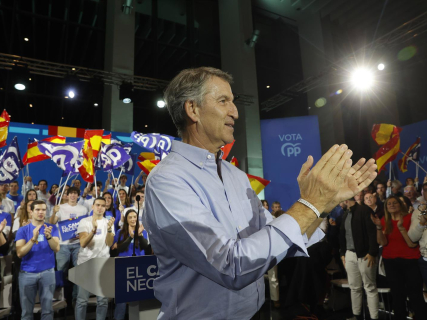
General election survey: PP and Vox add up to 192 seats before the debate between Sánchez and Feijóo, according to 40dB

The tracking of El País and SER keeps the PP two points ahead of the PSOE, although Sánchez surpasses Feijóo in preferences for president. The right retains a large majority with 49.8% of the votes.

fotonoticia 20261119185228 1920

fotonoticia 20261119185228 1920

Add DEMÓCRATA to Google

Ask FREN

Published

Last updated

3 minutes

Most read

Elecciones 29N · Encuestas

La media de las encuestas

Media a 19 de noviembre de 2026 · 19 institutos

  • PP31,0 %
  • PSOE27,7 %
  • Vox19,1 %
  • Frente Amplio6,2 %
  • ERC2,5 %
01020304050ene 2024jul 2024ene 2025jul 2025ene 2026jul 2026

Media del último estudio de cada instituto en 30 días y su evolución semanal desde el 23J. Partidos con al menos un 2 %.

Todas las encuestas

Elecciones generales del 29 de noviembre · Demócrata

PP and Vox maintain a clear absolute majority ten days ahead of the general elections on 29 November, according to the daily tracking by 40dB. for El País and the Cadena SER published this Thursday. The poll, released hours before the face-to-face between Pedro Sánchez and Alberto Núñez Feijóo, gives the conservatives 32.2% of the votes and 134 seats if their coalition with UPN is included, while Vox would obtain 17.6% and 58 deputies. Between the two parties they would add up to 192 seats, 16 more than the 176 needed for an absolute majority.

The PSOE continues to close the gap with the PP in voting intention, although it is still two points behind. The socialists would obtain the 30.2% of the votes and 120 seats, compared with the 132 seats that the PP would achieve separately. The difference between the two parties remains within the survey’s margin of error, set at 2.2 points, while the distance between blocs continues to be considerable.

Results of 40dB. tracking for the 29N elections

The vote estimate published this Thursday reflects an advantage for the PP over the PSOE, although both parties maintain a close contest for first place. Vox retains third place and shows signs of recovery after several days of decline.

Party Estimated vote Seats
PP and UPN 32.2% 134
PSOE 30.2% 120
Vox 17.6% 58
Frente Amplio 3.6% 5
Podemos 1.1% 0
Other left-wing coalitions 1.7% 4
Other parties — 29

Source: daily tracking by 40dB. for El País and the Cadena SER, 19 November 2026. The PP’s 134 deputies include the two attributed to its coalition with UPN. Frente Amplio does not include Podemos or the left-wing regional coalitions.

PP and Vox retain an absolute majority despite the PSOE’s recovery

The parliamentary distribution continues to clearly favor the right. PP and Vox would get 192 seats, while the parties that have supported Sánchez’s government would total 155, according to the bloc grouping made by 40dB.

The advantage remains despite the socialists’ approach toward the PP. In recent days, the distance between the two parties shrank to as little as 1.3 points, although Feijóo has regained ground in the latest batches of the tracking.

Part of that improvement coincides with a recovery in popular support against Vox, which had gained support during the previous weeks. Now, the Santiago Abascal party again shows a slight recovery and stays close to 18% of the votes.

Sánchez surpasses Feijóo as preferred president

Although the PP continues to lead voting intention, Pedro Sánchez is ahead of Alberto Núñez Feijóo in preferences to occupy the Presidency of the Government.

On 31.8% of those surveyed prefer the socialist candidate, compared with 23.1% who choose the popular leader. Santiago Abascal gets 16.9%, while Ada Colau receives 4.5% and Irene Montero 2.5%.

The gap between voting intention and presidential preference also reflects the competition that Feijóo maintains with Abascal within the right-wing bloc, where both leaders vie for the backing of part of the electorate.

The PSOE reduces vote leakages toward the PP

One of the most relevant movements in recent days occurs among former socialist voters. According to 40dB., the PSOE is progressively reducing vote transfers to the Partido Popular, although this recovery has not yet been reflected in a significant way in its electoral estimate.

The vote fidelity data show that 76% of those who backed the PSOE in 2023 maintain their support, while 7% would now lean toward the PP and 4% toward Vox.

Among the popular electorate, 76% would also repeat their vote, while approximately 15% would opt for Vox. Abascal’s party has 90% loyalty among its voters from the last general election.

Voter turnout, another challenge for Sánchez before the debate

This Thursday’s debate offers Sánchez an opportunity to try to mobilize his electorate, especially after polls have shown a greater willingness among PP voters to go to the ballot boxes.

According to the tracking, 78.6% of those who voted for the PP in 2023 say they will return to participate in the 29N, six points more than among former socialist voters.

The turnout estimated by 40dB. is around 69%, below the 75% target that Sánchez has defended during his campaign events as one of the conditions to achieve the comeback.

Among PP voters, almost half would prefer a Feijóo government on its own, while 40% lean toward a coalition with Vox. In the socialist electorate, the preference for an executive exclusively of the PSOE is just two points higher than those who back a new coalition with Frente Amplio.

The tracking is published hours before the only face-to-face between Sánchez and Feijóo, scheduled for this Thursday at 22.00 hours. The meeting, organized by the Television Academy and moderated by María Casado, will address housing, the economy, public services, corruption, migration, and foreign policy.

More key points, information and questions with FREN

AI-GENERATED CONTENT

What stage of processing is the official call for the general elections on November 29 in, and what are its next legal steps?

As of November 19, 2026, the official call for the general elections on November 29 has already been approved, published, and is in force; the electoral process is currently in the campaign phase. Therefore, it is not pending parliamentary approval: the next steps are to complete the voting deadlines, hold the elections, carry out the official count, and constitute the new Chambers.

The call has already produced its effects

The legal instrument is Royal Decree 806/2026, of October 5, dissolving the Congress of Deputies and the Senate and calling elections. It was published in the BOE on October 6 and came into force that same day. Its final provision states: "This royal decree shall enter into force on the day of its publication."

The decree was issued at the proposal of the President of the Government, following deliberation by the Council of Ministers on October 5, in accordance with Article 115 of the Constitution and Article 42.1 of the Organic Law of the General Electoral Regime, known as LOREG. It dissolved both Chambers and set the vote for Sunday, November 29. It is a royal decree of call, not a decree-law that must be submitted for validation.

Phases that have been completed

The call, the presentation and proclamation of candidacies, and the start of the campaign have already been completed. The BOE published the proclaimed candidacies on November 3, as reported by Demócrata. The specific period to consult the census and request corrections also ended, which ran from October 12 to 19, according to the INE information.

The campaign began on November 13 at 00:00. Article 4 of the decree establishes that it will last fifteen days and end at twenty-four hours on Friday the 27th. While the Chambers remain dissolved, their Permanent Deputations maintain the constitutionally provided powers; they do not replace ordinary parliamentary activity.

Next steps and dates
  • November 19: the ordinary deadline to request postal voting in Spain ends. This should not be confused with the deadline to deliver the vote, which ends on November 25, according to the Interior Ministry information.
  • November 21 to 26: voters registered as residents abroad can cast their vote in person at designated centers. Postal sending from abroad has a deadline of November 24, according to the external voting guide.
  • November 27 and 28: the campaign ends at 24:00 on Friday the 27th. Saturday the 28th is the reflection day, with no electoral propaganda.
  • November 29: voting takes place from 9:00 to 20:00. Afterwards, the polling stations first count the votes for the Congress and then for the Senate. The results released that night are provisional.
From the count to the new Cortes

After the vote, the provincial electoral boards are responsible for carrying out the general scrutiny, that is, the official count, and subsequently proclaiming the elected candidates. Electoral agreements may be subject to claims and appeals provided by law: the call in force does not automatically make all subsequent acts definitive.

Article 5 of the decree sets the constitution of the Congress and the Senate for December 23, at 10:00. In the Congress, the Board will be elected and the deputies will take an oath or promise to uphold the Constitution. Then the investiture procedure will begin: constituting the Chambers does not mean that the new President of the Government has already been elected.

What powers and functions does the President of the Government of Spain have according to the Constitution?

The President of the Government of Spain is the main authority of the executive power and his figure is mainly regulated in Articles 97, 98, 99, and 112 to 116 of the Spanish Constitution of 1978. His powers combine general political direction, coordination of the Council of Ministers, and responsibility before the Cortes Generales.

1. Direction of Government action

Article 97 establishes the central idea: the Government directs domestic and foreign policy, civil and military administration, and the defense of the State, and exercises executive function and regulatory power. Within this collegiate body, the President of the Government is the one who directs the action of the Government and coordinates the functions of the other members.

This implies that he is responsible for setting the major political orientations of the Executive, marking legislative priorities, defining lines of economic, social, foreign, and defense policy, and ensuring the coherence of the actions of the different ministries. Although formal decisions are made in the Council of Ministers, the president is the main driver and arbiter of government strategy.

2. Appointment, dismissal, and coordination of ministers

Article 98 establishes that the president is free to propose to the King the appointment and dismissal of ministers. In this way, he configures the structure of the Government (which ministries exist and who heads them) and can reshape it to adapt it to his priorities or the political situation.

He is also responsible for coordinating the work of the ministers. This includes convening and presiding over the Council of Ministers, organizing its work, setting the agenda, and resolving conflicts of competence between departments. The Constitution does not go into organizational detail but does enshrine this position of primacy of the president over the rest of the Government.

3. Relationship with the Cortes Generales and political responsibility

The President of the Government is subject to strong parliamentary control. The Constitution provides various mechanisms:

  • Election and investiture (art. 99): the King proposes a candidate for president and the Congress of Deputies votes on his investiture. Without the confidence of the Congress, there is no President of the Government.
  • Vote of confidence (art. 112): the president can submit a vote of confidence to the Congress to verify if he maintains its support. If he loses it, he must resign.
  • Motion of censure (arts. 113 and 114): the Congress can demand the political responsibility of the Government through a motion of censure, which must be constructive (it must propose an alternative candidate for president). If approved, the president ceases and the candidate of the motion is appointed new president.

These rules reflect that the President of the Government is politically accountable before the Congress. Losing its confidence implies the fall of the Government.

4. Dissolution of the Cortes and calling elections

Article 115 assigns the president a key power: to propose to the King the dissolution of the Congress, the Senate, or the Cortes Generales and the calling of elections. The formal decision is made by the King, but only at the initiative of the President of the Government, which must be deliberated in the Council of Ministers.

The Constitution sets some limits (it cannot be dissolved while a motion of censure is in process, nor before a year has passed since the previous dissolution), but within those margins the president has a central role in setting the electoral calendar.

5. Extraordinary powers in states of crisis

Articles 116 and following regulate states of alarm, exception, and siege. Although their declaration requires formal agreements (by the Government and, where appropriate, authorization or participation of the Congress), in practice the President of the Government leads the political and administrative response to serious situations (disasters, serious public order disturbances, etc.), directing the Executive's action in these exceptional contexts.

6. Institutional representation and other functions

The Constitution does not exhaustively detail all representative functions, but from the set of provisions it follows that the president:

  • Is the highest representative of the Government before the King, the Cortes Generales, and other State institutions.
  • Exercises the political direction of the Government's relations with the European Union and other States, within the framework of foreign policy that formally corresponds to the Government as a whole.
  • Is responsible, together with the Government, for the execution of laws approved by the Cortes, through regulatory power and the direction of the Administration.

In summary, according to the Constitution, the President of the Government is the central piece of the executive power: he sets the political orientation of the Government, chooses and coordinates his ministers, is accountable before the Congress, and can promote the dissolution of the Cortes and the calling of elections, as well as leading the State's action in ordinary and crisis situations.

What has been Alberto Núñez Feijóo's political trajectory before becoming the national leader of the PP?

Before becoming the national president of the PP on April 2, 2022, Alberto Núñez Feijóo had developed a career combining administrative management, responsibilities in the central Government, and political leadership in Galicia. His main experience was the presidency of the Xunta, which he held from 2009 to 2022, after obtaining four consecutive absolute majorities.

From civil servant to senior official of the Xunta

Graduated in Law from the University of Santiago de Compostela, Feijóo joined the Superior Body of the General Administration of the Xunta de Galicia in 1985. His beginnings were therefore linked to administrative work, before assuming political responsibilities and long before standing for elections.

In 1991 he was appointed technical secretary-general of the Ministry of Agriculture, Livestock, and Forestry. Later he moved to Health, where he worked alongside José Manuel Romay Beccaría and held responsibilities as secretary-general of the ministry and vice president and secretary-general of the Galician Health Service, the body responsible for public health in Galicia. This stage lasted until his incorporation into the central Administration in 1996. (Review of his first positions).

Health and Correos: his first stage in Madrid

With José María Aznar's arrival to the Government in 1996, Feijóo moved to Madrid. He was secretary-general of Health Assistance at the Ministry of Health and president of Insalud, which then managed public health care in much of Spain. These responsibilities expanded his experience from the regional to the state level.

In 2000 he went on to direct Correos y Telégrafos. From June 2001 he held the presidency of the state company and remained in charge until January 2003. Before becoming an electoral leader of the Galician PP, he had thus accumulated experience in health management and in a large public company. (Administrative and state career).

Return to Galicia with Manuel Fraga

In January 2003 he returned to the Galician Government as Minister of Territorial Policy, Public Works, and Housing, under the presidency of Manuel Fraga. His incorporation took place in the context following the Prestige disaster.

In September 2004 he was appointed first vice president of the Xunta, a promotion that placed him among the main officials of the regional Executive. In the 2005 elections he obtained a seat for Pontevedra in the Parliament of Galicia. That year ended Fraga's Government and began a coalition Government of the PSdeG and the BNG. (Profile and return to Galicia).

From leadership of the PPdeG to regional presidency

In January 2006 he was elected president of the People's Party of Galicia, succeeding Fraga. His first stage at the head of the organization was in opposition, until he led the candidacy that recovered the Xunta in 2009. (Biographical chronology).

Feijóo presided over Galicia for thirteen years, with four absolute majorities obtained in the elections of 2009, 2012, 2016, and 2020. That institutional and electoral continuity constituted the main basis of his trajectory before the leap to national leadership. (His four Galician majorities).

Finally, after the internal crisis that ended Pablo Casado's leadership, he was elected national president of the PP at the extraordinary congress in Seville in April 2022. He arrived with experience as a civil servant, senior health official, president of Correos, regional vice president, and president of the Xunta. (The leap to national leadership).

Play

Test your knowledge with FREN!

How much do you know about this topic? Answer the following 3 questions.

What percentage of votes and how many seats would the Popular Party obtain according to the 40dB. survey published before the debate?

Question 1 of 3

Who is the preferred president by the highest percentage of respondents according to the daily tracking by 40dB.?

Question 2 of 3

What is the estimated turnout by 40dB. for the general elections on November 29?

Question 3 of 3