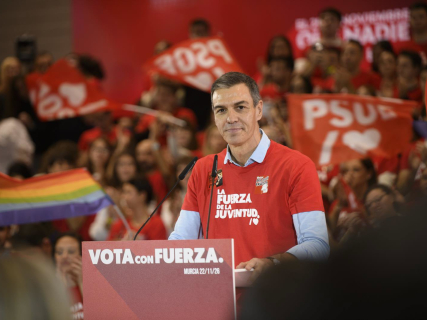
Sánchez acknowledges that he almost called elections for Cerdán and explains what led him to bring the elections forward

In his interview with Gonzo, the president addresses the judicial situation of those around him and accuses PP and Vox of “dehumanizing him”

fotonoticia 20261122231957 1920

fotonoticia 20261122231957 1920

Add DEMÓCRATA to Google

Ask FREN

Published

Last updated

4 minutes

Most read

Elecciones 29N · Encuestas

La media de las encuestas

Media a 23 de noviembre de 2026 · 20 institutos

  • PP31,2 %
  • PSOE28,2 %
  • Vox18,5 %
  • Frente Amplio6,2 %
  • ERC2,6 %
  • SALF2,0 %
01020304050ene 2024jul 2024ene 2025jul 2025ene 2026jul 2026

Media del último estudio de cada instituto en 30 días y su evolución semanal desde el 23J. Partidos con al menos un 2 %.

Todas las encuestas

Elecciones generales del 29 de noviembre · Demócrata

In the end, it was housing that pushed Pedro Sánchez to call elections, but before that there was another moment in which the president was about to bring the polls forward. This was confessed by the Socialist candidate on Salvados. With Gonzo, he has even acknowledged that he came to consider leaving politics and calling elections after the imprisonment of Santos Cerdán. "It was the most difficult moment for me, I seriously thought about leaving," he admits in the interview, in which he also recalls that he was "for two days very shaken" after learning the situation of the man who had been his right-hand in the PSOE. 

The conversation, recorded just twelve hours after his face-to-face with Alberto Núñez Feijóo, also served Sánchez to claim his strategy in the debate. The president assured that he went to sleep satisfied and that he was not worried about the assessments that gave victory to the PP candidate. "The published and public opinion do not have to coincide," he said. In his view, his approach allowed him to direct himself toward undecided voters, instead of limiting himself to confronting those who have already decided their vote.

Sánchez stated that he won the debate "by a long way" and criticized Feijóo's conduct, whom he accused of resorting to false data and rumors. He also described his personal relationship with the popular leader as distant: "We are like water and oil. We are not people who connect personally." He defined him as "a person from another era, out of sync with Spain in the 21st century."

The head of the Executive linked that strategy to his claim for another way of doing politics. "To dignify politics is to recognize mistakes, but also successes," he said. In that context, he denounced that in recent years an attempt has been made to dehumanize him and he questioned the level of personal disparagement that, as he stated, he has had to endure from the right and the far right.

He rejected a self-determination referendum even though Junts asks for it

Sánchez defended that amnesty was approved to favor coexistence in Catalonia. "I did it for coexistence," he explained, and he acknowledged that his Government turned "necessity into virtue" when addressing a political situation that conditioned the legislature.

However, he ruled out accepting a self-determination referendum if Junts demanded it in order to avoid a PP and Vox Government. The president argued that this possibility falls outside the constitutional framework and said that the actions of his Executive have precisely gone in the opposite direction. "In these eight years, the Constitution has been respected," he said.

Zapatero advises him, but will not take part in the campaign rallies

The president said that José Luis Rodríguez Zapatero continues to advise him during the campaign, even though the former president has decided not to take part in public events of the PSOE. "He is helping me, personally, he is advising me, he has a lot of experience in campaigns," he explained. Sánchez considers him "a party asset".

Asked about the investigation affecting the former president and about the jewels that were found in a safe, he stated that he had spoken with him and that he has given him his explanations. "José Luis gave me his explanations, I believe him," he replied. He also considered it likely that he is regretting not having delivered the pieces to Patrimonio Nacional earlier.

He defended Óscar Puente and talked again about Begoña Gómez

Sánchez described Óscar Puente’s management as good while in charge of Transportes and recognized that he had doubts about his resignation after the Urda rail accident. Even so, he considered that the former minister did the right thing by submitting his resignation after approving aid for the families of the victims, appearing to give account and proposing measures to deal with the loss of confidence in the Madrid-Seville high-speed line.

Regarding Begoña Gómez, the president again expressed his personal support. "I am a person in love with my wife, I cannot conceive my life without Begoña," he said. He called the judicial case affecting his wife a "Kafkaesque process" and said that he has "no choice" but to trust in Justice. He also defended that she has participated in campaign events and said that he likes dancing and kissing with his wife.

The eviction of Maricarmen, behind the advance of the elections

The president identified the eviction of Maricarmen as the episode that finished pushing him to bring forward the elections, although he acknowledged that he did not want to do it. As he explained, the case made visible a difficulty affecting broad sections of society: accessing housing whether owned or rented. Around it, he added, a social movement emerged that went beyond the specific issue of evictions.

Sánchez held that the Government had taken measures on housing to Congress during the previous three and a half years and that PP, Junts and Vox rejected them. On this occasion, he said, that blockade led him to call the elections. He also defended the regulation of protected housing and the incorporation into state law of mechanisms to prevent properties financed with public funds from ending up in the hands of investment funds.

Asked by Gonzo how he thinks he will go down in history, Sánchez avoided making an assessment of his legacy: "I leave that to you and to the historians." His answer was limited to pointing out what his priority is now: "I am focused on November 29."

More key points, information and questions with FREN

AI-GENERATED CONTENT

What are the powers of the Prime Minister according to the Spanish Constitution?

According to the 1978 Spanish Constitution, the Prime Minister is the highest authority of the Executive Power and the political center of gravity of the parliamentary system. Their powers are mainly set out in articles 97, 98, 99, 100, 101, and 115, although they also derive from the entire constitutional text and parliamentary practice.

1. Direction of the Government and political action

Article 97 establishes that the Government directs domestic and foreign policy, the civil and military Administration, and the defense of the State, and exercises executive functions and regulatory power. Within this collegiate body, the Prime Minister has the function of directing and coordinating the actions of the other members:

  • Set the major guidelines of general policy (economic, social, foreign, defense, etc.).
  • Coordinate the ministers and resolve conflicts among them, ensuring the unity of government policy.
  • Promote the Government program that has been presented to the Congress during the investiture debate.

Although the Government is a collegiate body, the Constitution grants the Prime Minister a position of political primacy: they set the general line and are, in fact, the one whom the Congress grants or withdraws its confidence.

2. Confidence relationship with the Cortes Generales

The Prime Minister is the key figure in the relationship between the Executive and Legislative Powers:

  • Investiture (art. 99): the candidate for Prime Minister is proposed by the king after consulting parliamentary groups and needs the confidence of the Congress of Deputies. Without that confidence, the Government cannot be formed.
  • Vote of confidence (art. 112): the Prime Minister can submit a vote of confidence to the Congress to reaffirm support for a specific policy or the entire program. If lost, they must resign.
  • Motion of censure (art. 113): although the initiative belongs to the Congress, the direct addressee is the Prime Minister. If the motion passes, the Prime Minister ceases office and the alternative candidate becomes the new Prime Minister.

Thus, the Constitution establishes a parliamentary system in which the Government's permanence essentially depends on confidence in its Prime Minister.

3. Appointment and dismissal of ministers

Article 98 grants the Prime Minister the power to politically organize the Government:

  • Proposes to the king the appointment and dismissal of ministers. Although the formal decision is made by the king, the political will is that of the Prime Minister.
  • Can reshuffle the Government at any time (create, merge or suppress ministries, change officeholders, etc.).

This makes the Prime Minister the true head of the Executive: the other Government members act under their direction and are politically accountable to them and to the Cortes.

4. Representation of the State and institutional function

The Constitution does not dedicate a specific article to the "representative functions" of the Prime Minister, but they can be inferred from several provisions:

  • Represents the Government in relations with the Cortes Generales, other State institutions (such as autonomous communities), and internationally alongside the king.
  • Negotiates and directs the Executive's position in the European Councils and international organizations where relevant political decisions are made.
  • Countersigns acts of the king related to the formation, dismissal, or actions of the Government (for example, the appointment of ministers), assuming political responsibility for those acts.

5. Dissolution of the Cortes and calling elections

One of the most relevant powers is the ability to influence the timing of the legislature:

  • According to article 115, the Prime Minister can propose to the king the dissolution of the Congress, the Senate, or the Cortes Generales, and the calling of general elections, within the temporal limits set by the Constitution itself (for example, it cannot be done during a state of siege or when a motion of censure is underway).
  • This power provides an important political strategy tool, allowing the Prime Minister to advance elections to renew or strengthen parliamentary majorities.

6. Leadership in crisis situations and Government continuity

In crisis contexts (for example, declaration of states of alarm, exception, and siege regulated in article 116), the Government acts collegially, but political leadership falls to the Prime Minister, who:

  • Coordinates the Executive's response and relations with the Cortes during the crisis.
  • Assumes primary responsibility before public opinion and Parliament.

Additionally, when the Government ceases (due to resignation, loss of confidence, elections, etc.), article 101 establishes that it remains in office until the new Government takes office, with the Prime Minister at the head, ensuring Executive continuity.

Overall, the Constitution configures the Prime Minister as the apex of the political system: directing and coordinating the Government, being the main person accountable to the Congress, and having key instruments (appointment of ministers, dissolution of the Cortes, votes of confidence) that make their figure the core of executive power in Spain.

What is the parliamentary process for approving a state housing law in Spain?

A state housing law follows the common legislative procedure: initiative, debate, and approval in the Congress, examination by the Senate, and finally, sanction, promulgation, and publication. It is not enough for the Government to approve a proposal: it must obtain the corresponding parliamentary support. This is the ordinary course, not the processing of a specific law.

1. Presentation of the initiative

The origin determines a first difference:

  • Bill: presented by the Government to the Congress, accompanied by a statement of reasons and necessary background. It does not require a prior vote for consideration.
  • Private member's bill: may come, among other subjects, from a parliamentary group or fifteen deputies. There are also initiatives from the Senate, autonomous parliaments, and citizens, with their respective requirements.

Private member's bills from the Congress are sent to the Government for its opinion and, when they affect revenues or budget credits, its agreement with the processing. Then they go through the consideration phase: the Plenary decides whether to start studying them, without yet approving the law. Those coming from the Senate do not repeat this procedure in the Congress.

2. Publication and amendments

The Board of the Congress orders the publication of the text in the Official Bulletin of the Cortes Generales, sends it to the competent committee, and opens the amendment period: proposals to change it. The ordinary period is fifteen working days, subject to modification.

Amendments to the articles allow deleting, modifying, or adding content. In government bills, groups can also present total amendments: requesting its return to the Government or proposing a complete alternative text. If presented, they are debated in the Plenary. An approved return ends the processing; if an alternative text succeeds, it becomes the basis for further work.

3. Committee and subcommittee

After this phase, the committee appoints a subcommittee, a parliamentary team that studies the text and amendments and drafts a report. Its ordinary period is fifteen working days, extendable.

Then, the committee debates the articles and modifications and approves a report: the resulting text that serves as the basis to continue. Transactional amendments can be negotiated here, i.e., agreed wordings between existing proposals.

4. Approval in the Congress

When it corresponds to the Plenary to decide, it debates the report and the amendments that groups maintain for that session. The general rule is a simple majority: more favorable than opposing votes. An organic law requires an absolute majority in a final overall vote; this requirement does not automatically apply for housing.

There is an important variant: if the committee acts with full legislative competence, it can approve the text without a final Plenary vote. The Plenary can recover that decision. Once approved, the text is sent to the Senate.

5. Senate and final decision

The Senate can approve the text without changes, introduce amendments, or veto it, i.e., reject it globally. If it introduces no changes or veto, parliamentary approval is complete. In other cases, it returns to the Congress:

  • Amendments: the Congress decides which to incorporate by simple majority.
  • Veto: can be lifted by absolute majority or, after two months from its imposition, by simple majority. If it does not obtain the latter, the bill is rejected.
6. Publication and deadlines

After parliamentary approval come the sanction and promulgation by the King and publication in the Official State Gazette (BOE). This final publication must be distinguished from prior parliamentary publications.

There is no fixed total duration: negotiations and deadline extensions influence it. Urgency halves the ordinary deadlines of the Congress. The main reference for these phases is the Congress Rules, especially articles 108 to 150.

What have been the results of the PSOE and PP in the latest general elections?

The latest general elections held in Spain were on July 23, 2023. In the Congress of Deputies, the PP obtained 137 seats and the PSOE, 121: the PP came first both in votes and representatives, and the PSOE took second place (23J results).

Results of each party

  • PSOE: obtained 7,821,718 votes, equivalent to 31.68% of valid votes, and 121 deputies; the total socialist count includes the PSC and associated candidacies integrated into its state result (PSOE results).
  • PP: gathered 8,160,837 votes, 33.06% of valid votes, and 137 deputies; these figures correspond to the PP alone, excluding UPN results (23J results).

The difference between them was 339,119 votes, 1.38 percentage points, and 16 seats, always in favor of the PP. These are three different ways to express the gap: the number of ballots, their weight in the total valid vote, and the representation obtained in Congress (23J results).

Why other figures may appear

It is important to use the definitive result and not rely on those released during election night. The initial count attributed 136 deputies to the PP and 122 to the PSOE; after including external votes and completing the official proclamation, the distribution was 137 and 121, respectively. Therefore, information published immediately after voting may show a different distribution without referring to other elections (final results).

There are also differences due only to rounding: PP's 33.06% often appears as 33.1%, and PSOE's 31.68% as 31.7%. To compare their support precisely, it is advisable to keep the same number of decimals and verify that definitive results are used in both cases (23J results).

What those results meant

The PP was the most voted candidacy, but its 137 deputies did not give it an absolute majority, set at 176 seats. Even adding Vox's 33 representatives, both formations reached 170, six below that threshold. Therefore, coming first at the polls did not equate to having that parliamentary majority (comparison with 23J).

For the PSOE, its 121 seats meant one more than in November 2019, when it obtained 120. It also increased its support by 1,029,519 votes compared to that election, although in July 2023 it remained behind the PP. That is, improving over its previous result did not allow it to keep the first position (PSOE electoral evolution).

These data specifically refer to the Congress and are results of an already held vote, not poll estimates. The reference to answer your question is, therefore, the definitive distribution of 23J: 137 deputies for the PP versus 121 for the PSOE (23J results).

Play

Test your knowledge with FREN!

How much do you know about this topic? Answer the following 3 questions.

What specific reason did Pedro Sánchez finally decide to call early elections?

Question 1 of 3

What option did Pedro Sánchez rule out for Catalonia if Junts demanded it to avoid a PP and Vox government?

Question 2 of 3

Who does Pedro Sánchez consider an asset to the party and who advises him during the campaign?

Question 3 of 3