Where is it a holiday on December 7, 2026: the communities that will have a bridge day

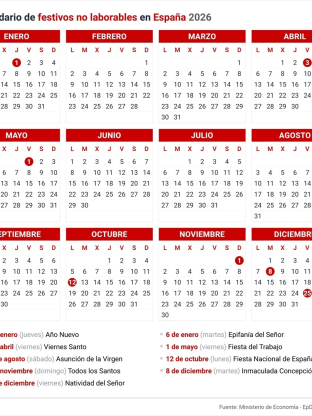
Nine autonomous communities and Melilla move the Constitution Day holiday to Monday, which this year falls on Sunday. Tuesday, December 8 will be a public holiday throughout Spain, although not all workers will be able to enjoy four consecutive days off

EuropaPress 7061088 calendario laboral espana 2026 seran fiesta toda espana jueves enero ano

EuropaPress 7061088 calendario laboral espana 2026 seran fiesta toda espana jueves enero ano

Add DEMÓCRATA to Google

Ask FREN

Published

3 minutes

Most read

Elecciones 29N · Encuestas

La media de las encuestas

Media a 19 de noviembre de 2026 · 18 institutos

  • PP31,1 %
  • PSOE27,4 %
  • Vox19,1 %
  • Frente Amplio6,2 %
  • ERC2,5 %
01020304050ene 2024jul 2024ene 2025jul 2025ene 2026jul 2026

Media del último estudio de cada instituto en 30 días y su evolución semanal desde el 23J. Partidos con al menos un 2 %.

Todas las encuestas

Elecciones generales del 29 de noviembre · Demócrata

Monday, December 7, 2026 will be a working holiday in nine autonomous communities and in Melilla, according to the official calendar published in the Boletín Oficial del Estado (BOE). Andalusia, Aragon, Asturias, Cantabria, Castile and León, Extremadura, the Community of Madrid, the Region of Murcia, and La Rioja have chosen to move to that date the holiday corresponding to Constitution Day, which this year coincides with a Sunday.

In these territories, the calendar will allow you to enjoy four consecutive days off, from Saturday 5 to Tuesday 8 December, for workers who usually have weekends off. On Tuesday, the Immaculate Conception is celebrated, a national holiday that is maintained in all autonomous communities.

On the other hand, in the Balearic Islands, the Canary Islands, Castile-La Mancha, Catalonia, the Valencian Community, Galicia, Navarre, and the Basque Country, as well as in Ceuta, Monday 7 will be generally a working day, although Tuesday 8 will be a holiday.

Which communities have a holiday on Monday 7 December

The distribution of public holidays responds to the decisions adopted by the autonomous communities when preparing their respective working calendars. Although Constitution Day is celebrated on December 6 throughout Spain, its coincidence with a Sunday makes it possible to move the day off to the following Monday or replace it with other holidays.

According to the resolution of the Directorate General of Labour published in the BOE on October 28, 2025, the December working calendar is distributed as follows:

Working calendar for December 7 and 8, 2026 by autonomous community

Autonomous community Monday 7 December Tuesday 8 December
Andalusia Holiday Holiday
Aragon Holiday Holiday
Asturias Holiday Holiday
Balearic Islands Working day Holiday
Canary Islands Working day Holiday
Cantabria Holiday Holiday
Castile-La Mancha Working day Holiday
Castile and León Holiday Holiday
Catalonia Working day Holiday
Community of Madrid Holiday Holiday
Valencian Community Working day Holiday
Extremadura Holiday Holiday
Galicia Working day Holiday
La Rioja Holiday Holiday
Navarre Working day Holiday
Basque Country Working day Holiday
Region of Murcia Holiday Holiday
Ceuta Working day Holiday
Melilla Holiday Holiday

Source: BOE. Resolution of October 17, 2025 of the Directorate General of Labour, by which the list of public holidays for 2026 is published. The table includes public holidays of national and autonomous scope, without including possible local holidays.

Why December 7 is not a holiday throughout Spain

Although Constitution Day is a national holiday, legislation allows the autonomous communities to decide how to distribute certain days of rest when they coincide with a Sunday.

This is set out in Royal Decree 2001/1983, which contemplates the possibility of replacing the rest on the following Monday with other traditional holidays of each territory. For this reason, the 2026 working calendar does not set December 7 as an obligatory public holiday across the whole country.

In communities where the holiday has not been moved, Monday will be a regular working day. To enjoy four consecutive days of rest, employees who are off on weekends will have to request vacation, use a personal leave day, or avail themselves of the conditions provided in their company.

In any case, the working calendar does not automatically guarantee four days off to all people who work in a community where Monday is a public holiday. The scheduling of shifts, weekly rest periods, and the conditions applicable to certain sectors can result in different calendars.

The school calendar can be different from the working calendar

Although December 7 is a working day in some communities, that does not necessarily mean there will also be classes. School calendars are approved by education administrations and may establish non-instructional days that do not coincide with working public holidays.

Therefore, a school may remain closed on Monday, December 7 even though that day is a working day for the workers of its autonomous community. Families should check the calendar for the 2026-2027 school year corresponding to their territory and, where applicable, the dates set by the educational center itself.

It is also advisable to review local public holidays. In addition to national and autonomous community holidays, municipalities may schedule up to two of their own working celebrations each year, so there could be exceptions in towns where Monday 7 is not an autonomous community public holiday.

The official calendar makes it possible to check the rest days established for each community, but municipal particularities must be consulted in the respective autonomous or provincial gazettes.

More key points, information and questions with FREN

AI-GENERATED CONTENT

What procedures must autonomous communities follow to approve their annual work calendar?

Autonomous communities must set their holidays within the state framework, approve the decision through the competent body, publish it, and communicate it to the Ministry of Labor. There is no single identical internal procedure for all: the form of approval and reports depend on each community's regulations, but there are common state limits and obligations.

1. Prepare the proposal respecting legal limits

The starting point is article 37.2 of the Workers' Statute: labor holidays are paid and non-recoverable, meaning they are paid and their hours do not need to be compensated. They cannot exceed 14 per year, including two local ones. Therefore, they are not fourteen additional autonomous holidays beyond the state ones.

The autonomous proposal must integrate the mandatory state holidays and exercise the permitted options. The Statute expressly protects New Year's Day, May 1st, October 12th, and Christmas. The regime is developed in article 45 of Royal Decree 2001/1983, according to the wording of Royal Decree 1346/1989.

  • The community chooses between Saint Joseph and Saint James the Apostle; if it does not communicate its option within the deadline, Saint Joseph applies.
  • It may replace the holidays in section 45.1.d — Maundy Thursday, Epiphany, and Saint Joseph or Saint James — with other traditional ones of its own.
  • When a national holiday falls on a Sunday, the rest day moves to the following Monday; the community may replace that rest day with another traditional holiday.
2. Process the autonomous file

The proposal must follow the organizational and procedural rules of the corresponding community. This requires determining which department prepares it, which body can approve it, and which reports or participation procedures apply.

A habitual practice should not be confused with a uniform state obligation. The cited labor provisions do not impose, for all communities, the same public consultation, the same advisory opinion, or a mandatory agreement with unions and employers. The need for these procedures must be established according to the applicable autonomous regulation.

3. Approve and publish the decision

Approval corresponds to the competent autonomous body, through the instrument that proceeds according to its rules. It cannot be stated that all must necessarily use a decree of the Government Council.

The decision must receive official publicity within the autonomous scope. It is important to separate this approval from its subsequent dissemination in the BOE: state publication allows knowing the holidays of the different territories together but does not replace the autonomous decision.

4. Communicate the holidays to the Ministry

Article 45.4 establishes a specific deadline: the list of traditional holidays and the option between Saint Joseph and Saint James must be sent to the Ministry of Labor before September 30 each year. Its purpose is to allow publication in the BOE and meet European communication obligations.

There is an express exception: when the list of traditional holidays that replace the national ones has been adopted permanently, it is not necessary to reiterate its sending annually.

5. Complete the local holidays

The two local holidays follow a different path. According to article 46 of Royal Decree 2001/1983, they are determined by the competent labor authority at the proposal of the Municipal Plenary. They must be published in the autonomous bulletin and, when appropriate, also in the provincial one.

This holiday calendar does not replace the annual calendar of each company, which must incorporate the applicable holidays and be displayed in a visible place at the workplace.

What are the competencies of the Directorate General of Labor in the preparation of the holiday calendar?

The Directorate General of Labor of the Ministry of Labor and Social Economy is responsible for gathering and publishing the annual list of national and autonomous labor holidays. Its main function is to give joint publicity to the calendar resulting from state regulations and territorial decisions: it does not freely choose all holidays nor replace the competencies of the autonomous communities.

1. Publish the annual list of labor holidays

The specific competence is supported by article 45.4 of Royal Decree 2001/1983, as amended by Royal Decree 1346/1989. This provision obliges autonomous communities to send the Ministry their traditional holidays and substitution options before September 30, to publish them in the BOE. If that list is adopted permanently, annual sending is not necessary. The text of the reform can be consulted.

The Directorate General arranges this publication by resolution. Its task includes:

  • Incorporating the holidays communicated by the autonomous communities and the cities of Ceuta and Melilla.
  • Including alongside them the permanent national holidays provided in the regulations.
  • Distinguishing non-substitutable national holidays, national holidays maintained by each territory, and autonomous holidays.
  • Facilitating knowledge of the set of holidays throughout the national territory.

The resolution for 2025 expressly explains this competence: it corresponds to the Directorate General to "arrange the publication" of the communicated holidays. Therefore, publishing the list does not equate to discretionary decision of all its dates.

2. Apply the legal distribution of competencies

Article 37.2 of the Workers' Statute establishes the general limit of fourteen annual holidays, paid and non-recoverable, of which two are local. It expressly protects as national holidays Christmas, New Year's Day, May 1st, and October 12th.

Autonomous communities may substitute certain national holidays with their own traditional celebrations, choose between Saint Joseph and Saint James the Apostle, and substitute the Monday rest corresponding to national holidays that fall on Sunday. The Directorate General reflects those decisions; it does not make them.

There is an exception to the general limit: when a community cannot include a traditional holiday because there are not enough national holidays on Sunday, it may add one more, but as recoverable. This possibility corresponds to the autonomous community, not a choice of the Directorate General.

3. Regulatory support, without unlimited authority

Article 3 of Royal Decree 502/2024 assigns the Directorate General general functions on working conditions, preparation of regulatory projects, and interpretation and application reports. These functions allow preparing proposals and legal criteria, but do not authorize modifying through the annual resolution the holidays set by higher norms or legally recognized autonomous options.

4. What is outside its function

Local holidays follow their territorial procedure and are published in the corresponding autonomous or provincial bulletin; they are not replaced by the state list. This list should also not be confused with each company's calendar: article 34.6 of the Statute obliges the company to prepare it annually and display it at each workplace.

In short, the Directorate General integrates and publishes the national and autonomous calendar within the legal framework; it does not concentrate all decisions about holidays.

What requirements does Royal Decree 2001/1983 set to substitute a national holiday with an autonomous or local celebration?

Royal Decree 2001/1983 allows autonomous communities to substitute certain national holidays, but not just any, with celebrations that are traditional to them. Local holidays have a different procedure: the town hall proposes them and the competent labor authority determines them. Therefore, a municipality cannot decide on its own that a local celebration replaces a national holiday.

1. Which national holidays can be substituted

The decisive rule is in article 45.3, which authorizes autonomous communities to substitute "the holidays indicated in section d) of number one of this article with others that, by tradition, are their own." That section includes:

  • Maundy Thursday.
  • January 6, Epiphany of the Lord.
  • March 19, Saint Joseph, or July 25, Saint James the Apostle.

The rule also grants each community the choice between Saint Joseph and Saint James the Apostle. If it does not exercise that option within the established deadline, Saint Joseph is to be celebrated. The substitution power does not extend, by this means, to the rest of the national holidays. This results from article 45 of the decree, whose wording was modified by Royal Decree 1346/1989.

2. The alternative celebration must be traditional

It is not enough that the community wants to introduce a different date: the chosen holiday must be traditionally its own. This is the material condition expressed in article 45.3. The decision corresponds to the autonomous community, not to a company nor directly to a town hall.

The same section allows another substitution: when a national holiday falls on a Sunday, the rest on the following Monday may be replaced by another traditional celebration of the community. Here what is substituted is the rest moved to Monday, not the national holiday on its original date.

3. Communication before September 30

Article 45.4 requires communities to send the competent ministry the list of traditional holidays and the corresponding option "before September 30." The text mentions the then Ministry of Labor and Social Security.

The purpose is for the ministry to publish the holidays in the Official State Gazette and comply with the indicated European obligations. There is an exception: when the list of traditional holidays that replace the national ones is adopted permanently, annual sending is not required.

4. Local holidays follow another path

Article 46 regulates up to two local holidays per calendar year, paid and non-recoverable. It requires these elements:

  • That they are traditional celebrations of the municipality.
  • That there is a proposal from the corresponding Municipal Plenary.
  • That they are determined by the competent labor authority.
  • That they are published in the autonomous official bulletin and, when appropriate, in the provincial one.

This procedure does not grant the town hall a general power to eliminate or replace national holidays. A municipal celebration must be channeled through article 46, while the autonomous substitution of certain national holidays is supported by article 45.

5. Is agreement with unions and employers necessary?

Articles 45 and 46 do not require such agreement as a condition for each substitution. It should not be confused with the consultation with union and employer organizations mentioned in the preamble to approve the decree. In summary: substitutable holidays, the tradition of the alternative celebration, administrative competence, and communication and publication rules must be respected.

Play

Test your knowledge with FREN!

How much do you know about this topic? Answer the following 3 questions.

Why will Monday, December 7, 2026, be a holiday in some autonomous communities?

Question 1 of 3

Which autonomous communities have declared Monday, December 7, 2026, a holiday?

Question 2 of 3

Which legislation allows autonomous communities to decide on the distribution of holidays when they coincide with a Sunday?

Question 3 of 3