The parties spent 58 million in the last elections: how much the campaign for 29N costs and who pays for it

PP, PSOE, Vox, and Sumar allocated more than 47 million euros to the 2023 elections. The 29N campaign is again subject to legal limits and to a system of public subsidies by votes, seats, and electoral propaganda

EuropaPress 7922033 presidente pp candidato presidencia gobierno alberto nunez feijoo

EuropaPress 7922033 presidente pp candidato presidencia gobierno alberto nunez feijoo

Add DEMÓCRATA to Google

Ask FREN

Published

Last updated

5 minutes

Most read

Elecciones 29N · Encuestas

La media de las encuestas

Media a 19 de noviembre de 2026 · 19 institutos

  • PP31,0 %
  • PSOE27,7 %
  • Vox19,1 %
  • Frente Amplio6,2 %
  • ERC2,5 %
01020304050ene 2024jul 2024ene 2025jul 2025ene 2026jul 2026

Media del último estudio de cada instituto en 30 días y su evolución semanal desde el 23J. Partidos con al menos un 2 %.

Todas las encuestas

Elecciones generales del 29 de noviembre · Demócrata

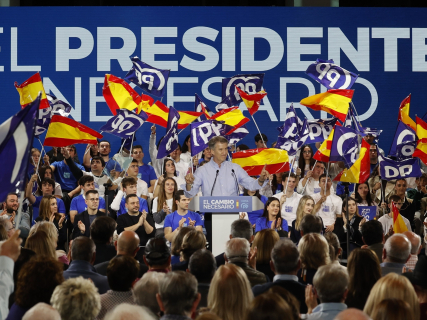
While the parties tour Spain with rallies, propaganda, and election convoys, the campaign for the general elections on November 29 is mobilizing millions of euros again. In the last election, held in July 2023, political groups spent 58.1 million euros, according to the accounts audited by the Court of Auditors. More than 25 million were allocated solely to the mailing of election propaganda to voters’ addresses.

Although the final budgets of the candidacies for Nov. 29 are still unknown, the accounts from the previous general elections make it possible to see how much money the main parties devoted to seeking votes. The PP spent 18.1 million euros; the PSOE, 16 million; Vox, 8.1 million; and Sumar, 5.2 million. These amounts include both ordinary operations and election mailings, and correspond to the candidacies counted separately in the report.

Ten days before the election, the Treasury has already set the spending limits and the subsidies that political groups will be able to receive based on their results. The State will pay 21,167.64 euros for each deputy or senator obtained and 0.81 euros for each vote to the Congress that meets the legal requirements. However, these amounts are not handed over without conditions: the parties must justify their expenses and submit their accounts to an audit.

How much each party spent in the 2023 general elections

According to the report approved by the Court of Auditors in March 2025, the 16 audited groups justified election spending totaling 58,115,272.22 euros. The figure makes it possible to know the cost of the previous campaigns and provides a reference for this year’s elections, although it does not anticipate how much each candidacy will spend in 2026.

The Partido Popular allocated more than 10.8 million to ordinary operations and another 7.2 million to election mailings, while the PSOE declared justified expenses of 9.5 million and 6.5 million, respectively.

In the case of Vox, spending on postal propaganda, close to five million, surpassed what was allocated to the rest of the election operations. Sumar, for its part, dedicated 3.37 million to ordinary expenses and 1.82 million to mailings.

How much the parties spent in the 2023 general elections

Millions of euros · Audited expenses

Party Ordinary Mailings Total
PP 10,87 7,26 18,13
PSOE 9,52 6,53 16,06
Vox 3,17 4,93 8,10
Sumar 3,37 1,82 5,19
PSC 1,72 1,17 2,89
Junts 0,84 1,26 2,10
PNV 0,80 0,46 1,26
ERC 0,60 0,39 0,99
EH Bildu 0,40 0,41 0,81

Source: Court of Auditors. Rounded figures. The accounts of PSOE and PSC appear separately. The table includes a selection of the audited formations.

The cost of sending election propaganda to households

One of the highest items in any campaign is what is called postal propaganda or election mailing. It includes the preparation, printing, and distribution of envelopes, ballot papers, and advertising that parties send directly to voters.

In 2023, the expenses justified for this item amounted to 25 million euros, approximately 43% of all audited election spending. The formations carried out more than 137 million mailings, according to the Court of Auditors.

To this item were added ordinary expenses, which exceeded 33 million euros. Among them, 6.4 million euros earmarked for outdoor advertising and 5.6 million euros for ads in the press and radio stood out.

Rentals of spaces for rallies, travel by candidates and teams, the hiring of temporary staff, and the operation of election offices are also accounted for.

How much parties can spend on the campaign for 29N

Spanish legislation prevents candidates from spending unlimited amounts during a campaign. For the elections of 29 November, the order published by the Ministry of Finance on 8 October establishes a limit of 0.37 euros per inhabitant of the constituencies in which each party, federation, coalition, or grouping competes.

In this way, the maximum budget allowed depends on the territories where the candidates present themselves. Parties that compete throughout Spain will have an upper limit higher than that of formations that only present themselves in certain provinces or autonomous communities.

The limit applies to ordinary election expenses, while the direct sending of propaganda has a specific treatment and may be left out of that cap when the requirements for grants and justification are met.

The regulations also establish specific restrictions for certain types of election advertising, compliance with which will be supervised by the Court of Auditors.

How much money parties receive for votes and seats

A large part of the financing of campaigns is linked to public subsidies that the State grants depending on election results.

For 29N, the Treasury has set the following amounts:

  • 21,167.64 euros for each seat obtained in the Congress of Deputies or in the Senate.
  • 0.81 euros for each vote to the Congress, provided that the candidacy has won at least one deputy.
  • 0.32 euros for each vote obtained by a candidate to the Senate who has won a seat.
  • 0.26 euros per voter for direct mailings of propaganda, in the electoral districts that meet the requirements for parliamentary representation established by law.

Thus, a candidacy that obtained 100 deputies would be entitled to 2,116,764 euros for those seats. If it won five million votes to the Congress, the subsidy corresponding to those votes would amount to another 4,050,000 euros.

In that case, both concepts would add up to 6,166,764 euros, not including the amounts that could correspond for representation in the Senate and electoral mailings.

Who advances the money to finance the campaigns

Although the subsidies are calculated based on results, parties need financing to cover electoral activity before knowing the final allocation of seats.

In the 2023 general elections, the audited parties declared resources worth 56.85 million euros, of which 35.7 million came from bank loans. That is, approximately 63% of the declared financing was linked to indebtedness with financial entities.

Another 13.9 million corresponded to advances of public subsidies and nearly seven million came from contributions from the political organizations themselves.

Private contributions had a much smaller weight: barely 247,382 euros, approximately 0.4% of the total declared.

Who controls the accounts and when the final spending for the 29N will be known

the Spanish Court of Auditors will be responsible for checking how much the formations competing in the November 29 elections have actually spent and whether they respected the established limits.

To do so, the parties required to give an account will have to submit detailed accounting of their income and expenses between March 9 and April 3, 2027. The documentation will include invoices, contracts, credit operations, private contributions, and a report on the acts of the election campaign held.

In the 2023 general election, the body rejected 492,851 euros declared by the parties when it considered that they were not sufficiently justified, did not correspond to election activities, or were not permitted by legislation.

In addition, it detected payments made outside the legal deadline by six formations, for a total amount close to two million euros, and proposed reductions in subsidies for a total of 208,299 euros.

Despite these irregularities, none of the 16 parties audited exceeded the maximum limit of election spending.

The review of the accounts from 29N will make it possible to check whether the formations have maintained the spending levels of the previous general elections, how much they have allocated to propaganda and election acts, and what part of their campaigns will end up being financed through public subsidies.

More key points, information and questions with FREN

AI-GENERATED CONTENT

What is the parliamentary procedure to modify the electoral spending limits established by Spanish legislation?

To modify the legal rules that set electoral spending limits, the parliamentary route is a legislative reform, with the guarantees of an organic law when it affects the general electoral regime reserved for that type of norm. The procedure combines the common legislative process with a decisive requirement: the absolute majority of the Congress in a final vote on the entire text.

1. Define what is to be changed

The proposal must identify the affected provisions and specify whether it modifies the maximum amount, the calculation formula, the computable expenses, or the rules applicable when elections coincide. A modification of these rules should not be confused with the updating of amounts that a law may allow to be carried out through another instrument: the latter requires compliance with the corresponding legal authorization.

Article 81 of the Constitution establishes the reservation of organic law for the general electoral regime. According to Article 130 of the Congress Regulations, the Board, after hearing the Board of Spokespersons, classifies the initiative as organic. Therefore, it is not enough to rely on the name given by the presenter.

2. Initiative and presentation

The reform can be promoted through a Government bill or a parliamentary or regional law proposal. In Congress, a proposal can be presented by a parliamentary group or a deputy with the signature of fourteen others, accompanied by a statement of reasons and background.

The Board orders its publication and referral to the Government. Proposals usually require a consideration: the Plenary decides whether to start processing them. Those coming from the Senate that have already passed this procedure do not repeat it. Government bills go directly to the opening of amendments and the competent committee.

3. Processing and voting in Congress

The common procedure includes these phases, developed in Articles 109 to 131 of the Congress Regulations:

  • Amendments: the initial ordinary period is fifteen working days. They can propose specific changes or, when appropriate, the return of the bill or an alternative text.
  • Committee and subcommittee: the subcommittee studies the text and amendments and drafts a report; then, the committee debates and approves an opinion.
  • Plenary: debates the opinion and the maintained amendments and carries out the final overall vote.

The latter requires an absolute majority of the members of Congress, not just more favorable than opposing votes. If not reached, the text returns to the committee for a new opinion within a month. If that majority is again lacking, it is rejected.

4. Senate intervention and return to Congress

The Senate may approve the text without changes, introduce amendments, or oppose a veto, that is, reject it through a reasoned agreement. Article 90 of the Constitution establishes a two-month period and requires an absolute majority for the veto. A special absolute majority is not required for each amendment since it is an organic law.

If there is a veto, Article 132 of the Congress Regulations requires an absolute majority to lift it in any case. If there are amendments, Congress decides which to accept and submits the result to another overall vote: without an absolute majority, the initial text is maintained and all Senate modifications are rejected.

5. Acceleration and publication

Urgency halves the ordinary deadlines of Congress. A single reading is also possible when the nature or simplicity of the reform justifies it, by agreement of the Plenary at the proposal of the Board, after hearing the Board of Spokespersons. No modality eliminates the organic majority.

After final approval, sanction and promulgation and official publication proceed. The reform must specify from when the new limits apply and which electoral processes are subject to them.

What powers does the Court of Auditors have according to the Constitution and the Organic Law of the Court of Auditors?

The Court of Auditors has two main powers: to audit the accounts and economic management of the public sector and to judge accounting responsibility of those who handle public funds. These are distinct functions: the first examines how public money is managed; the second allows declaring responsibilities and demanding their repair through a judicial procedure.

1. Its constitutional position

Article 136 of the Constitution configures it as the supreme auditing body of the accounts and economic management of the State and the public sector. It depends directly on the General Courts and examines the State General Account by delegation from them. This parliamentary link does not turn its jurisdictional decisions into political decisions.

Article 153.d of the Constitution also contemplates its economic and budgetary control over the autonomous communities. The Organic Law 2/1982, of May 12, of the Court of Auditors develops this position and differentiates its two functions, as explained in STC 18/1991.

2. Auditing function: examining public management

This consists of external control of the economic-financial activity of the public sector. According to the constitutional interpretation of the Organic Law, it examines and verifies this activity based on the principles of legality, efficiency, and economy: whether the rules are respected and how resources are used.

  • Subjective scope: includes the State, autonomous communities, local entities, and other entities comprising the public sector. Town councils are not excluded because the Constitution does not expressly mention them in its Article 136.
  • Result: this function is expressed in reports or memoranda sent to the General Courts. It allows identifying irregularities and making observations about the examined management.
  • Scope: auditing alone does not equate to condemning a person to return money. To declare accounting responsibility, the corresponding jurisdictional function must intervene.

The distinction between both functions is developed in STC 187/1988.

3. Jurisdictional function: demanding accounting responsibility

The Court judges the accounting responsibility that those in charge of handling public funds or effects may incur. It is not limited to issuing an opinion: it applies the rules to the accounting act, declares if responsibility exists, acquits or condemns, and can enforce its decision coercively.

This jurisdiction is exclusive and full and covers the entire national territory. According to constitutional doctrine, the Court is "supreme, but not unique, when auditing" and "unique, but not supreme when judging accounting responsibility." Therefore, its status as the highest auditor and its position within the judicial appeals system should not be confused.

4. Relations with the General Courts and regional bodies

The General Courts receive its reports and may promote their parliamentary examination. Article 199 of the Congress Regulations regulates the receipt of the annual report and allows requesting reports, documents, or background on specific matters, in cases provided by the Organic Law.

Regional external control bodies can audit their respective scopes, including local entities when appropriate: their powers do not exclude those of the Court of Auditors. However, they do not exercise their own accounting jurisdiction. The Court may delegate the instruction of procedures to them, but not the power to judge. Coordination must avoid duplications without eliminating the powers of each institution.

What has been the historical evolution of electoral spending by the main political parties in Spain in recent legislatures?

The evolution of electoral spending in Spain shows two changes: a greater diversity of parties with relevant budgets since 2015 and an increase in total spending between November 2019 and July 2023. However, the verified figures do not allow constructing a complete series, party by party, for all recent legislatures. The comparison must be made by election, not by legislature: in 2019 there were two general campaigns.

How to interpret the figures

The Court of Auditors distinguishes between ordinary campaign expenses and direct mailings of electoral propaganda, known as mailing. Also, the spending declared by a candidacy may differ from what the Court considers justified. To avoid misleading comparisons, the following amounts correspond to justified spending when that breakdown is available; they are expressed in nominal euros, without discounting inflation.

2008–2011: concentration in PP and PSOE

In the 2008 and 2011 elections, spending was mainly concentrated in PP and PSOE. This starting point helps understand the subsequent change, but the consulted sources do not offer a complete and homogeneous breakdown of both elections. Therefore, it is not rigorous to assign specific amounts to each party here or calculate how much their campaigns increased or decreased compared to those years.

2015–2016: more candidacies with a national dimension

The emergence of Podemos and its coalitions and the expansion of Ciudadanos increased the number of candidacies with relevant electoral spending. PP and PSOE continued to hold a prominent position, but the distribution ceased to be concentrated in just two formations. The consulted sources also do not provide complete amounts for 2015 and 2016 that would allow precisely measuring this shift.

2019: two elections that must be separated

The general elections of April and November 2019 constitute distinct campaigns: comparing their annual sum with a single election would exaggerate spending growth. For November, the Court of Auditors recorded 48.93 million euros of justified regular expenses: 48.27% corresponded to ordinary operations and 51.73% to postal propaganda. Bank loans provided 43.93% of declared resources, a measure of the importance of credit to finance campaigns (Court of Auditors, November 2019).

2023: aggregate increase and differences between parties

In the July 23, 2023 elections, the total justified spending reached 58.115 million euros, approximately an 18.8% increase over November 2019. The aggregate includes the audited candidacies, not only the following four. Adding ordinary operations and postal propaganda, their amounts were:

  • PP: 18.13 million; 10.87 million in ordinary operations and 7.26 million in mailings.
  • PSOE: 16.06 million; 9.52 million in ordinary operations and 6.53 million in mailings.
  • Vox: 8.10 million; 3.17 million in ordinary operations and 4.93 million in mailings.
  • Sumar: 5.19 million; 3.37 million in ordinary operations and 1.82 million in mailings.

All these amounts come from the same official audit summary. The distribution also matters: in Vox, mailings exceeded ordinary spending; in the other three candidacies, the opposite occurred.

In conclusion: there is a diversification of the main spenders and a recent nominal growth of the total, but not a demonstrated continuous increase for each party. Also, Sumar and Unidas Podemos are not identical candidacies: linking their accounts as if they were a single organization would require adjusting the comparison perimeter.

Play

Test your knowledge with FREN!

How much do you know about this topic? Answer the following 3 questions.

How much did the parties spend in total on the July 2023 general election campaign according to the Court of Auditors?

Question 1 of 3

Which political party allocated the most money to the 2023 general election campaign?

Question 2 of 3

Which body audits and reviews the parties' accounts after the general elections?

Question 3 of 3