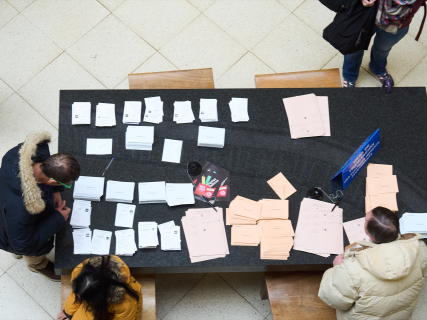

The electoral day of November 29 is leaving an uneven mobilization across the territory. The first participation update, published by the Ministry of the Interior at 14.00, places national participation at 45.7%, 5.3 points higher than the figure recorded at the same time in the general elections of July 2023.
But the increase is not distributed in a homogeneous way. The comparison municipality by municipality makes it possible to observe differences between territories and link that evolution to the electoral behavior of those same localities in the previous elections. The analysis of the Interior data prepared by Mapa Electoral points to a difference between the municipalities where participation grows the most and those where it barely changes.
Where participation grows the most, the PSOE and Sumar had more support
In the fifth of electors who reside in the municipalities where participation has increased the most — an average rise of 9.8 points compared to 2023 —, the PSOE and Sumar brought together 45.8% of the vote for candidacies in the previous general elections. PP and Vox totaled 28.1%.
The pattern is different in the group of municipalities where participation has grown the least, with an average variation of zero points. There, PP and Vox concentrated 52.3% of the 2023 votes, compared with 44.3% for the PSOE and Sumar.
The difference is relevant for understanding the map of mobilization, but it requires caution: it is a matter of comparing the previous electoral behavior of the municipalities in which participation is now rising or falling. It does not mean that the new voters are necessarily from one bloc or the other, nor does it allow the result of this Sunday to be anticipated.
The increase reaches the majority of the municipalities
The rise in participation extends across much of the country. At 14.00, the figure was higher than in 2023 in 5,662 municipalities and had fallen in 2,265, according to the municipal map published by El País.
By provinces, the largest increases are recorded in Bizkaia, with 10.6 points more; Gipuzkoa, with 9.7; and Álava, with 9.4. Girona also stands out, with an 8.8-point rise, and Barcelona, with 8.6. At the other end, participation falls in Jaén (2.1 points less), Córdoba (1.3), Cáceres (0.3) and Badajoz (0.2).
Madrid records an increase of 6.3 points compared with the 2023 general elections, while Zaragoza rises 7.7 and Navarra, 7.8.
City and countryside: a difference that requires looking at each municipality
The division between urban and rural voting cannot be established solely with provincial data. The figures show that mobilization changes from one municipality to another, but they do not allow concluding that cities are voting more or less than towns as homogeneous blocks.
In fact, the analysis of Mapa Electoral groups municipalities by number of electors and compares the evolution of turnout with the 2023 results. Its methodology warns that within each group there are localities with very different patterns of behavior and that part of the variations also responds to territorial differences among autonomous communities.
That is why the snapshot at 14.00 makes it possible to identify where the electorate is mobilizing more and what political orientation those territories had in 2023, but it does not yet allow identifying who is electorally benefiting from the additional turnout.
The second advance and the completed count will complete the picture
The second official turnout figure is scheduled for 18.00. It will be a new reference to check whether territorial differences remain or change during the afternoon.
The results of the candidacies will not be known until after the polling stations close and counting begins. Until then, any attribution of the increase in turnout to a specific party would be an unconfirmed interpretation.