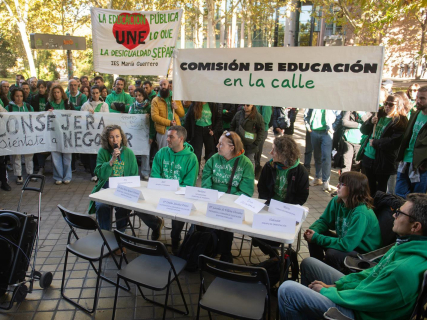
Demonstration in Madrid for education and public services: date, time and route

The strike of Madrid’s public education takes its demands to a demonstration from Atocha to Sol

fotonoticia 20261103112627 1920

fotonoticia 20261103112627 1920

Add DEMÓCRATA to Google

Ask FREN

Published

Last updated

2 minutes

Most read

Hasta el día de las elecciones (29 de noviembre) se muestran los resultados de las elecciones generales anteriores, las del 23 de julio de 2023.

Resultados de las elecciones generales del 29N en directo

Elecciones generales del 23 de julio de 2023 · Congreso de los DiputadosSenado

Escrutado: 100,00 %Votantes: 24.952.447Participación: 66,59 %

Votos

PartidoEscañosVotosPorcentaje
PP1378.160.83733,06 %
PP: 137 escaños. Se presenta con estos nombres:
  • PARTIDO POPULAR (PP)131 escaños
  • PARTIDO POPULAR / PARTIT POPULAR (PP)5 escaños
  • PARTIT POPULAR / PARTIDO POPULAR (PP)1 escaño
PSOE1217.821.71831,68 %
PSOE: 121 escaños. Se presenta con estos nombres:
  • PARTIDO SOCIALISTA OBRERO ESPAÑOL (PSOE)85 escaños
  • PARTIT DELS SOCIALISTES DE CATALUNYA (PSC-PSOE)19 escaños
  • PARTIDO DOS SOCIALISTAS DE GALICIA-PSOE (PSdeG-PSOE)7 escaños
  • PARTIDO SOCIALISTA DE EUSKADI-EUSKADIKO EZKERRA (PSOE)5 escaños
  • PARTIDO SOCIALISTA DE ISLAS BALEARES-PSOE (PSIB-PSOE)3 escaños
  • PARTIDO SOCIALISTA DE NAVARRA-PSOE (PSN-PSOE)2 escaños
Vox333.057.00012,38 %
Sumar313.044.99612,33 %
Sumar: 31 escaños. Se presenta con estos nombres:
  • SUMAR10 escaños
  • SUMAR - EN COMÚ PODEM (SUMAR - ECP)7 escaños
  • SUMAR ANDALUCÍA (SUMAR)5 escaños
  • COMPROMÍS - SUMAR: SUMEM PER GUANYAR (SUMAR - COMPROMÍS)4 escaños
  • SUMAR GALICIA (SUMAR)2 escaños
  • SUMAR CANARIAS (SUMAR)1 escaño
  • SUMAR ARAGÓN1 escaño
  • SUMAR MÉS (MÉS PER MALLORCA-MÉS PER MENORCA-SUMAR)1 escaño
ERC7466.0201,89 %
Junts7395.4291,60 %
EH Bildu6335.1291,36 %
EAJ-PNV5277.2891,12 %
BNG1153.9950,62 %
CCa1116.3630,47 %
UPN152.1880,21 %
PACMA0169.2370,69 %
PACMA: 0 escaños. Se presenta con estos nombres:
  • PARTIDO ANIMALISTA CON EL MEDIO AMBIENTE (PACMA)0 escaños
  • PARTIT ANIMALISTA AMB EL MEDI AMBIENT (PACMA)0 escaños
CUP-PR099.6440,40 %
FO046.2740,19 %
NC-bc045.5950,18 %
PDeCAT-E-CiU032.0160,13 %
RECORTES CERO023.4210,09 %
PUM+J023.2900,09 %
PUM+J: 0 escaños. Se presenta con estos nombres:
  • POR UN MUNDO MÁS JUSTO (PUM+J)0 escaños
  • POR UN MUNDO MAIS XUSTO (PUM+J)0 escaños
  • BIDEZKO MUNDURANTZ (PUM+J)0 escaños
U.P.L.023.2010,09 %
EXISTE020.4400,08 %
EXISTE: 0 escaños. Se presenta con estos nombres:
  • TERUEL EXISTE - COALICIÓN EXISTE (EXISTE)0 escaños
  • ARAGÓN EXISTE - COALICIÓN EXISTE (EXISTE)0 escaños
PCTE013.3820,05 %
GBAI099380,04 %
SY096970,04 %
Adelante091910,04 %
JM+082930,03 %
ESCAÑOS EN BLANCO079860,03 %
XAV073620,03 %
BQEX058070,02 %
CJ056200,02 %
FE de las JONS046830,02 %
PAR041730,02 %
PCTC038750,02 %
ESPAÑA VACIADA031580,01 %
PH029020,01 %
ASTURIAS EXISTE EV023140,01 %
XH019310,01 %
VP019170,01 %
Zsi018430,01 %
VB017740,01 %
POR MI REGIÓN016980,01 %
AHORA CANARIAS-PCPC016740,01 %
PARTIDO AUTÓNOMOS014460,01 %
EVB014420,01 %
CpM012980,01 %
JxG012180,00 %
EV-PCAS-TC011840,00 %
PREPAL09640,00 %
Somos Cc09630,00 %
ALM08740,00 %
PCTG07020,00 %
F.I.A.05060,00 %
3e04840,00 %
Ud.Ca04630,00 %
ESCONS EN BLANC04620,00 %
GITV03660,00 %
PUEDE02690,00 %
EVC02650,00 %
LB02630,00 %
PCTE/ELAK02590,00 %
UNIDOS SI02530,00 %
+RDS+01650,00 %
CCD01530,00 %
FUERZA CÍVICA01150,00 %

Los partidos que se presentan con varios nombres van juntos: pasa por encima del ? para ver el detalle. Porcentajes sobre votos válidos. Resultados definitivos del 23J de 2023.

Escaños (350)

Mayoría: 176
PP: 137 escaños en 2023 (PARTIDO POPULAR: 131; PARTIDO POPULAR / PARTIT POPULAR: 5; PARTIT POPULAR / PARTIDO POPULAR: 1)PSOE: 121 escaños en 2023 (PARTIDO SOCIALISTA OBRERO ESPAÑOL: 85; PARTIT DELS SOCIALISTES DE CATALUNYA (PSC-PSOE): 19; PARTIDO DOS SOCIALISTAS DE GALICIA-PSOE: 7; PARTIDO SOCIALISTA DE EUSKADI-EUSKADIKO EZKERRA (PSOE): 5; PARTIDO SOCIALISTA DE ISLAS BALEARES-PSOE: 3; PARTIDO SOCIALISTA DE NAVARRA-PSOE: 2)Vox: 33 escaños en 2023Sumar: 31 escaños en 2023 (SUMAR: 10; SUMAR - EN COMÚ PODEM: 7; SUMAR ANDALUCÍA: 5; COMPROMÍS - SUMAR: SUMEM PER GUANYAR: 4; SUMAR GALICIA: 2; SUMAR CANARIAS: 1; SUMAR ARAGÓN: 1; SUMAR MÉS: 1)ERC: 7 escaños en 2023Junts: 7 escaños en 2023EH Bildu: 6 escaños en 2023EAJ-PNV: 5 escaños en 2023BNG: 1 escaño en 2023CCa: 1 escaño en 2023UPN: 1 escaño en 2023137121333120232023
  • PP 137
  • PSOE 121
  • Vox 33
  • Sumar 31
  • ERC 7
  • Junts 7
  • EH Bildu 6
  • EAJ-PNV 5
  • BNG 1
  • CCa 1
  • UPN 1

Simulador de Pactos

Pulsa los partidos para sumar sus escaños.Abrir el Simulador de Pactos

Los escaños más ajustados

Quién tiene el último escaño, quién le sigue y los votos que le faltan
  1. GironaJxCAT - JUNTSyPP285 votos

    El último escaño de Girona (el 6.º) es para JxCAT - JUNTS. Le sigue el PP, que necesitaría 285 votos más para quitárselo. Ver Girona ›

  2. CantabriaVOXyPP403 votos

    El último escaño de Cantabria (el 5.º) es para VOX. Le sigue el PP, que necesitaría 403 votos más para quitárselo. Ver Cantabria ›

  3. TarragonaJxCAT - JUNTSyPSC1247 votos

    El último escaño de Tarragona (el 6.º) es para JxCAT - JUNTS. Le sigue el PSC, que necesitaría 1247 votos más para quitárselo. Ver Tarragona ›

  4. AlbacetePSOEyVOX1412 votos

    El último escaño de Albacete (el 4.º) es para el PSOE. Le sigue VOX, que necesitaría 1412 votos más para quitárselo. Ver Albacete ›

  5. SalamancaPPyPSOE1495 votos

    El último escaño de Salamanca (el 4.º) es para el PP. Le sigue el PSOE, que necesitaría 1495 votos más para quitárselo. Ver Salamanca ›

Ver todas las provincias y el mapa

Provincias donde el último escaño cambiaría de manos con menos votos, con lo escrutado hasta ahora. Pulsa una para ver el detalle.

Senado

100,00 % escrutado
PartidoSenadores
PP120
PSOEPSOE: 73 senadoresSe presenta con estos nombres:
  • PSOE48
  • PSC12
  • PSdeG-PSOE4
  • PSE-EE (PSOE)4
  • PSN-PSOE3
  • PSIB-PSOE1
  • PSOE-SUMAR-EUIB-ARA EIVISSA1
73
EH Bildu4
EAJ-PNV4
ERCERC: 3 senadoresSe presenta con estos nombres:
  • ERC-ESQUERRES PER LA INDEPENDÈNCIA2
  • ERC1
3
Junts1
UPN1
A.H.I.1
ASG1

Los partidos que se presentan con varios nombres van juntos: pasa por encima para ver el detalle. Baleares y Canarias eligen sus senadores por islas.

Senadores (208)

Elegidos en las urnas
PP: 120 senadores en 2023PSOE: 73 senadores en 2023 (PSOE: 48; PSC: 12; PSdeG-PSOE: 4; PSE-EE (PSOE): 4; PSN-PSOE: 3; PSIB-PSOE: 1; PSOE-SUMAR-EUIB-ARA EIVISSA: 1)EH Bildu: 4 senadores en 2023EAJ-PNV: 4 senadores en 2023ERC: 3 senadores en 2023 (ERC-ESQUERRES PER LA INDEPENDÈNCIA: 2; ERC: 1)Junts: 1 senador en 2023UPN: 1 senador en 2023A.H.I.: 1 senador en 2023ASG: 1 senador en 20231207320232023
  • PP 120
  • PSOE 73
  • EH Bildu 4
  • EAJ-PNV 4
  • ERC 3
  • Junts 1
  • UPN 1
  • A.H.I. 1
  • ASG 1

Los senadores designados por los parlamentos autonómicos no se eligen en las urnas.

Mapa

Ganador por provincia

    CanariasCeutaMelillaAraba/Álava: PSE-EE (PSOE) 27,7 %Albacete: PP 39,9 %Alicante/Alacant: PP 36,7 %Almería: PP 40,9 %Ávila: PP 43,3 %Badajoz: PSOE 39,2 %Illes Balears: PP 35,6 %Barcelona: PSC 35,7 %Burgos: PP 40,6 %Cáceres: PSOE 38,9 %Cádiz: PP 34,8 %Castellón/Castelló: PP 35,2 %Ciudad Real: PP 40,5 %Córdoba: PP 37,9 %A Coruña: PP 43,1 %Cuenca: PP 39,8 %Girona: PSC 28,9 %Granada: PP 37,0 %Guadalajara: PP 36,3 %Gipuzkoa: EH Bildu 31,2 %Huelva: PP 36,4 %Huesca: PP 38,2 %Jaén: PP 37,3 %León: PP 36,9 %Lleida: PSC 29,5 %La Rioja: PP 45,6 %Lugo: PP 50,2 %Madrid: PP 40,6 %Málaga: PP 38,3 %Murcia: PP 41,2 %Navarra: PSN-PSOE 27,4 %Ourense: PP 50,0 %Asturias: PP 35,7 %Palencia: PP 42,0 %Las Palmas: PSOE 33,2 %Pontevedra: PP 39,7 %Salamanca: PP 46,9 %Santa Cruz de Tenerife: PP 35,4 %Cantabria: PP 42,1 %Segovia: PP 45,0 %Sevilla: PSOE 36,6 %Soria: PP 37,2 %Tarragona: PSC 32,9 %Teruel: PP 35,0 %Toledo: PP 37,8 %Valencia/València: PP 33,6 %Valladolid: PP 40,8 %Bizkaia: EAJ-PNV 26,9 %Zamora: PP 44,7 %Zaragoza: PP 36,0 %Ceuta: PP 38,8 %Melilla: PP 49,2 %

    Pulsa una provincia para ver sus resultados y elegir municipio.

    Mapa

    Partido con más senadores por provincia

    CanariasCeutaMelillaAraba/Álava: PSOE, 3 de 4 senadoresAlbacete: PP, 3 de 4 senadoresAlicante/Alacant: PP, 3 de 4 senadoresAlmería: PP, 3 de 4 senadoresÁvila: PP, 3 de 4 senadoresBadajoz: PSOE, 2 de 4 senadoresIlles Balears: PP, 3 de 6 senadoresBarcelona: PSOE, 3 de 4 senadoresBurgos: PP, 3 de 4 senadoresCáceres: PP, 2 de 4 senadoresCádiz: PP, 3 de 4 senadoresCastellón/Castelló: PP, 3 de 4 senadoresCiudad Real: PP, 3 de 4 senadoresCórdoba: PP, 3 de 4 senadoresA Coruña: PP, 3 de 4 senadoresCuenca: PP, 3 de 4 senadoresGirona: PSOE, 3 de 4 senadoresGranada: PP, 3 de 4 senadoresGuadalajara: PP, 3 de 4 senadoresGipuzkoa: EH BILDU-INDEPENDENTZIA EZKERRETIK, 3 de 4 senadoresHuelva: PP, 2 de 4 senadoresHuesca: PP, 3 de 4 senadoresJaén: PP, 3 de 4 senadoresLeón: PP, 3 de 4 senadoresLleida: PSOE, 3 de 4 senadoresLa Rioja: PP, 3 de 4 senadoresLugo: PP, 3 de 4 senadoresMadrid: PP, 3 de 4 senadoresMálaga: PP, 3 de 4 senadoresMurcia: PP, 3 de 4 senadoresNavarra: PSOE, 3 de 4 senadoresOurense: PP, 3 de 4 senadoresAsturias: PP, 3 de 4 senadoresPalencia: PP, 3 de 4 senadoresLas Palmas: PSOE, 4 de 5 senadoresPontevedra: PP, 3 de 4 senadoresSalamanca: PP, 3 de 4 senadoresSanta Cruz de Tenerife: PSOE, 3 de 6 senadoresCantabria: PP, 3 de 4 senadoresSegovia: PP, 3 de 4 senadoresSevilla: PSOE, 3 de 4 senadoresSoria: PP, 3 de 4 senadoresTarragona: PSOE, 3 de 4 senadoresTeruel: PP, 3 de 4 senadoresToledo: PP, 3 de 4 senadoresValencia/València: PP, 2 de 4 senadoresValladolid: PP, 3 de 4 senadoresBizkaia: EAJ-PNV, 3 de 4 senadoresZamora: PP, 3 de 4 senadoresZaragoza: PP, 3 de 4 senadoresCeuta: PP, 2 de 2 senadoresMelilla: PP, 2 de 2 senadores

    Pulsa una provincia para ver sus senadores y candidatos.

    Resultados definitivos de las elecciones generales del 23 de julio de 2023 (Ministerio del Interior). Mapas: Instituto Geográfico Nacional (es-atlas, CC BY 4.0). Demócrata.

    The Mixed Strike Committee of the Community of Madrid has called on all citizens to take part this Friday, 27 November, in a demonstration to defend public services, workers’ rights and democratic freedoms. The rally will begin at 17:30 in Atocha and will reach Sol.

    The call comes from the strike of public education in Madrid, which has been going on for more than a month, but it seeks to bring together other sectors of society. The Committee places among the causes of the conflict the lack of staff and resources, the overcrowding of classrooms, the deterioration of the centers, and working conditions which, it maintains, prevent guaranteeing the education that students deserve.

    The convening body also denounces the response of the regional Government. It considers that, instead of negotiating, the Community of Madrid has resorted to attacks and disqualifications against education workers and measures which, in its view, make it difficult to exercise the right to strike and limit the spread of its demands in the centers. The Committee expressly points to the regional president, Isabel Díaz Ayuso, and the Minister of Education for maintaining an attitude of confrontation and delegitimization of the protest.

    The organization adds that in the last few weeks there have been detentions and aggressions in the context of mobilizations. It also questions proposals to expand minimum services, which it considers abusive, and denounces the existence of instructions intended to pursue, censor or silence references to the strike in educational centers.

    An open call to all of society

    The conveners argue that the conflict has ceased to affect only teaching staff because, in their view, restrictions on protest, freedom of expression and the right to strike affect all citizens. For this reason, the demonstration is aimed at workers, families, students, neighborhood groups, social movements and trade-union and political organizations, as well as at any person who defends a free, fair and egalitarian society.

    The mobilization includes five demands:

    • The defense of public education and all public services.
    • Workers’ rights and decent conditions for all female workers.
    • Full respect for the right to strike and to peaceful protest.
    • The end of repression and the withdrawal of measures that curtail liberties.
    • The defense of society’s critical conscience, above political labels and partisanship.

    The Committee highlights especially the importance of preserving citizens’ capacity to question, protest, and organize. In its statement, it warns that measures applied against teachers could be extended to other groups and claims the right to strike, protest, organize, and express themselves as tools to improve living conditions.

    Organizations from different areas join the mobilization

    The demonstration is promoted by the organizations that make up the Committee of Indefinite Strike of the Community of Madrid. The call has been joined, among other entities, by the Inquilinas Trade Union, the 8M Madrid Commission and the Coordinadora de Mareas Blancas.

    The objective is to bring together demands from different areas around the defense of public services, decent living conditions, and the right to protest and organize without being persecuted. The mobilization will take place this Friday, November 27. The demonstration will begin at 5:30 p.m. in Atocha and will end in Sol. 

    More key points, information and questions with FREN

    AI-GENERATED CONTENT

    What is the current status of the Madrid public education strike in terms of negotiation with the Community of Madrid?

    As of November 27, 2026, the indefinite strike of Madrid's public education continues without an agreement to end it. The negotiation presents two distinct levels: the direct dialogue demanded by the strike committee remains blocked, while the Community has convened a Sectoral Table today regarding its proposal for the teaching professional career. No results from that meeting have yet been reported in the sources consulted.

    The main blockage: with whom and about what to negotiate

    The committee demands a direct meeting with the Ministry to address all the claims that motivated the strikes, which began on October 14. The Community, on its part, maintains that the negotiation channel is the Education Sectoral Table, where CCOO, CSIF, UGT, and ANPE participate.

    This difference is important: negotiating the professional career is not equivalent to negotiating the end of the strike. The organizers argue that talks about this supplement do not replace negotiations on salaries, working hours, staffing, and teaching conditions. On November 19, teachers went to the Territorial Area Directorates to demand a commitment for a meeting with the minister, according to Demócrata.

    The novelty: a remuneration proposal for the Sectoral Table

    The most recent move by the regional government is the proposal announced on November 25. Education summoned the four organizations represented at the Sectoral Table for this Friday the 27th with the declared objective of ratifying it. The official information from the Community describes these conditions:

    • A horizontal professional career: a supplement for trajectory, experience, and performance, organized into six levels.
    • Annual amounts from 600 euros for primary teachers and 684 for secondary teachers at the first level, up to 4,200 and 4,800 euros respectively at the sixth.
    • Automatic initial recognition of accumulated seniority to assign the corresponding level.
    • Payment of 50% of the amounts during 2027 and 100% from January 2028, in addition to existing six-year increments and other supplements.

    Therefore, the announcement of up to 400 euros per month does not imply an immediate and uniform raise for all teachers: it corresponds to the maximum planned for secondary teachers at the sixth level when fully paid. The Community itself presents the text as a proposal pending ratification and subsequent processing, not as an agreement already closed with the unions.

    What remains unresolved

    The strike demands are broader than this offer. They include a raise of 600 euros per month; reducing teaching hours from 19 to 17 in Secondary and Vocational Training, and from 25 to 22 in Early Childhood and Primary; lowering the number of students per classroom; strengthening guidance and attention to diversity; reducing bureaucracy and improving facilities. These are detailed by Demócrata.

    It is also important to distinguish the calls: the unified indefinite strike and the CSIF stoppages have different committees and schedules. Their participation in the Sectoral Table does not imply, by itself, a common position on calling off the strike, as explained in this conflict analysis.

    In conclusion: there is a concrete initiative to negotiate remuneration, but no exit agreement from the strike. The immediate milestone is to know if the meeting on the 27th obtains union support and, above all, if it opens negotiations on the remaining demands with the conflict representatives.

    What are the competencies and functions of the regional president Isabel Díaz Ayuso according to the Statute of Autonomy of the Community of Madrid?

    According to the Statute of Autonomy of Madrid, approved by Organic Law 3/1983, Isabel Díaz Ayuso, as regional president, represents the Community, directs its Government, and coordinates the autonomous Administration. Her powers are those inherent to the office, not personal faculties, and are exercised under the control of the Assembly of Madrid.

    1. Institutional representation and Government leadership

    Article 17.1 concentrates her main functions: "she holds the supreme representation of the Autonomous Community and the ordinary representation of the State within it, presides over and directs the Government's activity, appoints and dismisses Vice Presidents and Ministers, and coordinates the Administration."

    • Representation: assumes the highest institutional autonomous representation and the ordinary representation of the State within Madrid.
    • Political leadership: presides over and directs the regional Government's activity.
    • Executive formation: appoints and dismisses vice presidents and ministers. Article 22.2 specifies that these do not need to be deputies of the Assembly.
    • Administrative coordination: coordinates the Community's Administration, differentiating this function from the direct management of each ministry.

    Article 17.2 allows delegating executive and representative functions to vice presidents and other Government members.

    2. Relationship with the Assembly and parliamentary confidence

    The president is politically responsible before the Assembly, according to article 17.3. Article 16.1 assigns this Chamber the election of the Presidency among its members and the control of her and the Government's actions.

    According to article 19, she can raise a vote of confidence, that is, ask the Assembly to confirm its support for her program or a general policy declaration. This must be done after Government deliberation. A simple majority suffices; if lost, she must resign.

    She can also be replaced through a motion of censure, regulated in article 20: it must be proposed by at least 15% of deputies, include an alternative candidate, and be approved by an absolute majority. If successful, the president and her Government cease.

    3. Electoral call and early dissolution

    Article 10.4 assigns the Presidency the power to call regional elections. Additionally, article 21 allows early dissolution of the Assembly, after Government deliberation and under her exclusive responsibility. The decision is formalized by decree, which also calls the elections.

    This power has explicit limits. It cannot be used:

    • During the first session period of the legislature.
    • When less than one year remains to complete it.
    • While a motion of censure is pending.
    • When a state electoral process is underway.
    • Before one year has passed since the previous dissolution.

    The resulting Assembly has a mandate limited by the date the original legislature would have ended.

    4. What corresponds to the Government, not exclusively to the president

    Article 22.1 assigns the Government, as a collegiate body, the direction of autonomous policy, executive and administrative functions, and regulatory power, that is, approving regulations in matters not reserved for the Assembly. Therefore, leading the Executive does not convert all its powers into individual attributions of Ayuso.

    Finally, article 24 establishes that the Government ceases after elections, loss of parliamentary confidence, and resignation, incapacity, or death of the president. The outgoing Executive continues in office until the new one takes office. In sum, the Presidency combines representation, leadership, and coordination, but does not replace decisions reserved by the Statute to the Government or the Assembly.

    What legal requirements must organizations meet to call a demonstration in Madrid?

    To call a demonstration in Madrid, an organization must notify it in advance to the Government Delegation in Madrid, but does not need administrative authorization. Article 21 of the Constitution recognizes the right to peaceful and unarmed assembly; its requirements are mainly developed in Organic Law 9/1983, regulating the right of assembly.

    1. Who can organize it

    Legal entities — for example, associations, unions, or parties — can promote and call demonstrations through their representative. The notification must identify both the entity and the natural person acting on its behalf. The law requires that promoters or callers be in full exercise of their civil rights.

    These rules refer to demonstrations and assemblies in public transit places. They should not be confused with internal meetings of an organization in closed premises, which have a different regime.

    2. Notification deadline
    • Ordinary procedure: it must be notified in writing with a minimum advance of ten calendar days and a maximum of thirty. Calendar days include Saturdays, Sundays, and holidays.
    • Urgent case: when there are extraordinary and serious causes justifying urgency, the notification can be submitted with a minimum advance of twenty-four hours. This urgency must be explained and justified; it is not enough to freely choose a shorter period.

    It is advisable to keep the submission receipt. The recipient is the Government Delegation, not only the Madrid City Council. If submitted electronically, an enabled administrative registry must be used and addressed to the competent body; legal entities are generally obliged to interact electronically with the Administration.

    3. Mandatory content

    According to article 9 of Organic Law 9/1983, the document must include:

    • Name, surname, address, and official identification document of the organizer or their representative. For a legal entity, also its name, nature, and address.
    • Place, date, time, and expected duration of the gathering or demonstration.
    • The purpose of the call, that is, its objective.
    • The planned itinerary when circulation through public roads is foreseen.
    • Security measures planned by the organizers or requested from the governmental authority.

    It is useful to precisely describe the starting point, route, and finishing place, avoiding ambiguities that hinder security and traffic coordination.

    4. Possible restrictions

    The authority cannot prohibit a demonstration simply because it is annoying or affects traffic. It can prohibit it or propose changes of date, place, duration, or route when there are well-founded reasons of public order disturbance with danger to persons or property.

    The decision must be motivated and notified within a maximum of seventy-two hours from the notification. If organizers do not accept the prohibition or proposed changes, they can appeal before the contentious-administrative jurisdiction within the following forty-eight hours, through the special judicial procedure provided for these cases.

    5. Obligations during the demonstration

    Organizers must adopt measures to maintain good order and ensure the call is peaceful and unarmed. The authority retains its protection and security obligations. Failure to notify and certain breaches may generate administrative liabilities; there may also be liability for damages under legal terms, but calling does not automatically make the organization responsible for any individual conduct.

    Attention to accessory elements: stages, installations, specific occupations, or sound equipment may be subject to additional rules. These requirements should not be confused with authorization of the demonstration nor replace notification to the Government Delegation.

    Play

    Test your knowledge with FREN!

    How much do you know about this topic? Answer the following 3 questions.

    What is the starting point and time of the demonstration called by the Mixed Strike Committee in Madrid?

    Question 1 of 3

    What is one of the main demands of the demonstration organized by the Mixed Strike Committee?

    Question 2 of 3

    Which organizations have shown their support for the demonstration alongside the Mixed Strike Committee?

    Question 3 of 3