

Turning Alberto Núñez Feijóo into Cristiano Ronaldo has been the latest bet by the Partido Popular to attract attention on TikTok. Through an artificial intelligence montage, the party has placed the face of its candidate over that of the Portuguese footballer in a viral video in which he states that it is not number seven, but number one. The idea has worked: 58,787 interactions and 306,159 views make the post the most prominent among the accounts of political parties, according to data from Lo que más mueven los partidos en redes by Poder Digital.
The PSOE has also found, in viral content, a way to fuel its campaign. The socialists hold second and third place with two posts that take advantage of trends that emerged outside their official channels: the song "Yo sí te voy a votar", which Pedro Sánchez has incorporated into his rallies, and a meme that answers Isabel Díaz Ayuso with a resounding "Vete ya". Against these strategies, the Podemos/Commons manage to get into the top positions with a video by Ada Colau explaining proposals for the self-employed.
The conversation on social networks
In total, Poder Digital’s monitoring collects 1.163 posts by political parties shared on X, Instagram and TikTok in the last 30 hours.
Among the ten most far-reaching contents, humorous montages predominate, responses to adversaries, and messages adapted to the language of social networks.
The PP changes its electoral message for the codes of football and TikTok
With the message "Number one, not number 7", the PP’s national account has recovered a well-known Cristiano Ronaldo sequence to make Feijóo its protagonist. Artificial intelligence makes it possible to replace the footballer’s face with that of the Popular Party candidate, who appears delivering a phrase associated with competitiveness and sporting success.
The video, published on Tuesday at 13:54, accumulates 40,899 'likes', 210 comments and 17,678 shares. These last explain a large part of its reach: nearly three out of every ten interactions correspond to users who have redistributed the content.
The post does without election proposals and uses an easily recognizable reference to convey a message about Feijóo's leadership. The edit connects with an trend usual on TikTok, where fragments of sports interviews and the expressions of football players are reused as memes, to comment on situations that have little to do with sports.
Also, the PP of Madrid has turned to a similar format, although this time to attack the President of the Government. Its most prominent post enlarges the face of Pedro Sánchez during the interview he gave Carlos Franganillo on Telecinco, along with the comment: "Trust, trust, what you call trust, doesn't inspire much".
The popular account adds a clarification that is part of the joke: "It's not AI. It seems incredible, but it isn't". The video achieves 27,925 interactions and 355,669 views, more views than Feijóo's montage as Cristiano Ronaldo, although fewer replies from users.
The party also occupies eighth place with another content aimed against Sánchez, which accumulates 22,380 interactions, while the Madrid PP appears in ninth place with a video dedicated to Ayuso under the message "Boss lady", which adds another 17,767.
"I am going to vote for you", the song that the PSOE has turned into a campaign resource
A phrase uttered by Ester Muñoz against Pedro Sánchez has ended up becoming one of the contents that the PSOE uses the most on social media. The origin is in an event by the PP in Salamanca, where the popular spokesperson said that no one was going to vote for the President of the Government. The response came through a song created with artificial intelligence that repeats exactly the opposite: "I am going to vote for you".
Featured story
The other electoral race of 29N: Sánchez leads Digital Power during the campaign
5 minutes
The topic began circulating among TikTok and Instagram users and gained more reach through videos, edits and posts by socialist supporters. Its creator, Adrián, a 42-year-old Valencian cook, told El País that he wrote the lyrics and used an artificial intelligence tool to generate the music, after trying different versions.
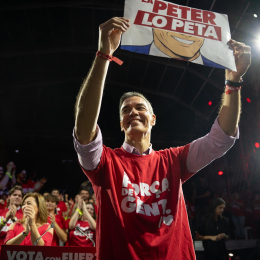
The phenomenon has ended up entering PSOE election events. During a rally, Sánchez referred explicitly to the song before a montage played with the chorus: "I don’t know what the song of the summer is going to be, but I do know what the song of this campaign is: 'I am going to vote for you'. Thank you very much, Ester".
The video posted by the socialist account on TikTok, accompanied by the message "Thank you Ester, thank you PP", has achieved 47,444 interactions and 293,738 views.
Using this song allows the PSOE to appropriate a critique from its opponents and turn it into a message favorable to its candidate. In addition, the content was created outside the party’s official structure, a circumstance that has made it easier to circulate among profiles that usually do not share conventional election propaganda.
The same logic appears in the third most viral post, also socialist. In it, the party retrieves some statements by Isabel Díaz Ayuso in which she says she would leave Spain if Sánchez wins the elections again and combines them with a meme of a woman who replies: "Go already".
The PSOE attributes the montage to the creator @Misco Jhones and accompanies it with the comment "This thing by @Misco Jhones represents us quite a lot, the truth". The post adds 38,211 interactions and 193,479 views.
Electoral proposals also find room among the memes
Not all the content with the greatest impact responds to the same strategy. Catalunya en Comú occupies fourth place with a video of Ada Colau explaining the Frente Amplio measures for self-employed workers, also disseminated by the coalition and by the candidate herself.
"Being self-employed shouldn’t be a series of obstacles," begins the message from the commons, which acknowledges the difficulties faced by those who work for themselves and defends offering them greater security, reducing administrative procedures, and making it easier for their businesses to function.
The post has achieved 38,027 interactions on Instagram, just 184 fewer than the PSOE meme about Ayuso. The result allows Frente Amplio to compete in terms of reach with humorous videos through content focused on specific proposals.
The difference can also be seen in the way it communicates. While the PP and PSOE use well-known figures, sports references, and viral songs, Colau appears explaining directly an economic issue that affects millions of workers.