
In the Community of Madrid, around 669,000 residents, 9.3% of the total, do not have a Family Doctor or an assigned Pediatrician. According to the available data, in Madrid’s Primary Care there are 485 professionals missing from these specialties in order to be able to provide adequate coverage to the entire population (368 Family Doctors and 117 Pediatricians).
The figures come from the Observatorio sobre las plantillas médicas de los Centros de Salud, prepared by the medical union Amyts and the platform APSeMueve, which brings together doctors and pediatricians at this level of care. The analysis was carried out using information from 265 health centers and their consulting rooms, that is, the 100% of those that exist in the region, with the situation recorded as of November 9, 2026.
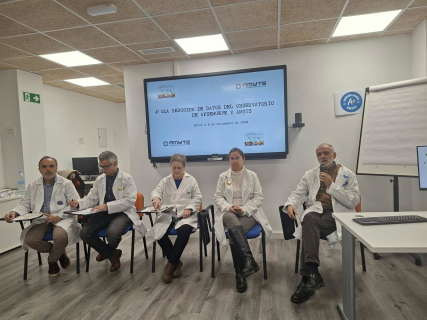
The results, which show “the real situation” based on data provided by the professionals themselves, were presented at a press conference at Amyts’ headquarters. It included the general secretary of the union, Ángela Hernández, and the doctors Ezequiel Arranz (Centro de Salud San Blas de Parla), Mar Nogerol (Centro de Salud de Cuzco de Fuenlabrada), Antonio Cabrera (Centro de Salud Daroca in La Elipa) and Javier Amador (Centro de Salud Los Ángeles de Villaverde).
As they have stressed, the report’s conclusions show “a situation of generalized deterioration and that extends over time” with a “structural deficit” of physicians that “continues to affect most health centers and hundreds of thousands of patients,” without the Health Department providing effective solutions.
The study details that 66.8% of the 265 health centers analyzed, that is, 177, have incomplete medical staffing. “Two out of three centers open every morning incomplete,” Mar Noguerol has denounced, who has emphasized that this shortfall “has a postal code,” as it concentrates mainly in the south and west of the Community, the areas with the highest economic vulnerability. Only 14.3% of the centers (38 in total) has its complete medical staffing available every day.
Regarding Family Medicine, of the 3,784 positions offered in the region, 9.7% are not filled, which amounts to 368 posts. Of these, 161 correspond to vacancies (posts without a holder, where the population does not have an assigned doctor), 207 to prolonged absences without replacement (sick leave of two months or more in posts with a holder) and 107 to reductions in working hours of the titular doctors that have not been reinforced.
In Pediatrics, of the 877 positions offered, 117 are unfilled, 13.19%. In this case, 50 are vacancies, 67 are due to long-term absences without a substitute, and 41 to reductions in working hours without coverage.
The report also identifies the centers where the sum of structural vacancies and unaddressed prolonged absences amounts to at least 20% of the workforce of each category. Under this criterion, 46 health centers are in a critical situation in Family Medicine and 65 in Pediatrics, that is, they have less than 80% of their available doctors in these areas.
If compared with the picture from the previous year, of the 47 centers that were in a critical situation in Family Medicine in March 2025, only 12 remain the same, while another 33 have gone on to swell this list. The hardest-hit areas of the Community are the west and the south.
Specifically, in the western area, 12.8% (57) of family doctors and 14.4% (16) of pediatricians are missing, while in the south, 11.9% (55) of the Family Medicine positions and 19.5% (25) of the Pediatrics positions are not covered. The central area is the one that concentrates the most vacancies for family doctors, with 85 positions without a professional.
The situation is especially serious at the Centro de Salud Martínez de la Riva, in Puente de Vallecas, where four of the six doctors on the afternoon shift are missing. A reality described as “unsustainable,” in response to which the professionals have issued an ultimatum to the Healthcare Management Office: if the positions are not filled, they will submit their resignation.
Break in care continuity
The doctors have also warned about the collapse of an essential principle of Primary Care: care continuity, that is, the follow-up of the patient by the same professional over time. In this way, about 668,000 people in the Community do not have ongoing follow-up by a family doctor or pediatrician, which is equivalent to 9.3% of the inhabitants.
This group is made up of 552,000 adults and 117,000 minors. Although a slight improvement is observed compared with the previous wave, from March 2025, this does not offset the increase in population (+1.1%). As a result, the number of inhabitants per effective family doctor rises from 2,096 to 2,108.
For the first time, the study incorporates a systematic measurement of the professionals who split their weekly working day between two health centers, the so-called '4+1' model (doctors hired for a specific center who must travel one day a week to another different one).
In Family Medicine, 144 doctors work part of their schedule outside their home center, coming from 94 health centers, which amounts to 3.8% of the workforce in this category. As they explained, the equivalent cost would be that of 300 full-time contracted family doctors, which would allow teams to be stabilized and cover 87% of the current structural shortfall.
In Pediatrics, there are 13 professionals assigned from 11 centers, averaging about two days a week outside their usual caseload. In total, 29 weekly assigned days are counted, which would be approximately six full-time pediatricians.
The report’s authors have also criticized the continued use of the absorption modules (overtime hours), an "exceptional" and temporary tool included in the strike-out agreements that, they denounce, the Department has turned into a permanent practice.
Based on the data obtained by Amyts and APSeMueve through the Transparency Portal, in Family Medicine, 285 doctors would have been needed to take on the 399,891 overtime hours carried out in 2025, during which 2,399,346 patients were attended to, at a cost close to 20 million euros. In Pediatrics, the shortfall is calculated at 27 pediatricians, after more than 37,000 overtime hours intended for the care of 223,156 children.
Both organizations have reproached the lack of response from the Department of Health to this scenario, as well as the underfunding of Madrid’s Primary Care, which sits below the national average. "Hiding reality does not hide problems. Despite having the capacity to solve it, it prefers to ignore reality rather than face it," the secretary general of Amyts has said.
Along these lines, they have presented what they call "the ladder of the solution," a roadmap that would have to be followed "step by step" until reaching compliance with the regulations, which would involve incorporating 1,000 additional doctors.
The first step, "the basics", would consist of covering 100% of the current staff, that is, signing 485 contracts. The second would involve adjusting the staff to the population increase, raising hiring to 537, with 52 new doctors due to the increase in residents. A third step would incorporate reductions in working hours until reaching 600 doctors.
Finally, the fourth level would be to reach the ratio recommended by the Ministry (1,500 adults/1,000 children per doctor), for which those additional one thousand professionals would be required. "Madrid Primary Care continues to lack the necessary professionals to offer accessible, high-quality care with the continuity that the population deserves," they have concluded.