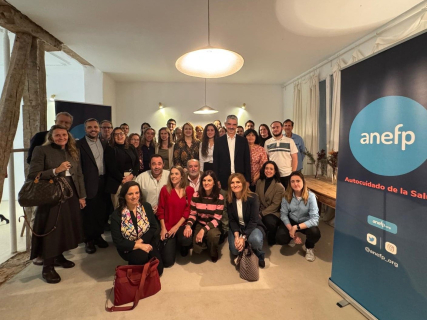

The general director of the Association for Self-Care of Health (Anefp), Jaume Pey, has defended “the strategic role of self-care and of the Consumer Health sector in order to address some of the main current challenges of the healthcare system,” among which he has cited “the increase in care demand, the need to strengthen prevention and the sustainability of the health system itself.”
During a meeting with the media, Pey highlighted “the contribution of Consumer Health companies, through research and innovation in medicines and products intended for the prevention and treatment of minor ailments, as well as the essential role of healthcare professionals to ensure responsible self-care and quality information,” while reviewing the recent evolution of the market.
When analyzing the behavior of the set formed by medicines and healthcare products not subject to prescription, food supplements, dermocosmetics, personal care items, self-tests and biocides, which account for around 30 percent of the pharmaceutical market in the pharmacy office, he recalled that, according to the consulting firm IQVIA, between September 2025 and September 2026 this segment exceeded 9,000 million euros in value (in pharmacy and para-pharmacy, both physical and ‘online’), which represents a 5.7 percent increase compared to the previous period.
In terms of volume, 692 million units were dispensed between September of last year and the same month of the current year, in the channels of physical pharmacy and para-pharmacy, with an increase of 1.6 percent compared to the previous period. Among the categories that are advancing the most, in the OTC sphere mineral supplements, products for ophthalmic care, analgesics, anti-flu products, and items for acidity and digestive conditions stand out; in cosmetics, facial care and sun protection; and, in nutrition, diets, baby food and sports nutrition.
Four pillars for the sector’s agenda through 2028
Looking at the coming years, Anefp has transferred to the Administrations a roadmap based on four priorities: a stable and predictable regulatory framework, the push for digitalization, environmental sustainability, and the strengthening of self-regulation. These pillars underpin the 'Strategic Plan for the Consumer Health sector 2026-2028', which seeks to turn these lines into tangible progress for companies, the healthcare system, and the health of the population.
Pey has reminded that the sector’s strategic role has been reaffirmed through its inclusion in the 'Pharmaceutical Industry Strategy' and has pointed out as key issues the approval of the new Medicines and Medical Devices Law, an appropriate definition of the medicine not subject to prescription and of the concept of the first diagnosis, as well as the maintenance of a solid self-regulation system. In his view, over-the-counter medicines contribute to the sustainability of the system by facilitating the prevention and resolution of minor ailments.
The meeting has also served to discuss the recent inclusion of the term "self-care" in the Dictionary of the Spanish Language, where it is described as the "active dedication of a person to maintain their health and prevent or combat diseases." Anefp had requested the inclusion of this word from the Real Academia Española (RAE), considering that its habitual use and social weight reflect the growing civic sensitivity to adopting a proactive attitude toward health care and quality of life.
The acceptance of the term "is excellent news because it recognizes a reality that is firmly established in our society, where citizens want to participate more and more actively in the care of their health and in a responsible manner," Pey has said, who has added that, "for Anefp, this recognition also highlights the work carried out by the association over nearly five decades, focused on promoting self-care as a health tool for people and for better efficiency and sustainability of healthcare systems".
Likewise, support for the objective of the Urban Waste Water Treatment Directive has been reiterated, linking the health of the planet with the health of people, and it has been argued that the implementation of the Extended Producer Responsibility should be based on criteria of proportionality, scientific rigor, and a balanced distribution of obligations, so that maximum environmental effectiveness is achieved without generating undesirable effects on access to health treatments.
Pharmacy First model, AI, and a radiograph of self-care
In this context, Anefp has reaffirmed its commitment to moving forward with models such as 'Pharmacy First', which strengthen community pharmacy as the first point of consultation for minor ailments. An approach supported by clear protocols and coordination between professionals would make it possible to make better use of the proximity and capillarity of the network of pharmacies. To this end, the association maintains joint projects with the Sociedad Española de Farmacia Clínica, Familiar y Comunitaria (SEFAC), with the official colleges of Pharmacists in Madrid (COFM) and Barcelona (COFB), and with the Consejo General de Colegios Oficiales de Farmacéuticos (CGCFO).
"The key is to combine prevention, professional advice, and swift access to medicines and self-care products, with the pharmacist playing a fundamental role in this process," Pey said, who also emphasized the need to keep moving forward on the integration of medicines and self-care products into public and private prescribing electronic systems. At the same time, Anefp is incorporating artificial intelligence (AI) into its internal processes through the 'Turing Project' and continues to strengthen its self-regulation framework through the 'Sello anefp'.
The meeting also delved into the 'II Radiograph of Self-Care of Health in Spain', which will be continued with a third edition planned for February 2027. "In an environment in which health misinformation can spread with enormous speed, we have to reinforce health education and place even more value on healthcare professionals as reliable sources of information and advice," Pey said, also in relation to the recent update of the open part of the entity's website.
In view of the commemoration in 2028 of the 50th anniversary of Anefp, the association sets itself as its goal to consolidate an innovative, competitive, sustainable Consumer Health sector fully integrated into the health system, capable of driving a health model increasingly focused on prevention, health education, and the responsible involvement of citizens in the self-care of their health.