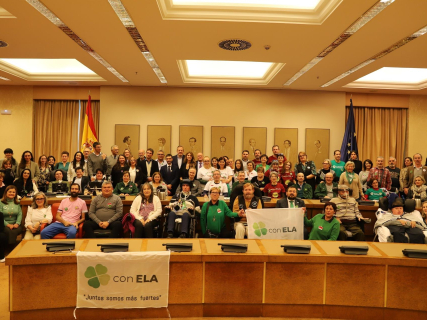

The National Confederation of ALS Entities (ConELA) has urged the parliamentary groups of the Congress of Deputies to promote and give the green light, with the greatest possible consensus, to the Bill amending the General Law on the rights of persons with disabilities and their social inclusion, as well as the Law on the Promotion of Personal Autonomy and Care for Persons in Situations of Dependency.
The organization emphasizes that the request comes in the midst of the parliamentary processing of the text, a point it considers decisive for strengthening it and introducing adjustments to ensure "truly adequate" care for people with disabilities and in situations of dependency, "especially those living with highly complex diseases such as ALS."
In this regard, ConELA joins the call of the Spanish Committee of Representatives of Persons with Disabilities (CERMI), which demands that the reform advance and be approved with a "broad agreement" among the different parties in the parliamentary spectrum.
According to the entity, the project develops the new article 49 of the Constitution, culminates a "long-awaited" regulatory update, and opens a "decisive opportunity" to consolidate the rights, inclusion, autonomy, and accessibility of people with disabilities, in addition to strengthening care for those in situations of dependency.
The Confederation highlights that the text, enriched during its passage through Parliament with the contributions of the groups, incorporates "relevant advances" that allow for "consolidating more person-centered care, strengthening support for living in the chosen environment, and improving coordination between the health and social systems."
"The approval of this reform must serve to eliminate the obstacles that still prevent the rights recognized by the ALS Law from translating into real support for people and their families. We cannot allow co-payments, lack of personal assistance, or inequalities between territories to continue conditioning access to essential care," stated the president of ConELA, José Jiménez.
Three key demands from ConELA
First, the Confederation proposes to eliminate the economic participation of users provided for in article 31 of the Dependency Law, at least when it comes to essential support to guarantee autonomous living, remaining at home, and high-intensity care. ConELA argues that no one should be forced to reduce hours of care, give up a benefit, or leave their home due to being unable to bear the cost of care that constitutes a subjective right.
"This issue becomes particularly serious in the advanced stages of ALS, when the need for continuous assistance, support products, home adaptation, and professional care can involve extraordinary costs. 'Dependency cannot become a cause of impoverishment for sick people and their families'," ConELA points out.
Secondly, the organization demands that personal assistance be configured not only as an economic benefit, but as a "genuine guaranteed service" within the System for Autonomy and Care for Dependency, with public provision or, at least, guaranteed by the administrations.
For ConELA, personal assistance must be a "professional, accessible, flexible, and sufficient" resource, which can be adjusted to the evolution of each person and offer the necessary support at each stage. "The freedom to choose to live in one's own home, the Confederation emphasizes, will only be real when professional support is available, compatible with each other, and has sufficient funding," it maintains.
Thirdly, ConELA demands an "effective gateway" between dependency and disability, including its fiscal implications. The organization values that the reform contemplates the assimilation of people in situations of dependency to the legal status of a person with a disability, but considers it unjustified that this recognition is not reflected in the tax sphere.
"There is no reason of equity to administratively recognize that a person with dependency has a disability of 33 percent or 65 percent, depending on the recognized degree, and at the same time deny them the tax benefits linked to that condition," argues ConELA, which recalls that people with dependency and their families assume material, personal, and economic surcharges that justify equivalent tax protection.