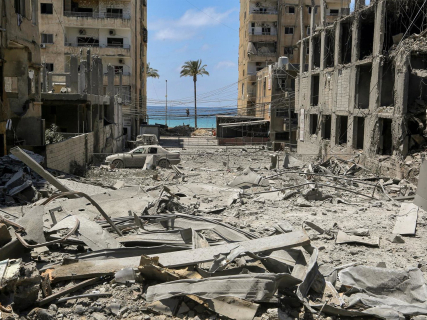

The NGO Amnesty International has demanded this Thursday that the deaths of minors and the "annihilation of entire families" in Lebanon be investigated as "war crimes", in the context of the bombings carried out by the Israeli Army despite the ceasefire agreed with the Lebanese party-militia Hezbollah.
"Three airstrikes carried out by Israel in southern Lebanon in March 2026 that killed 24 civilians --twelve of them minors-- annihilating entire families must be investigated as war crimes," Amnesty stated in a statement in which it indicated that, after a series of investigations, it has found "reasonable grounds to conclude that in each of these airstrikes Israeli forces violated International Law by failing to distinguish between civilian and military objectives."
Along these lines, the organization has accused Israel of "carrying out attacks directed against civilians or civilian objects or failing to take all possible precautions to minimize harm to the civilian population." "In just one week, the Israeli Army annihilated entire families in Lebanon, demonstrating a cruel disregard for civilian lives," stressed Kristine Beckerle, the NGO's deputy regional director for the Middle East and North Africa.
"How many more families will have to pull the remains of their children's bodies from the rubble before this devastating cycle of war crimes ends? The international community must act now: states must impose a comprehensive and immediate arms embargo on Israel and use universal and extraterritorial jurisdiction to investigate and prosecute those responsible," she stated.
"There is growing fear that the most recent agreement, brokered by the United States, between Israel and Lebanon may become another obstacle to justice and deny victims a path to accountability. The heartbreaking testimonies of survivors and witnesses of these attacks offer a chilling glimpse into what the total impunity of Israel's illegitimate attacks means in practice," she lamented.
Thus, it has stressed that the Lebanese authorities "must act decisively and give the International Criminal Court (ICC) jurisdiction over the crimes committed in their territory and support international justice initiatives by initiating credible and independent national investigations into these crimes." "Without coordinated action --nationally and internationally-- the cycle of war crimes and impunity will continue with no end in sight," it said.
According to the Lebanese government, between March 2, when the conflict intensified, and June 29, 4,257 people lost their lives in Lebanon, of whom more than 250 were children.
The organization explained that in mid-June it wrote to the Israeli authorities to request information on nine attacks carried out in Lebanon, including the three named above, and asking for clarifications on the military objectives selected and the measures taken to avoid, minimize, investigate or redress damage to the civilian population.
In their response of June 22, the Israeli authorities stated that they had "reviewed the complaints filed" and that some attacks "were carried out against Hezbollah military targets," while others had been "referred for examination."
Likewise, they said they were "committed to mitigating harm to the civilian population during operational activities" and stressed that Hezbollah "systematically uses civilian infrastructure for military purposes." Despite this response, the Israeli army "did not provide concrete information on the three attacks documented or what their objectives were," the text states.
DISTINCTION BETWEEN MILITARY AND CIVILIAN OBJECTIVES
Amnesty has thus emphasized that International Law "requires parties to distinguish at all times between military objectives and civilian population or civilian objects, and to direct their attacks solely against military objectives." "In addition to prohibiting direct attacks against the civilian population or civilian objects, International Law prohibits indiscriminate attacks that do not distinguish between military objectives and civilian population or civilian objects," it maintained.
"The parties to a conflict must also ensure that they avoid causing damage to the civilian population and civilian objects, which includes taking all possible precautions to minimize damage to the civilian population and damage to civilian objects. This includes doing everything possible to verify that the objectives intended to be attacked are military objectives and to suspend attacks if it becomes apparent that they are directed against wrong objectives or are disproportionate," he stated.
In addition, he addressed Israel's evacuation orders in the face of possible attacks and clarified that "these orders, excessively general and lacking clear information about safe routes (...) do not constitute effective advance warnings." "Issuing these orders does not give the Israeli Armed Forces the right to treat these areas as free-fire zones nor does it exempt them from their obligations to respect International Law, distinguish between military and civilian objectives, and take all possible precautions to minimize damage to the civilian population," he pointed out.
The organization, which has found no evidence pointing to the presence of military objectives in the investigated attacks, clarified that they are "part of a documented pattern of illegitimate attacks in a context of total absence of accountability."
"The persistent impunity for illegitimate attacks risks normalizing serious violations of International Law and sends the dangerous message that Israeli forces can continue to kill and injure civilians illegitimately without anyone stopping them and without any prospect of justice or reparation," Beckerle asserted.