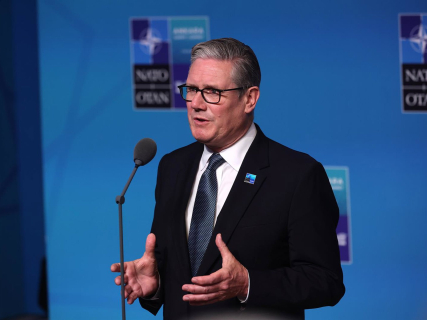

British Prime Minister Keir Starmer assured this Wednesday, at the close of the NATO summit held in Ankara, his last international meeting before leaving office, that he has maintained a "very good relationship" with US President Donald Trump, and that both have expressed their willingness to remain in contact.
After the Atlantic meeting, Starmer reviewed the transatlantic ties during his time in Downing Street, which is about to conclude due to an internal revolt in the Labour Party that will lead to a new leader and head of government in a few weeks. In this context, referring to his dialogue with Trump, he insisted that there has been "a very good relationship" between them throughout his term.
"There is no doubt about it, and a moment ago we talked about it; we will stay in touch. That is important with regard to the relationship between the United Kingdom and the United States, because it is a really important strategic relationship," he said, according to statements reported by the newspaper 'The Guardian'.
Referring to his legacy as prime minister, he stressed that his main responsibility was "to make that relationship work." In doing so, Starmer downplayed the repeated attacks from the White House, especially over London's refusal to support the war in Iran.
Amidst the debate on increasing military spending and after presenting a new 'roadmap' to be managed by his probable successor, Andy Burnham, the outgoing prime minister has recommended that he not alter fiscal rules and has urged him to avoid resorting to borrowing to finance the increase in the defense budget.
"I think the fiscal rules are really important. They are undoubtedly one of the reasons why we have managed to stabilize the economy," he pointed out, insisting that increasing debt is not "the most sensible way to obtain more resources for defense."
The plan designed by Starmer, now pending approval from the next government, contemplates increasing defense spending by more than 15 billion pounds (more than 17 billion euros), with the aim of placing the United Kingdom at 4.2% of GDP in military investment and thus approaching the threshold set by NATO for 2035.