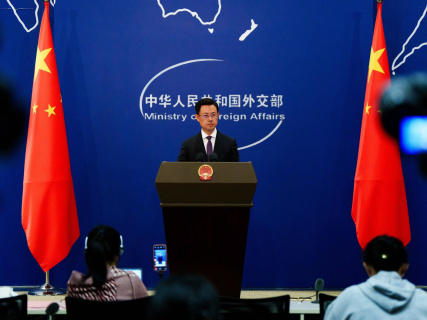

The authorities of China have expressed this Thursday their firm opposition to the proposal by the United States to apply new tariffs of up to 20% to fourteen economies, including China, after a trade investigation into alleged excess capacity in industry. Beijing has denounced that this initiative is unilateral in nature, violates the rules of the World Trade Organization (WTO) and harms the current international economic order.
The office of the United States Trade Representative (USTR, for its acronym in English) announced its decision on Wednesday after analyzing certain manufacturing practices of the countries singled out, which it holds responsible for generating trade imbalances and for imposing obstacles on exports from the United States, following the conclusions of an investigation carried out under Section 301 of the Trade Act of 1974.
The spokesperson of the Ministry of Commerce of China, He Yadong, has described the investigation as a "typical act of unilateralism" and has stressed that it "seriously undermines the international economic order and the WTO rules," insisting that China "strongly rejects it."
According to statements released by the official agency Xinhua, He has urged Washington to correct its position and that the differences be addressed through dialogue and bilateral consultations.
Along the same lines, the spokesperson of the Chinese Ministry of Foreign Affairs, Guo Jiakun, has emphasized that "tariff and trade wars do not benefit any of the parties" and has defended that tensions between the two countries must be resolved through negotiations based on equality, mutual respect and the pursuit of shared benefits.
Guo has also rejected that the concept of "overcapacity" be used as an argument for political manipulation and has called for applying the consensuses reached by the two heads of state in order to maintain stability in bilateral economic ties.
Beijing has warned that it will continue to monitor the development of this conflict and reserves the right to adopt the measures it deems necessary to safeguard its "rights and legitimate interests."
The American investigation covers China, the European Union, Singapore, Switzerland, Indonesia, Malaysia, Cambodia, Thailand, South Korea, Vietnam, Taiwan, Bangladesh, Japan, and India. Washington argues that industrial policies, subsidies to manufacturers, practices linked to technology transfer and intellectual property, as well as labor and environmental conditions undermine the competitiveness of its companies and exporters and pose a threat to its economic security.
Among the affected sectors are aluminum, the automotive industry, batteries, the chemical industry, consumer electronics, medical devices, semiconductors, shipbuilding, steel, textiles, telecommunications, robotics, and solar and wind energy, among other productive areas.