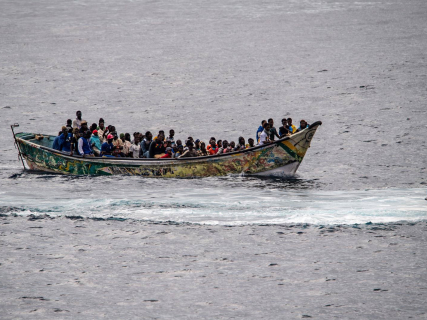

At least four migrants have lost their lives and several dozen remain missing after the sinking of a boat off the coast of Senegal, when they were trying to complete the Atlantic route to the Canary Islands, the main destination of this crossing.
The incident occurred off the town of Yenne, south of Dakar, which has prompted the launch of an extensive search and rescue operation. To date, four bodies have been recovered in the Tenne-Todd and Sendou areas.
The boat is believed to have been carrying between 40 and one hundred people when it sank for reasons still unknown on Wednesday afternoon, according to the Senegalese daily "Le Soleil". The shipwreck occurred just a few hours after the Senegalese Navy reported that in the previous two days it had rescued more than 1,400 migrants aboard nearly ten boats.
The seriousness of the situation has led Senegalese President Bassirou Diomaye Faye to order the Ministry of the Interior to prepare a "detailed" report on the social problems that are feeding the increase in migration flows to Europe, in a context in which Senegal has been consolidated as one of the main departure points in West Africa.
As the head of state has specified, the document must include information "on the problems and the concerted and adapted solutions related to the phenomenon of irregular migration", in addition to "an assessment of the strategy and the actions carried out within the framework of the Interministerial Committee for Combating Irregular Migration (CILMI)".
Faye has also expressed concern about the upturn in migrant departures toward European territory and has stressed that the current situation "requires strengthening controls" and "implementing rapid government measures that make it possible to neutralize and stop this scourge", according to Senegal's state news agency APS.
Along the same lines, he has warned that "the acceleration and complexity of irregular migration highlight the urgency for the Government to intensify the relaunch of the agriculture and fishing sectors", with the goal of improving living conditions and economic opportunities in the country and preventing more people from being forced to risk their lives on these dangerous maritime routes.
The president has also insisted on the need to set in motion in a “diligent and efficient” manner a set of public policies aimed at young people in areas such as education, vocational training and employment, as well as strengthening women’s economic autonomy through “specific public mechanisms” that make it possible to address this migration crisis at its root.
According to data published on the website of the International Organization for Migration (IOM), around 7,000 people have died or gone missing since 2014 on this Atlantic route to the Canary Islands, which places it only behind the Sahara desert, where close to 7,200 deaths and disappearances have been recorded.
The IOM has recently pointed to a certain decline in the arrivals of migrants from West Africa to Europe, with the Canary Islands as the main gateway, although it has warned that the strengthening of controls in Morocco, Mauritania and Senegal has shifted the departure points further south, further increasing the risk and dangerousness of these crossings.