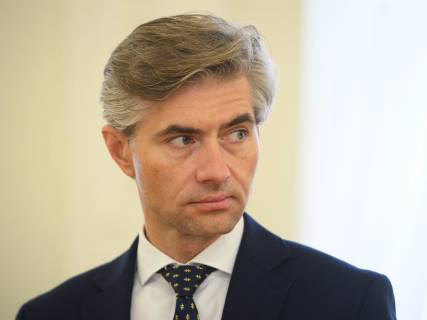

The Minister of Foreign Affairs of Lithuania, Kestutis Budrys, has urged that the European Union (EU)—whose Council will soon take over the rotating Presidency under the leadership of Vilnius—include the Russian military intelligence service (GRU) "as a terrorist organization".
"We want the GRU, the Russian military intelligence service, to be classified as a terrorist organization in the EU, just like Iran's Revolutionary Guard", he said in an interview with the German newspaper 'Welt', in which he described the GRU as an entity that "terrorizes our societies, those who make decisions, and other individuals".
The foreign affairs official has linked the GRU to various episodes recorded in Lithuania, which he has not detailed but about which "Lithuanian courts have already issued sentences", and he has likewise linked it to the attempted attack against the Leipzig airport in Germany last September.
"We must make it clear to Russia that its actions against us no longer constitute 'hybrid warfare', but rather 'unconventional warfare', and that, in this way, the threshold that triggers NATO Article 5 could be overcome", he has snapped, referring to the collective defense clause that obliges all members of the Atlantic Alliance to respond to an aggression against one of them.
In addition, Budrys regretted that in Vilnius they are missing "a collective response to Russia's actions" from the Twenty-Seven. "So far, each one acts on its own, including Germany", he has stated, although he has wanted to "expressly praise the closure of the consulate (in Bonn) and the restriction of certain Russian activities in Germany".
"We need common instruments, especially sanctions", he emphasized, calling from Brussels for joint decisions that would make it possible to "show Russia that its actions have a political cost: lower economic income coming from Europe and, at the same time, greater support for Ukraine".
Thus, Budrys has once again underscored Lithuania's position, which on numerous occasions has warned about the increased risk associated with espionage and sabotage activities attributed to Russia. This Baltic state, bordering the Russian exclave of Kaliningrad and Belarus—which is allied with Moscow—has also shown itself firm in its support for Ukraine in the face of the Russian invasion.