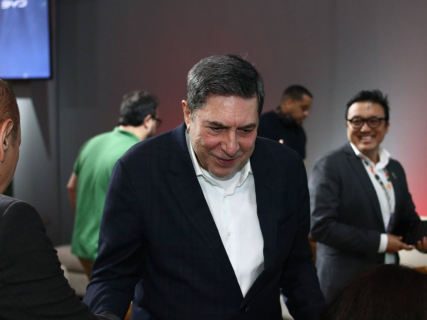

Brazil’s Executive has announced this Thursday who will be its next Minister of Finance for the next term: it is Luiz Carlos Trabuco Cappi, 75 years old, until now president of the board of directors of the bank Bradesco. The veteran banker has accepted the proposal of President Luiz Inácio Lula da Silva after a meeting in which the Minister of Planning and Budget, Bruno Moretti, and the current head of Finance, Dario Durigan, also participated.
The announcement, released by the Palacio do Planalto —the seat of Government and the official office of the head of State—, specifies that Trabuco will take over the leadership of the Ministry of Finance "from 2027". According to the note, the confirmation of his appointment was finalized at a meeting held late in the afternoon at the Palacio da Alvorada, the official residence of the President of Brazil.
On the occasion of the handover, his predecessor, Durigan, has wished him "much success" and has highlighted the importance of continuity in economic management: "A country is on the right path when it is governed with seriousness and ethics. That was the case with Minister Fernando Haddad (who preceded Durigan), it has been like that with me and I am convinced it will be so with the future Minister Trabuco," he said on social media. "You can count on me and on all my team when you assume the position," he added, addressing Trabuco directly.
The current top executive of Bradesco —very close to Lula and a member of the Council on Sustainable Economic and Social Development, a forum that brings together representatives of the Government, the business community and civil society— will arrive at the Ministry in a particularly delicate context for Brazil’s public accounts. The budget deficit stands at around 10% of gross domestic product (GDP), while public debt continues to rise.
To address this situation, Congress has already given the green light to an initial package of measures aimed at strengthening public finances. The plan consolidates the new Brazilian fiscal framework by setting a 2% limit on the real growth of spending when budgetary targets are at risk, which gives the Government more capacity to freeze budget items and reduce tax benefits.
The goal of this program is to improve the primary fiscal balance —which does not include the payment of interest on the debt— by almost 60,000 million reais (9.7 million euros) by 2027, with an even greater effect in the subsequent years. In addition, approval of new initiatives before the end of the year is planned to reinforce this adjustment.
After the election of Trabuco became known, the markets have responded with strong gains in Brazilian assets. According to data collected by the Bloomberg agency, an exchange-traded fund based in Tokyo that replicates the performance of Brazilian stocks has risen by as much as 8.3% in the first hours of trading in Asia, after the announcement of the banker as the new Finance Minister. At the same time, futures on the Brazilian real have recorded an increase close to 4%.