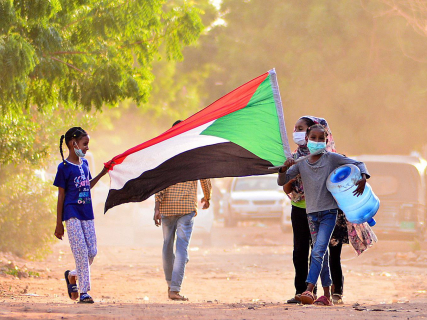

The NGO Save the Children has warned this Thursday that nearly one in four boys and girls currently live in conflict zones around the world, the highest percentage since these data have been collected in 1990, and which implies an increase of more than 50% in the last ten years.
In 2015, 378 million children were counted in these areas, while now the figure reaches 589 million, according to details provided by the organization in its report "No to the war against children: a future beyond the numbers", where it is established that the proportion of children living in warlike contexts has increased significantly.
In the 1990s the percentage was around 10%, compared with the current 23.4%. Africa concentrates the highest number of affected children, with about 260 million, 44% of the worldwide total, according to data from the Oslo Peace Research Institute (PRIO). "This figure represents an increase of almost 20% compared with the 218 million recorded in 2024," it added.
Across the whole African continent, the proportion of boys and girls who live in conflict zones has more than tripled: it has gone from approximately one in eight in 2010 to two in five in 2025, the highest percentage recorded to date. This proportion places Africa at the same level as the Middle East, where two in five children also currently live in these contexts.
Elsewhere in the world, almost one in four children in America was in areas affected by armed conflicts (24.2%), one in seven in Asia (14.3%), and almost one in nine in Europe (10.6%).
Gudrun Ostby, principal investigator at PRIO, has indicated that it is "estimated that last year 589 million children were living near armed conflict zones." "These record figures remind us in a forceful way that conflicts are devastating the everyday lives, education, health and future outlooks of hundreds of millions of children."
"If efforts to protect children in conflict contexts are not redoubled, the consequences of today’s wars will extend for decades," it denounced.
The document also examines serious violations against children in armed conflicts verified by the United Nations between 2005 and 2025. These include the killing and maiming of boys and girls, their recruitment and use by forces and armed groups, sexual violence, kidnapping, attacks on schools and hospitals, and the denial of humanitarian access.
Save the Children has emphasized that these statistics "represent only a small part of the serious violations that occur, since most attacks against children are not verified".
"Killing and maiming constitute the most frequent serious violation against children in the past two decades, with 171,712 verified cases since 2005. More than 70% of these cases occurred in five countries: the Occupied Palestinian Territory, Afghanistan, Somalia, Syria and Yemen", he has reiterated.
The organization has also warned that the denial of humanitarian access has risen from accounting for just over 2% of the total of verified serious violations in 2015 to surpassing 21% in 2025, making it the second most common violation, only behind killing and maiming.
The report recalls that abuses that encompass violations and other forms of sexual violence against boys and girls continue to be widely underdetected. Even so, it notes that "even so, since the records began, 28,909 cases have been verified." "The Democratic Republic of the Congo concentrates 12,698, almost 44% of the total, followed by Somalia, with 4,534, and Chad, with 2,979. These three countries account for around 70% of all verified cases," he added.