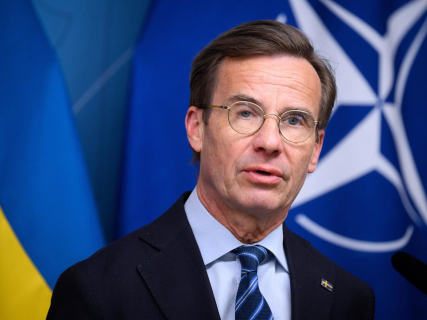

The Sweden Center Party has taken this Thursday a decisive step to unlock the formation of a Government. Its leader, Elisabeth Thand Ringqvist, has announced the convening of the party’s confidence council with the recommendation to vote in favor of the reappointment of Ulf Kristersson as prime minister in the parliamentary session next Monday, November 30.
The decision, adopted by majority, but without unanimity, represents a shift in the position of the centrists and opens the door to the establishment of a minority Government made up of the Moderate Party, the Center Party, the Christian Democrats, and the Liberals.
If the confidence council ratifies the recommendation of the leadership, Kristersson would have his way cleared to continue at the head of the Executive. Sweden Democrats have announced their intention to abstain in the parliamentary vote, which would allow the candidacy of the conservative leader to prosper.
The decision comes after several weeks of negotiations and successive attempts to resolve the political deadlock following the legislative elections of September.
The Center Party’s shift sharpens internal divisions
Thand Ringqvist ran in the elections with the Social Democrat Magdalena Andersson as the preferred candidate to occupy the head of the Government. However, the failure of negotiations with the center-left bloc led the centrist leader to resume contact with center-right formations.
This change of course has generated tensions within the Center Party, where part of the organization argues for maintaining the red line of not depending on the parliamentary support of the Sweden Democrats, a far-right party.
Thand Ringqvist herself tried to become prime minister on the past November 3, when the Swedish Parliament rejected her candidacy. After that vote, the Speaker of the Chamber, Andreas Norlén, tasked Kristersson with exploring the possibilities of forming a new Executive.
The budgets, the next test for Kristersson
The prime minister’s continuity is not the only pending issue. The vote on the budgets constitutes another of the main challenges for the future coalition, which will have to arrange the parliamentary support needed to carry forward its economic commitments.
The Moderate Party has worked on a budget proposal that incorporates measures defended by the centrists, in an attempt to facilitate understanding among the four parties.
Backing Kristersson in Monday’s vote does not necessarily imply stable support for all of the future Executive’s legislative initiatives. Governability and approval of the public accounts will continue to be conditioned by parliamentary arithmetic.
Early elections, the alternative to the agreement
In internal meetings over the past few days, Thand Ringqvist had conveyed to members of her party two possible scenarios: to facilitate Kristersson’s continuity or to face the risk of a new election call, according to Swedish public television SVT.
Monday’s vote could also make it possible to revive the center-right alliance that governed Sweden between 2006 and 2014 under the mandate of Fredrik Reinfeldt. At the time, Moderates, Centrists, Christian Democrats, and Liberals shared the Executive for two consecutive legislative terms.