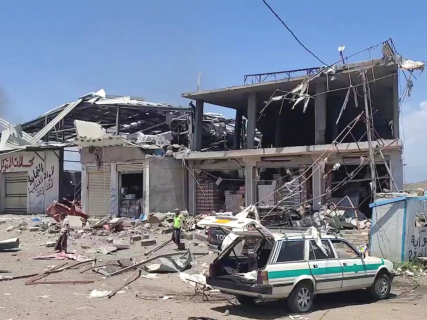

The Houthi rebels of Yemen have accused Saudi Arabia this Thursday of carrying out several airstrikes in Taiz province, including a bombing of a hotel in the port city of Mocha, where they have reported at least three deaths and ten injured, as well as another attack on the town of Al Shaab, east of the provincial capital, which would have affected “the only center that provides dialysis services to patients with kidney failure in the province.”
In the strategic city of Mocha, located across the Red Sea, “it is expected that the number of victims will increase as search and rescue operations at the site of the attack continue,” the spokesperson of the Houthi Ministry of Health, Anis al Asbahi, said in a social media post.
Later, Al Asbahi himself again turned to his social media to circulate a new statement in which his department “strongly condemns the bombings against the town of Al Shaab, in Al Hoban,” a district located to the east of the city of Taiz. “These attacks have caused damage to the Al Hoban dialysis center, the only center that provides dialysis services to patients with kidney failure in that governorate,” he added.
In a previous message, the spokesperson had updated at midnight of this Thursday the death toll since the start of the current military escalation, putting it at 397 dead and 895 injured.
DENOUNCES THE DEATH OF TWO PRISONERS WHO WERE TO BE EXCHANGED
In parallel, the representative of the Health portfolio has denounced in another statement “the death of two prisoners, Daifalá Mohamed Sad Abdulá al Afiri and Hashed Hasán Tabet Ahmed al Afiri, who were part of a prisoners’ exchange agreement under negotiation.”
As he detailed, the deaths would have occurred “as a result of torture in one case and as a result of medical negligence in the other,” insisting that these facts “constitute a crime that represents a serious violation of the Geneva Conventions and International Humanitarian Law.”
“This crime will not be time-barred, and justice will be done,” he emphasized, maintaining that “ensuring justice and fairness for the victims, as well as demanding accountability from the perpetrators, remains a legal, moral, and humanitarian obligation that admits no concessions.”