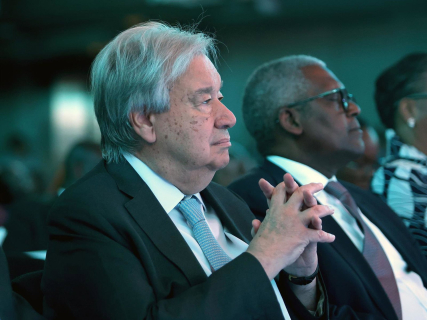
The UN Security Council has once again put one of the open fronts in the Iran war on the table: the Strait of Hormuz. The Secretary-General of the United Nations, António Guterres, has called for the "immediate" reopening of this maritime passage, key for the global transit of crude oil and has warned that its blockade could trigger a global energy crisis, serious disruptions to trade, and a direct impact on global food supply.
During a Security Council session held this Monday under the presidency of Bahrain, Guterres has warned that the situation represents one of the biggest risks to the international economy since the pandemic and the war in Ukraine.
“The world cannot afford a prolonged interruption of this strategic route”, has underlined the UN leader, who has insisted to the parties involved in the conflict to guarantee freedom of navigation and allow the safe passage of commercial vessels.
Trump studies Iran's peace plan
Meanwhile, this Monday different news agencies and media outlets have reported on a three-phase peace plan presented by Iran to the United States. The proposal would include the guarantee of a cessation of hostilities, both in Iran and Lebanon, as well as addressing the management of the Strait of Hormuz.
Thus, the president of the United States, Donald Trump, is currently analyzing this initiative from Tehran with his National Security team, prioritizing the reopening of the maritime passage over issues such as the Iranian nuclear program, as demanded by the Islamic Republic.
The White House spokeswoman, Karoline Leavitt, has indicated that the matter has been addressed in a high-level internal meeting held this Monday, although she has avoided anticipating conclusions on the administration's definitive stance.
“There has been a conversation this morning, but I am not going to get ahead of the decisions,” Leavitt stated at a press conference from the executive residence, underlining that “the president’s red lines regarding Iran are clearly defined”.
Six oil tankers, forced to turn back
This Monday, six oil tankers carrying Iranian crude have been forced to turn back after being unable to cross the strait due to the naval blockade by the United States.
According to the Reuters agency, the ships had sailed from ports in Iran but have not managed to complete their route to the international market, as the US Navy would be restricting traffic to and from Iranian facilities in the area.
In recent days, transit through this strategic corridor has been significantly reduced. Only seven ships have managed to cross it in one day, according to the platforms Kpler and SynMax, and none of them were carrying Iranian crude destined for global export.
Among the vessels that have passed is the raw materials freighter Bavand, along with other ships originating from Iranian ports, although without oil cargo for the international market, in a context of growing tension in one of the world's most important energy routes.
"Open the strait. Allow trade to resume. Let the world economy breathe. This moment calls for moderation and dialogue," Guterres has demanded. On another note, the UN Secretary-General has also warned of the deterioration of the global arms control system during a meeting linked to the Treaty on the Non-Proliferation of Nuclear Weapons, warning that international commitments are weakening and trust between nuclear powers continues to erode.
The IMO warns that any toll lacks a legal basis
The International Maritime Organization has once again warned that any attempt to impose a toll for transit in the Strait of Hormuz lacks international legal basis.
In a press conference held at the organization's headquarters in London, its secretary general, the Panamanian Arsenio Domínguez, stressed this Monday that freedom of navigation is non-negotiable and that no State can obstruct passage in international maritime corridors such as Hormuz.
Domínguez has insisted that there is no legal backing to establish taxes, fees, or tolls on international navigation, in a context in which Tehran had assured the start of charges to ships transiting the area, supposedly deposited in the Iranian Central Bank.
The impact of the blockade is already reflected in the volatility of energy markets, the increase in maritime transport costs, and the rise in insurance prices. The United Nations has warned that the most vulnerable countries would be the least developed, especially in Africa and South Asia, with a risk of worsening food insecurity.
The humanitarian situation in the area is also a concern. More than 20,000 sailors remain stranded and thousands of commercial vessels continue to be trapped by restrictions, amid growing global logistical tension.
US asks Security Council for a coalition to guarantee strait security
For his part, the United States ambassador to the United Nations, Mike Waltz, has proposed before the Security Council the creation of an international coalition to guarantee the security of ship traffic through the strait, including demining operations of the maritime route.
During his speech, Waltz stated that the US military has already begun to act to remove possible mines and secure passage, although he insisted that the situation requires a multilateral response. “The time has come to create a coalition of like-minded countries with the real capacity to support and protect freedom of navigation,” he pointed out.
The diplomat has also assured that mines have been placed "indiscriminately" in the area and has accused Iran of acknowledging these facts.
Victim Balance
The victim toll in Lebanon after the attacks attributed to Israel has risen to 2,521 dead, twelve more than in the last count, despite the ceasefire agreed between both parties and which theoretically remains in force until mid-May.
According to data from the Emergency Operations Center of the Lebanese Ministry of Health, since March 2, 7,804 people injured have also been counted in the context of the escalation of violence.
During Monday's session, new bombings have been registered in the south of the country, with air and artillery attacks against several towns, including Yater, Kafra, Maydal Selem, Touline, and Kfar Chouba, according to the Lebanese National News Agency.
In parallel, the Shiite group Hezbollah has claimed attacks against an Israeli tank in the Qantara area and against an excavator in Bint Yebeil, in an area of the south of the country that remains under Israeli military control despite the truce agreement.