
The war between United States and Iran continues to worsen both on the military and economic front. The Pentagon has raised the cost of the military campaign developed since February 28 to 37.5 billion dollars and has requested from Congress 67 billion dollars additional to maintain operations and replenish the arsenal used in recent months.
The announcement comes at a particularly delicate moment for the Trump Administration, which faces an increase in military casualties, growing pressure on energy markets, and a conflict whose economic bill threatens to become one of the main political fronts ahead of the midterm elections.
Trump hardens his rhetoric after the death of another soldier
The Pentagon's request coincides, however, with a new message of toughness from the U.S. president. Shortly before participating in a tribute to four soldiers who died in attacks attributed to Iran, Trump issued a new warning to the Iranian regime this Wednesday. "They are going to pay very dearly. We are already annihilating them", the president stated.
With the confirmation of a new military casualty in Iraq after the impact of an Iranian drone, the number of U.S. soldiers killed since the beginning of the offensive has risen to 18, while nearly a hundred have been injured in recent weeks, according to data from the Department of Defense.
The military escalation has reinforced the White House's position to maintain the campaign without requesting a new specific authorization from Congress, a matter that has sparked debate during the appearance of Defense Secretary Pete Hegseth before the Senate Appropriations Committee.
The Pentagon admits that the war will be much more expensive than expected
During his intervention in the Senate, Hegseth acknowledged that the duration of the conflict has forced a significant revision of the initial forecasts.
At the beginning of May, the Pentagon estimated that the war would cost 29 billion dollars. Barely two months later, that figure has increased to 37.5 billion, an increase of 8.5 billion that reflects the prolongation of military operations.
The Defense official has also defended the need to approve a new budget injection.
"Without these funds, we face critical shortages", he assured before the senators, justifying the request for new resources to sustain the military deployment in the Middle East.
The request is part of the Defense budget pushed by the Trump Administration, which contemplates a total expenditure of 1.5 trillion dollars, to which extraordinary funds specifically allocated for the war are added.
The economic cost goes far beyond military spending
The bill for the war is not limited solely to the Pentagon's budget.
Economic analyses point out that, if the impact caused by the rise in oil prices, raw materials, maritime transport, and interest rates is included, the total cost to the U.S. economy could reach 132 billion dollars.
This impact is beginning to be felt directly by American companies and consumers through higher energy costs, increased fuel prices, and new inflationary pressures.
All of this threatens to complicate Trump's economic strategy with only a few months left before legislative elections that could alter the balance of power in Congress.
Hormuz and Bab al-Mandeb: the threat over two arteries of global trade
One of the factors that most concerns international markets is the situation in the two major straits through which a large part of global energy trade flows.
The Strait of Hormuz, under constant tension since the beginning of the conflict, channels approximately 20% of the oil consumed in the world. The partial interruption of maritime traffic had already forced numerous companies to modify their routes.
Now the situation is becoming even more complicated. In recent hours, threats over the Strait of Bab al-Mandeb have also increased, a route through which around 12% of global maritime trade and nearly 6% of global oil transit.
This corridor had precisely served as an alternative for part of the crude oil that faced difficulties crossing Hormuz.
However, the growing insecurity in the area is already having immediate consequences. At least six tankers have turned back in recent hours due to the deterioration of the situation, while numerous shipping companies are considering rerouting their paths.
The alternatives now involve using the Suez Canal, with a more limited capacity, or completely circumnavigating the African continent via the Cape of Good Hope, an option that implies much longer routes, higher logistical costs, and delays in supply.
An increasingly expensive and unpopular war
The geopolitical uncertainty is already reflected in the energy markets. The price of Brent oil has surpassed 95 dollars per barrel, its highest level since June, while natural gas in Europe has reached 62 euros per megawatt hour, highs of the last four months.
During his appearance, Pete Hegseth also stated that China and Russia are providing support to the Iranian regime "at different levels," although he avoided specifying the extent of that collaboration.
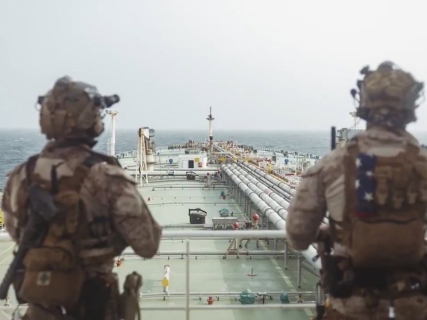
The Secretary of Defense has also confirmed that the U.S. Navy has been conducting an operation since May to ensure commercial navigation in the Strait of Hormuz, a mission that, as he explained, has facilitated the transit of hundreds of millions of barrels of oil despite the military escalation.
Five months after the start of the offensive, the Trump Administration is facing an increasingly complex scenario.
The constant increase in military spending, the rise in American casualties, the pressure on energy markets, and the rising cost of living are fueling the debate about the advisability of maintaining a war that, far from stabilizing, continues to expand its economic and strategic impact.
While Washington requests more funds from Congress to sustain operations, the evolution of the conflict in the Middle East threatens to become one of the main political challenges for Trump in the lead-up to the midterm elections.