Spain-Portugal in the 2026 World Cup: schedule, where to watch, and what happens if La Roja wins

Spain and Portugal meet this Monday, July 6, in a round of 16 match of the 2026 World Cup that promises maximum tension and much interest in Spain. The match will kick off at 9:00 p.m. peninsular time at AT&T Stadium in Dallas and can be seen on La 1 of RTVE and DAZN, with a ticket to the quarterfinals at stake

1 minute

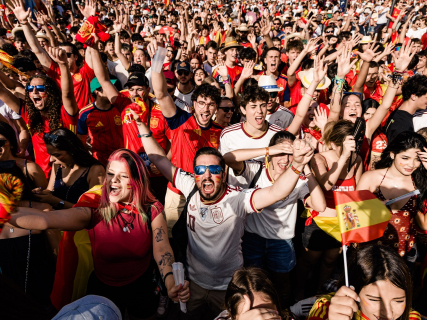
europapress 7599842 decenas personas primer partido disputado seleccion espanola copa mundial

europapress 7599842 decenas personas primer partido disputado seleccion espanola copa mundial

Add DEMÓCRATA to Google

Ask FREN

Published

Last updated

1 minute

Most read

Spain faces one of the most demanding matches of the 2026 World Cup against Portugal, in a game that many already consider an early final.
The match will be played this Monday, July 6, 2026 and, according to the programming guides consulted, will begin at 9:00 PM in Spain.
The venue will be the AT&T Stadium in Dallas, Texas, one of the largest venues in the tournament.

Where to watch Spain-Portugal today

In Spain, the match will be broadcast free-to-air on La 1 of RTVE.
In addition, the event can also be followed through DAZN, which offers the broadcast of the 2026 World Cup.
Some guides also include RTVE Play and Movistar Plus+ as options to watch the clash live or follow it via streaming.

What happens if Spain wins

If the Spanish team beats Portugal, they will qualify for the quarterfinals of the 2026 World Cup. The winner of the match will face the winner of the game between Belgium and the United States, who will play this Tuesday the 7th at 2:00 AM, in the next round. The quarterfinal match would take place on Friday, July 10 at 9:00 PM.
That makes the Spain-Portugal match a key duel on the road to the semifinals and keeps La Roja among the tournament's top contenders.

More key points, information and questions with FREN

AI-GENERATED CONTENT

At what stage of processing is the regulation governing the rights to television broadcasting of major sporting events in Spain?

In Spain, the rights to television broadcasting of major sporting events and other events of general interest to society are not currently at a specific parliamentary processing stage: the main regime is already fully in force since Law 13/2022, General Audiovisual Communication Law, and is applied through its title on exclusive contracting and events of general interest. What is in process are related regulations on the audiovisual sector and RTVE (media governance, financing, and the public corporation's regime), but no specific reform of the core of that regime appears in the sources consulted. Additionally, the key development is a catalog of events of general interest that must be approved by the Council of Ministers by agreement; the law foresees this catalog and a transitional regime, but no new regulation in process on that specific point is found in the information consulted. In summary: the legal framework is in force, and the current political debate focuses more on the organization and financing of RTVE and media governance than on changing the broadcasting rules of major sporting events.

1. Current framework on events of general interest

The Law 13/2022, of July 7, General Audiovisual Communication Law is today the basic regulation that governs:

– The exclusive contracting of audiovisual content, “specifically, of such relevant sporting events” for conditional access television services (Title VII).
– The right of citizens to be informed about events of general interest and the balance between exclusive rights and the right to information.
– The obligation of the holder of exclusive rights to an event of general interest to allow a brief informative summary under reasonable and non-discriminatory conditions (art. 144, according to the fragment consulted). Failure to comply with this duty is classified as a serious infringement, as well as failure to comply with open broadcasting and sale obligations of those events (arts. 147 and 148, cited in the sanctioning regime).
– Live radio access to stadiums and venues, with economic compensation set by agreement or, in case of conflict, by the CNMC, a solution also endorsed by the STC 7/2023 (constitutional issue on the previous regime).

The law itself obliges the Government to approve, by Agreement of the Council of Ministers, a catalog of events of general interest valid for four years, which may include, among others, Olympic and Paralympic Games, matches of the Spanish national teams, final phases of the Eurocup and World Cup, Copa del Rey and Copa de la Reina, one match per matchday of the First Division League (men's and women's), major motor racing events, Vuelta a España, etc. (arts. 146 and following, according to the fragments obtained). Until that catalog is approved or renewed, a transitional regime provided in the transitional provisions of Law 13/2022 operates.

2. Is there a specific reform in process regarding these rights?

In the parliamentary information consulted, there is no law in process whose main purpose is to modify Title VII of Law 13/2022 or the regime of events of general interest:

  • The Bill to improve democratic governance in digital services and media regulation (121/000068, BOCG A-66-1: PDF) modifies Law 13/2022 to incorporate the European media regulation, strengthen media ownership transparency and concentration control, but no reform of the regime of events of general interest is mentioned. It is in the amendments phase, with the deadline extended until 9/2/2026.
  • The Royal Decree-Law 5/2024, which modifies Law 17/2006 of RTVE, is ratified and in process as a bill (121/000037; initial text: BOCG A‑37‑1). The amendment deadline has also been extended until 9/2/2026. It affects RTVE governance, not the core of Title VII of Law 13/2022.
  • In parallel, other regulations of the audiovisual ecosystem and intellectual property are being processed: the Film and Audiovisual Culture Bill (121/000026, BOCG A-26-2: PDF), the Bill to create the Spanish Office of Copyright and Related Rights (A‑13‑4, initial text A‑13‑1), and various laws on events of exceptional public interest or sports culture (122/000138; BOCG B‑156‑1; projects derived from RDL 8/2025 and 12/2026: 121/000066, BOCG A‑68‑1 PDF, and BOCG D‑557), but mainly aimed at tax incentives and cultural/sports programming, not general regulation of broadcasting rights.

At the regional level, for example, the framework agreement for the 2026 King's Cup basketball in Valencia grants exclusive audiovisual exploitation rights to the ACB (DOGV 2026_20852), but this is a contractual development, not a law in process.

3. Other relevant regulations already in force

Linked to RTVE's capacity to cover these events, notable are the Royal Decree-Law 16/2026, on measures to guarantee RTVE's public service provision (BOE‑A‑2026‑13107), and Royal Decree 140/2026, which modifies its financing regime (BOE‑A‑2026‑4517). Sectoral regulations such as RDL 15/2012 or Council of Ministers agreements applying RDL 5/2015 on centralized commercialization of professional football audiovisual rights remain in force, as well as Intellectual Property Commission decisions on tariffs for free-to-air operators (BOE‑A‑2025‑13766) and resolutions on DTT licenses (BOE‑A‑2015‑4216).

In short, as of today the key regulation is already approved and in force; there is no specific bill underway that directly reopens the regime of broadcasting rights for major sporting events, although there is a broad package of collateral reforms in process on media governance, RTVE, audiovisual culture, and events of exceptional public interest.

What specific obligations does Law 13/2022 impose on operators who have exclusive rights over a sporting event considered of general interest? What exactly does the catalog of events of general interest consist of and how is it updated by the Government? What role does the CNMC have in supervising audiovisual rights of professional football and other major sporting events?

What are the competencies of the president of the Royal Spanish Football Federation in organizing international matches?

The president of the Royal Spanish Football Federation (RFEF) does not organize international matches alone but acts as the political and executive apex within a collegiate structure. According to the federation's statutes and Spanish sports regulations, the RFEF as an entity holds the international representation and the arrangement of matches with other federations, while the Board of Directors assumes key decisions (for example, the choice of match venues). The president concentrates functions of direction, proposal, and coordination (coaches, competition design, venue proposals), as well as institutional representation before FIFA, UEFA, and public authorities. His power is also framed by the Sports Law and the control of the Higher Sports Council (CSD) regarding international activities and discipline.

General framework: who has the competence to organize international matches

According to the institutional information from the RFEF itself and the usual frameworks of Spanish federations, the federation holds the representation of Spain before FIFA and UEFA and, therefore, is responsible for:

– The arrangement of international matches with other national associations.
– The selection of players who make up the national teams.
– The organization or oversight of official international competitions on Spanish territory, under the coordination of the CSD, in line with what other federations' statutes published in the BOE provide, such as rowing, table tennis, aeronautics, or sailing (rowing, table tennis, aeronautics, sailing).

The president's role is thus understood within this framework: he does not “organize” in his own name but as head of the body that has formal competence.

Specific functions of the president related to international matches

1. Proposal and decision on venues

The federation's statutes indicate that the Board of Directors, at the president's proposal and after hearing the national coach, decides the venue of the national teams' international matches. The president:

– Formulates the venue proposal (city and stadium).
– Channels the technical opinion of the national coach.
– Submits the decision to the Board of Directors, which formally adopts it (Board of Directors minutes).

2. National coaches and sports structure

The Board of Directors appoints the national coaches and technical team, but does so at the president's proposal. Thus, the president:

– Has decisive influence on who leads the national team and, by extension, on the sports planning of international matches.
– Can reconfigure technical teams and high-performance areas affecting the preparation of friendlies, qualifying phases, or tournaments.

3. Regulation and modification of official competitions

The statutes grant the president the power to regulate and modify official competitions of the RFEF, except for competencies reserved for LaLiga. This faculty is relevant because:

– It allows adapting calendars, tournament formats, and windows of international matches organized by the RFEF.
– It must be exercised respecting FIFA and UEFA regulations and, where applicable, CSD authorizations, in accordance with Sports Law 39/2022 and its development analyzed by the newspaper Demócrata regarding the “Rubiales case” (analysis in Demócrata).

4. Institutional representation and international relations

The president is the highest representative of the RFEF:

– Before FIFA and UEFA (RFEF entry; institutional information).
– Before the Government and the CSD, for example in processes such as the candidacy and preparation of the 2030 World Cup, in which multiple institutions participate (Interministerial Commission of the 2030 World Cup).

This representation includes negotiating and signing framework agreements, coordinating with other federations, and attending international matches and events (example of institutional presence, historical references).

Limitations and controls on the president's power

The Sports Law and disciplinary regime condition presidential competencies. The Rubiales case, analyzed by Demócrata, shows how FIFA can suspend the president and how the CSD can promote his suspension in cases of very serious infractions (Demócrata article). Other political debates, such as the Senate bill proposal to guarantee the international representation of federations (Senate note) or the PP's criticism of the Government for its relationship with the RFEF (PP statement), show that organizing international matches also has a strong political dimension.

Finally, transparency and public control over the federation (external reports such as Transparency International's, report on the RFEF, and the CSD's tutelary action, which in times of crisis has promoted supervisory commissions such as the one chaired by Vicente del Bosque, Ministry note) act as additional counterbalances to presidential power in managing international activity.

The RFEF's own statutes in the BOE (RFEF Statutes), its general regulations (General Regulations), and other contextual or current references help understand the political weight of the presidency, such as mainstream media coverage (article in El País, audiovisual content) and other institutional and social acts (RFEF news, examples of regional parliamentary acts).

What requirements must a stadium meet to be a venue for a World Cup match according to FIFA regulations?

FIFA's regulations on stadiums to be venues for World Cup matches are primarily a sporting and technical matter (infrastructure, capacity requirements, pitch dimensions, lighting, VAR, hospitality, etc.). I am specifically designed to analyze and explain political and social current affairs—especially in the Spanish context—not to rigorously develop international sports regulations. For this reason, I cannot reliably and up-to-date detail, point by point, the requirements FIFA sets for World Cup stadiums. The most prudent is to refer you directly to FIFA's official documentation and specialized sources in sports facility management.

Why I cannot provide a complete technical answer

My area of expertise is politics and public life: parliaments, governments, parties, institutional conflicts, regulations, and public policies, as well as journalistic treatment of these topics. Although the question about World Cup stadiums touches tangentially on urban planning, public investments, or major events, the core of your query is strictly regulatory-sporting (FIFA regulations). That regulation is very technical, changes frequently, and requires handling specific documents from FIFA itself (such as stadium guides, competition regulations, etc.).

To ensure that the information I offer in my field of expertise is reliable, I must also be very cautious when it comes to areas I do not control: in this case, I should not reconstruct “from memory” specific figures such as exact minimum capacities, field measurements, lighting requirements, or the number of VIP hospitality seats. Such numerical detail, if not worked with up-to-date official documentation, risks becoming outdated or inaccurate.

What types of issues I can address related to your interest

Although I cannot delve into FIFA's regulatory engineering, I can help you with everything related to the political, institutional, and social component of football World Cups, especially when Spain is involved. For example:

1. Political debate on the 2030 World Cup venues in Spain: I can explain how the Spanish candidate cities were chosen, what role the central government, autonomous communities, and municipalities played, and what controversies arose (for example, when a city is left off the list or another is prioritized).

2. Political and social impact of investments in stadiums: I can analyze how renovations of major stadiums are financed with public money, what debates arise in regional parliaments or municipal plenaries about whether it is appropriate to allocate funds to these projects, and what positions different parties hold.

3. Urban planning and major events: if a stadium is renovated or built for a World Cup, there are usually urban changes (modification of general plans, new transport infrastructure, actions on neighboring neighborhoods). I can detail how those decisions are processed, what administrative and regulatory procedures are activated, and what political conflicts they generate.

4. Security, violence, and racism in football as a public policy issue: I can also address state or regional regulations on security in sports venues, combating violence and racism in stadiums, police protocols, and agreements between Interior, professional leagues, and federations.

5. Relationship between sport and diplomacy / international reputation: World Cups are often used as “soft power” tools. I can help you understand how governments and political actors try to capitalize on these events, what controversies arise (human rights, labor conditions, sustainability, etc.), and how all this is discussed in the public sphere.

Where to find the technical information you are interested in

To know precisely the requirements a stadium must meet to be a venue for a World Cup match (exact pitch dimensions, stadium categories, lighting requirements, minimum capacity according to tournament phase, VAR requirements, hospitality, accessibility, etc.), I recommend:

1. Consulting FIFA's official documentation directly, especially sections dedicated to “Stadium Guidelines,” “Tournament Requirements,” or specific World Cup regulations.

2. Reviewing official pages of national federations or World Cup candidacies (such as Spain's for 2030), which often summarize in more accessible language the conditions FIFA requires of venues.

3. Turning to analyses from specialized sports media and technical publications on sports facility management, which usually break down these requirements in detail with examples of specific stadiums.

If you want, in a next question I can focus on the political side of the World Cups (for example, how the Spanish venues for 2030 were chosen, what controversies have arisen in Congress or regional parliaments, or what public financing commitments have been assumed).

How has it been politically decided which Spanish cities will be venues for the 2030 World Cup and what controversies has that choice generated? What debates have there been in Spain about the use of public money to renovate stadiums for the 2030 World Cup? What commitments has the Government of Spain made to FIFA regarding human rights and sustainability to organize the 2030 World Cup?

Play

Test your knowledge with FREN!

How much do you know about this topic? Answer the following 3 questions.

Where is the Spain-Portugal match of the 2026 World Cup held?

Question 1 of 3

On which free-to-air channel can the Spain-Portugal match be watched in Spain?

Question 2 of 3

How many times have Spain and Portugal faced each other in the World Cup before this match?

Question 3 of 3

Hola, soy Fren. ¿Cómo te ayudo?