CIS of July: PSOE extends its lead over PP to eight points and Vox remains above 15%

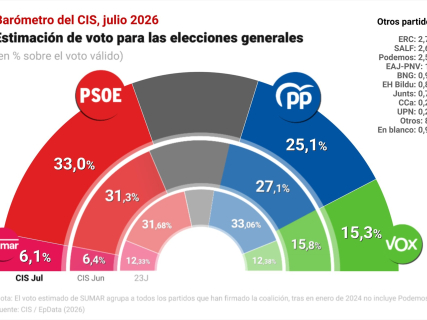
The CIS July barometer places the PSOE at 33% of the vote, compared to 25.1% for the PP and 15.3% for Vox. Sumar reaches 6.1% and Podemos remains at 2.5%

2 minutes

EuropaPress 7665763 infografia estimacion cis julio 2026 psoe sube 17 puntos estimacion voto

EuropaPress 7665763 infografia estimacion cis julio 2026 psoe sube 17 puntos estimacion voto

Add DEMÓCRATA to Google

Ask FREN

Published

Last updated

2 minutes

Most read

The PSOE would win general elections again with 33% of the votes and would widen its lead over the PP to 7.9 points, according to the electoral estimate from the July 2026 barometer of the Center for Sociological Research (CIS).

The study places Pedro Sánchez's party as the leading political force, followed by the PP, which would obtain 25.1%, and Vox, which would remain in third position with 15.3%.

The survey reflects a recovery for the socialists and a setback for the popular party compared to the CIS barometer from June. The PSOE gains 1.7 points, from 31.3% to 33%, while the PP loses two points, from 27.1% to 25.1%.

The gap between the two major parties, which was 4.2 points in June, practically doubles in July to reach 7.9 points.

Vox drops slightly and remains above 15%

Vox continues to be consolidated as the third political force. Santiago Abascal's party would obtain 15.3% of the votes, five tenths less than in June, when it reached 15.8%.

The sum of PP and Vox would thus stand at 40.4% of the votes. To these results could be added the 2.6% that the CIS attributes to Se Acabó la Fiesta, the formation led by Luis ‘Alvise’ Pérez, which improves by seven tenths compared to the previous month.

Sumar exceeds 6% and Podemos falls to 2.5%

To the left of the PSOE, Sumar would reach 6.1% of the votes. The estimate groups the parties that signed the 2023 electoral coalition, with the exception of Podemos.

The purple formation would run separately and obtain 2.5%, three tenths less than in June. The sum of PSOE, Sumar, and Podemos would reach 41.6% of the valid vote, although the CIS does not offer an estimate of seats nor does it allow for the determination of possible parliamentary majorities.

Party Vote Estimate
PSOE 33.0%
PP 25.1%
Vox 15.3%
Sumar 6.1%
ERC 2.7%
Se Acabó la Fiesta 2.6%
Podemos 2.5%
PNV 1.0%
BNG 0.9%
EH Bildu 0.8%
Junts 0.7%
Coalición Canaria 0.2%
UPN 0.2%
Other parties 8.0%
Blank vote 0.9%

ERC leads Basque and Catalan nationalist parties

Among the territorial formations, ERC appears as the force with the greatest support, with 2.7%. Behind it are PNV, with 1%; BNG, with 0.9%; EH Bildu, with 0.8%; and Junts, with 0.7%.

Coalición Canaria and UPN would each obtain 0.2%. The set of parties grouped by the CIS under the category of "others" would concentrate 8% of the valid vote.

The PSOE also clearly leads in direct vote

The socialist advantage also appears in the direct vote declared by respondents, before applying the CIS estimation model. 25.4% state they would vote for the PSOE, compared to 18.6% who lean towards the PP and 11.5% who would opt for Vox.

Sumar registers 4.4% of direct vote, while Se Acabó la Fiesta obtains 2% and Podemos 1.8%.

14.1% of respondents still do not know which party they would vote for, 5.7% state they would abstain, and 2.3% prefer not to answer.

The study was prepared from 4,020 interviews. The CIS specifies that its estimation refers to the moment the data was collected and is not prospective. The organization uses its so-called two-dimensional "inertia-uncertainty" model to calculate electoral support for each party.


More key points, information and questions with FREN

AI-GENERATED CONTENT

What are the next steps in the parliamentary processing of a possible electoral reform following these CIS results?

After certain CIS results, no parliamentary procedure to reform the electoral law is automatically opened; the next step is always for someone to exercise legislative initiative. From there, the processing will depend on whether the reform is proposed as a Government bill or as a parliamentary group bill, both in the Congress and the Senate. In all cases, these are initiatives aimed at creating, modifying, or repealing laws, unlike non-legislative motions, which only have political effects. The following explains in general terms what could happen in each scenario.

1. Starting point: from the CIS to legislative initiative

CIS barometers and studies can politically influence because they provide parties with information about public opinion, institutional evaluation, or electoral preferences. However, these results have no direct legal effects: only if the Government or one or more parliamentary groups decide to transform that debate into a normative proposal does a formal procedure begin.

Therefore, the first real “next step” would be one of these:

  • That the Government approves in the Council of Ministers a bill for electoral reform and submits it to the Congress of Deputies.
  • That one or more parliamentary groups register a bill for electoral reform in the Congress or the Senate.
  • That non-legislative motions (PNL) are presented to urge the Government to promote a reform, although these do not change the regulations by themselves.

2. If the reform comes from the Government: bill

If the Government decides to promote an electoral reform, it acts through a Government legislative initiative, called a bill. According to available information, the basic scheme is as follows:

  • Approval in the Council of Ministers: the Government drafts the text and formally approves it as a bill.
  • Submission to the Congress: once approved, it is sent to the Congress of Deputies for parliamentary processing as a law. From that moment, the bill follows the legislative process in the Lower House.
  • Parliamentary debate and vote: the bill is discussed and voted on in the Chambers. If approved, it becomes law and the electoral reform becomes legally binding.

The key here is that the Government assumes leadership of the reform and that the procedure always starts with a decision by the Council of Ministers, which then depends on parliamentary majorities to succeed.

3. If the reform comes from the Congress: bill

If the initiative does not come from the Government, the usual procedure would be a bill presented by one or more parliamentary groups or deputies. According to available information, these are its general characteristics:

  • Who presents it: parliamentary groups, deputies, the Senate itself, regional assemblies, or popular initiative.
  • Presentation in the Congress: it is registered directly in the Congress of Deputies.
  • Processing similar to a bill: the bill follows a process “similar to that of bills,” with debates and votes that may lead to its approval as law.

Applied to a possible electoral reform, this means that, after the CIS results, a group could decide to register a bill to modify the electoral regulations, and from that moment the text would follow the ordinary parliamentary processing in the Congress and, if applicable, in the Senate.

4. If the initiative starts in the Senate

The Senate can also promote a bill. In general terms, the scheme is the same: it is a legislative initiative aimed at creating, modifying, or repealing laws, presented in the Senate and “follows a process similar to that of bills.” After its approval in the originating Chamber, it must pass to the other Chamber to complete its parliamentary processing.

In this context, if the Senate detects, based on public debate and CIS data, the need to adjust electoral legislation, one or more groups could promote a bill there. Again, the key step is converting that debate into a formal registered text that can be submitted to debate and vote.

5. Non-legislative motions (PNL) as a prior political step

A more immediate effect of CIS results could be the presentation of non-legislative motions in the Congress or Senate. These are “debated and voted on in the Congress or committees but have no normative character”: they serve to urge the Government to present a bill or to politically position groups on the advisability of an electoral reform.

In conclusion, after the CIS results, the next steps are not legally predetermined: they depend on whether the Government or the groups make the leap from political discussion to legislative initiative (bill or proposal), which is what really opens parliamentary processing for an electoral reform.

What political and practical differences exist between processing the electoral reform as a Government bill or as a parliamentary group bill? What parliamentary majorities would be necessary to pass an electoral legislation reform in the Cortes Generales? What role can non-legislative motions and parliamentary debates after a CIS play in pushing an electoral reform?

What powers does the president of the CIS have and what is his professional background?

The president of the Sociological Research Center (CIS) is currently the sociologist José Félix Tezanos Tortajada, appointed by the Government on June 29, 2018, by royal decree. His powers focus on the senior management of the organization, institutional representation, study programming, and relations with the Cortes Generales, as well as budget and personnel management. His career combines a long academic career in Sociology with significant organizational involvement in the PSOE, which has generated intense political debate about the CIS's independence and has even led to a Senate investigation committee.

Who is the president of the CIS and since when

According to the appointment royal decree published in the BOE, Tezanos was appointed president of the CIS on June 29, 2018, at the proposal of the new socialist Government of Pedro Sánchez, through Royal Decree 771/2018, of June 29 (BOE 2018). The CIS is an autonomous body attached to the Ministry of the Presidency, Justice and Relations with the Cortes (article about the CIS), dedicated to producing reference surveys and sociological studies in Spain.

A chronology collected by the newspaper Demócrata also places the start of his mandate on that date: “June 29, 2018, José Félix Tezanos is appointed president of the CIS” in the context of the PSOE coming to power (Demócrata article), and identifies him as the active president during the investigation committees held in 2024 and 2025.

Powers and functions of the CIS Presidency

The president's powers derive from its organization law and organic statute (Royal Decree 1214/1997 and subsequent regulations), and are summarized, according to the official description of the presidency itself (CIS organizational chart), in several major blocks:

  • Senior management and internal coordination: directs the organization, promotes and coordinates all its services, and chairs the CIS Advisory Council meetings, which guide the planning of sociological studies.
  • Institutional representation: holds official representation of the CIS before public administrations, universities, research centers, and private entities, both in Spain and abroad.
  • Study programming and annual report: prepares the annual activity program (barometers, monographic studies, pre-electoral surveys, etc.), coordinates its execution, and approves the activity report submitted later to Congress and Senate.
  • Relations with the Cortes Generales: sends completed studies to Congress, Senate, and regional parliaments, and in the case of voting intention and political climate surveys, provisional result advances for institutional dissemination.
  • Budget and financial management: proposes the organization's draft budget, directs its execution, orders expenses and payments within the limits set by its statute, and accounts for budget execution.
  • Personnel and structure: proposes to the competent minister the appointment of the secretary general and department directors, and exercises senior personnel functions of the autonomous body.
  • Contracting and agreements: contracts on behalf of the CIS the necessary work and services for conducting surveys and studies, and signs cooperation agreements with universities and other entities dedicated to social research.
  • Methodological and technological promotion: approves computerization projects, databases, and technical tools that allow exploiting and disseminating survey microdata.

These functions place the Presidency as a key piece both in the study agenda (what is researched and when) and in the public projection of results, which explains its notable political relevance when sensitive barometers are published, for example, in pre-electoral periods.

Professional background of José Félix Tezanos

Tezanos's biography, collected from various open sources (Tezanos profile), defines him as a sociologist, politician, writer, and university professor. Born in Santander in 1946, he has been a professor of Sociology and has developed extensive research work in the social sciences field.

Politically, he maintains a long connection with the PSOE. He held the Secretariat of Studies and Programs of the Federal Executive and positions of responsibility in training within the party. After his appointment as president of the CIS in 2018, he requested suspension of his organizational functions in the socialist leadership to focus on the demoscopic organization.

His tenure at the CIS has been subject to intense parliamentary scrutiny. The Senate, with a PP majority, promoted in 2024 an investigation committee on his management (Demócrata news). In that context, he has been accused of “institutional corruption” and methodological bias in favor of the PSOE, while he has repeatedly defended his independence before the Upper Chamber and framed the criticisms as a “political strategy,” as recorded in both parliamentary records (Senate session diary) and various journalistic analyses (analysis about the CIS, information about reform of requirements).

Institutional context and public perception

The CIS, as its own institutional documentation and reference works recall (encyclopedic entry, CIS Presidency page), combines a technical-scientific mission with a strong impact on political competition. Under Tezanos's presidency, this dual profile has intensified: on one hand, broad social diagnosis reports have been promoted; on the other, pre-electoral barometers have been used by Government and opposition as political ammunition, fueling debate about whether survey design and its “cooking” respond strictly to scientific criteria or also strategic ones.

In parallel, proposals have been made to strengthen the independence of the Presidency, such as preventing people with recent political responsibilities from holding the position or attaching the organization directly to the Cortes. Until these reforms are approved, the CIS president remains a senior trusted Government official, with decisive influence on how public opinion is measured and interpreted in Spain.

Other contextual materials and previous CIS stages can be consulted in the following resources: a general overview of the organization (CIS summary), the Presidency profile on the official website (CIS Presidency), previous biographies and audiovisual materials (academic content, institutional profile, informative video) and chronicles about other presidents such as Cristóbal Torres or Félix Requena (Cristóbal Torres profile).

How is the president of the CIS appointed and how long is the term according to current regulations? What main conclusions did the Senate approve in the investigation committee on Tezanos's management of the CIS? What proposals are on the table to change the CIS president's election system and strengthen its independence?

What legal requirements must the CIS meet for the preparation and publication of its electoral barometers?

The CIS prepares and publishes its barometers (including electoral ones) as an official State statistical service and, therefore, is simultaneously subject to its own organic law, the Public Statistical Function Law, data protection regulations, and, when elections are called, the Organic Law of the General Electoral Regime (LOREG) and the instructions of the Central Electoral Board (JEC). In practice, this translates into obligations of objectivity and neutrality, statistical secrecy and anonymization, public access rules to microdata, and specific limits during electoral periods (prior communication to the JEC, delivery deadlines to parties, prohibition of publishing polls in the final stretch of the campaign). Additionally, reform proposals are underway to further restrict the CIS's capacity regarding vote estimation, but these are not yet in force.

1. Basic legal framework of the CIS as a statistical body

The CIS statute is set in three key normative pieces:

  • Law 39/1995, on the Organization of the CIS, which defines the CIS as an autonomous body with the purpose of scientific study of Spanish society and imposes principles of objectivity, neutrality, equal access to its data, and respect for statistical secrecy and citizens' rights. See Law 39/1995.
  • Royal Decree 1214/1997, on the organization of the CIS, amended by Royal Decree 485/2022, which specifies that the CIS is an official statistical service of the General State Administration and that its actions are governed, among others, by Law 12/1989, on the Public Statistical Function, Regulation (EU) 2016/679 (GDPR), and Organic Law 3/2018.
  • Law 12/1989, on the Public Statistical Function, which regulates data collection, processing, conservation, and dissemination, with extensive regulation of statistical secrecy and the obligation to anonymize disseminated data (Law 12/1989).

Law 39/1995 also details specific rules for survey studies: voluntariness of responses on sensitive issues; transparency towards the interviewee (who conducts the study and for what purpose); use of information only for CIS research purposes; and personal data protection at all stages. Results must enter the CIS data bank once the technical process is completed, and information is made publicly available after verification, cleaning, and anonymization within the deadlines set by law.

External access to macro and microdata is arranged through the CIS data bank, regulated by Order PRE/3188/2008: files are provided already anonymized, with limits on third-party transfer and commercial use, and an obligation to cite the source.

2. Specific rules when elections are underway: LOREG and JEC Instruction 1/2024

When an electoral process is underway, barometers including voting intention are also subject to LOREG and JEC instructions:

  • LOREG, article 69: regulates electoral surveys and requires that, between the call and the voting day, all poll publications be accompanied by a technical sheet (who commissions and conducts the study, technical characteristics, full text of questions, and number of responses). The basic text is in the LOREG.
  • Prohibition of publication during the “silent campaign”: LOREG itself prohibits disseminating electoral surveys in the last days before voting (the five days prior), which also affects the CIS if it tries to publish in that time frame.
  • JEC Instruction 1/2024, on voting intention surveys by public bodies, published in the BOE as Instruction 1/2024. This instruction, interpreting art. 69.8 LOREG, establishes that:
    • If a public body – such as the CIS – conducts a survey including questions on voting intention, party or political leader evaluation during an electoral period, it must notify the JEC in advance.
    • This notification must be made at least 48 hours before the start of fieldwork and include the essential technical characteristics (sampling system, sample size, margin of error, selection procedure, field dates, etc.), as highlighted by the newspaper Demócrata analyzing the instruction in the context of a CIS thematic macro-survey (article about the CIS macro-survey).
    • The JEC may require the draft questionnaire, as it has done in several cases with the CIS, to verify compliance with regulations.
    • Information is forwarded to the electoral board of the corresponding scope so that candidacies know the study and can request its results, as described in Demócrata's piece on the CIS and Centra pre-electoral surveys in Andalusia (CIS and Centra activate their pre-electoral surveys).

3. Publication, access to results, and microdata

Under Instruction 1/2024, the authoring body (CIS) must make results available to political parties that request them within a maximum of 48 hours from having them, simultaneously informing the JEC. Structurally, Law 39/1995 also obliges the CIS to send provisional advances of surveys with voting intention, party, and leader evaluation to the Cortes Generales shortly after fieldwork completion, reinforcing parliamentary control.

In parallel, the CIS's general policy on its monthly barometer and microdata is collected in its own methodological documentation, detailing sample sizes, errors, and the schedule for disseminating anonymized microdata (barometer methodology). Additionally, the Government has proposed reforming LOREG to require that surveys published during campaigns also provide their anonymized microdata files, as explained in a Ministry of Interior note on the draft (Ministry of Interior note) and the Demócrata newspaper analysis (electoral law reform). This reform, as of July 2026, is still in process.

4. Political neutrality, vote estimates, and reforms under debate

Beyond formal requirements, the CIS has the legal obligation to maintain the neutrality and impartiality of its barometers. Law 39/1995, RD 1214/1997, and its 2022 reform emphasize principles of objectivity, service to the general interest, and separation between technical work and partisan interests. From the opposition, additional changes have been promoted: a Popular Group bill, currently in process, proposes, among other things, that the CIS cannot conduct electoral surveys during campaigns nor make vote estimates or seat projections, limiting itself to publishing raw data; this initiative was taken into consideration by Congress according to an official note (Congress press release), but has not yet changed the current regime.

In summary, the CIS can continue preparing and disseminating electoral barometers, but must do so under a dense mesh of guarantees: statistical secrecy, data protection, public and parliamentary access to information, prior communication and enhanced transparency during electoral periods, and submission to JEC and Cortes control over its neutrality and methodological rigor.

What specific changes does JEC Instruction 1/2024 introduce regarding the control of CIS surveys during electoral campaigns? What is the parliamentary status of the PP bill to limit CIS electoral surveys and what support does it have? How does the CIS technically manage the anonymization of its barometer microdata to comply with the GDPR and the Public Statistical Function Law?

Play

Test your knowledge with FREN!

How much do you know about this topic? Answer the following 3 questions.

What percentage of votes does the CIS estimate the PSOE would obtain in July 2026?

Question 1 of 3

Which political party appears as the third force according to the CIS barometer of July?

Question 2 of 3

How many interviews were conducted for the CIS July 2026 barometer?

Question 3 of 3

Hola, soy Fren. ¿Cómo te ayudo?