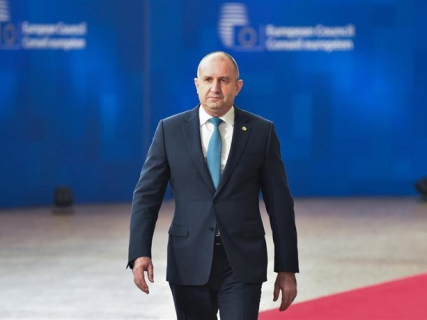
The former Bulgarian president Rumen Radev has made the definitive leap into active politics after his resignation in January, achieving victory in last Sunday's legislative elections and positioning himself as the next prime minister of Bulgaria.
With more than 44% of the votes in the partial count, his new political project, Progressive Bulgaria, capitalizes on the institutional wear and tear of a country that has chained elections and government crises in recent years.
A leadership forged against the elites
Former Air Force general and a figure outside traditional parties for a good part of his career, Radev has built his discourse on frontal criticism of Brussels political elites. His confrontation with the historic conservative leader Boiko Borissov has been constant, whom he accuses of tolerating corrupt practices.
The new leader has managed to channel social discontent in a context marked by protests, institutional instability, and distrust towards institutions. Bulgaria has held up to eight legislative elections since 2021, a reflection of a fragmented political system.
Euroscepticism and foreign policy shift
Radev has defended critical positions with the European Union, especially on issues such as the adoption of the euro or energy policies.
He has also opposed sending military aid to Ukraine and sanctions against Russia. In international politics, he advocates for a “pragmatic” line that involves recomposing relations with Moscow, reactivating Russian energy supply, and reducing dependence on Brussels.
His ideological closeness with Hungarian Prime Minister Viktor Orbán reinforces his profile within the bloc of European leaders critical of community integration.
Between Europe and Russian influence
Despite his Eurosceptic rhetoric, Radev has assured that Bulgaria will maintain its membership in both the EU and NATO. However, his discourse poses a delicate balance between European commitments and a strategic rapprochement with Russia.
This positioning reflects an internal division in Bulgarian society between pro-European sectors and currents closer to Moscow.
Governing in a country at its limit
Radev's main challenge will be to achieve stability in a country with high levels of poverty and strong political disaffection. Bulgaria remains one of the states with the greatest economic difficulties within the EU, which has fueled citizen discontent.
Faced with the lack of a clear majority, the leader of Progressive Bulgaria does not rule out agreements with other parties, in an attempt to avoid new elections and put an end to a cycle of institutional deadlock. With a nationalist discourse, critical of Brussels and focused on the regeneration of the State, Radev opens a new political stage in Bulgaria that could reconfigure its role within Europe.