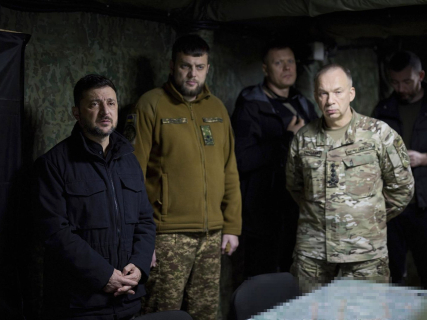

The president of Ukraine, Volodymyr Zelensky, has removed on Tuesday from his position the commander-in-chief of the Armed Forces, Oleksandr Sirski, shortly after the controversial replacement of the Minister of Defense, Mykhailo Fedorov, with whom the top military official had a relationship marked by a lack of understanding.
During his usual evening speech, the Ukrainian leader announced significant changes in the military leadership. "I have decided that Mykhailo Drapati will become the new commander-in-chief of the Armed Forces of Ukraine. Together with Mykhailo, Yevheni Jmara (current Minister of Defense) and Pavlo Palisa (deputy head of the president's office) we have determined how to update the configuration of the General Staff of the Armed Forces of Ukraine," he indicated.
Zelensky has publicly expressed his recognition to Sirski for his role at the forefront of the defense of Kiev and for his leadership in the offensive on Kharkiv and in the operations in Kursk. "We all have the same desire to defeat the enemy and achieve conditions, both on the front and through pressure on Russia, that force Russia to reach peace. Tomorrow we will formalize all the decisions," the president pointed out while detailing the change in military leadership.
The departure of Sirski is framed within the crisis opened by the dismissal of Mykhailo Fedorov as Minister of Defense, a decision that has provoked massive protests in various Ukrainian cities. Given the magnitude of the social discontent, Zelensky was forced to justify the change, which he attributed to the lack of internal cohesion and the existing communication problems between Fedorov and the now former commander-in-chief.
Fedorov communicated his resignation to the Executive after having assumed the Defense portfolio in January 2026, in a message in which he claimed his management in the midst of war. He recalled the technological improvements introduced in the Armed Forces and the start of the long-range attack campaign with weapons developed in Ukraine. He also emphasized having promoted an "unpopular but vital transformation" of the Army.
In his farewell, the now former minister launched harsh criticisms at his internal detractors. "He prefers to weave intrigues and believe that someone gave orders to some media outlet, instead of focusing on what is really happening (...) Instead of seeking Russia's defeat, he sought a way to divide the country," said Fedorov, who faced opposition from part of the military leadership to his plans to decentralize and digitalize the functioning of the Armed Forces.