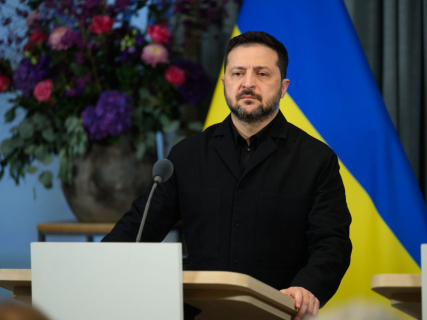

The President of Ukraine, Volodimir Zelenski, has confirmed this Monday that the Ukrainian Armed Forces carried out an attack with naval drones against an armoured corvette of the Russian Navy that was moored in the port of Benghazi, in eastern Libya. The Ukrainian leader described the action as “an exemplary operation” in direct response to the invasion of Ukraine ordered by Russian President Vladimir Putin in February 2022.
“An exemplary Ukrainian operation in response to Russia’s war,” the head of the Ukrainian state has stated, underlining that “the objectives set were achieved” and specifying that seven naval drones “of Ukrainian manufacture” were used in the action. According to him, “despite all the enemy’s efforts to counter the attack, the Russian corvette ‘Merkury’ was sunk.”
Zelenski has highlighted that the attacked vessel was one of the “most recent” ships in the Russian fleet, as it entered service in 2023. He added that, together with the corvette, a Ka-27 combat helicopter was destroyed and that the cargo ship ‘MV Angara’ was also hit, “used by the enemy for the transport of arms.”
In a message circulated on social media, the head of state insisted that “we continue our operations in designated waters. We are responding to Russia’s aggression. We are developing Ukrainian armament,” while expressing his gratitude to the military personnel involved in the operation.
Hours before the Ukrainian claim, the United Nations Support Mission in Libya (UNSMIL) had shown its “deep concern” about these attacks and stressed that “the sovereignty and territorial integrity of Libya, as well as the safety of its citizens and its assets, must be fully respected.”
In that context, UNSMIL called for “an immediate, independent and transparent investigation to clarify the facts and demand accountability from the perpetrators” and offered its support to Libyan authorities in the inquiries. At the same time, it urged “maximum restraint,” avoiding the dissemination of “unverified” information and “not politicizing the incident” while the investigations continue.
The UN mission also warned against “any action or rhetoric that could intensify tensions within Libya or draw the country into larger-scale regional or international confrontations.” It stressed that the North African country “must not become a battlefield for foreign conflicts” and said that incidents of this kind highlight “the urgent need to accelerate efforts to reunify Libya’s national institutions and strengthen their ability to safeguard the country’s sovereignty and security.”
In a statement released on social media, UNSMIL finally urged “all actors” in Libya to “act responsibly, preserve the country’s stability, and consolidate the progress, achieved with great effort, in the political process toward a lasting solution.”
For years, Libya has remained mired in a deep institutional split, originating after the overthrow and death of Muamar Gadafi in October 2011 in the context of the civil war, and worsened after the postponement of elections scheduled for 2021. This situation has led to the existence of rival authorities, with a parallel administration established in the east, without reunification talks, for now, having made it possible to restore the state structure.
The authorities in eastern Libya explained on Sunday that the ‘Merkury’, a 105-meter warship valued at more than 150 million euros, which had been in the port of Benghazi for several days according to specialized portals, was making a technical stop to refuel on its return trip to Russia. This stop would be part of the maritime cooperation agreements signed between Moscow and the eastern Libyan administration.
For his part, Ahmeid Huma, the deputy prime minister and minister of defense of the internationally recognized Libyan government, reiterated that Libya is not a party to the war between Russia and Ukraine and “rejects any attempt to drag its territory, ports or installations into international conflicts.” He also announced the opening of an investigation to clarify what happened and warned that the country reserves “the right to adopt legal, diplomatic and security measures to protect its sovereignty.”