
The PP has launched an offensive to "scrutinize" and demand "guarantees" on the "largest nationalization process" that, according to its denunciation, the Government is developing and which "affects 2.6 million people". In this context, it demands the presence in Congress of the Minister of Foreign Affairs, José Manuel Albares, requests a report from the State Legal Service on the outsourcing of the procedure, and demands copies of the contracting files of the public company Ineco and the Cuban company Palco.
These initiatives come after the leader of the PP, Alberto Núñez Feijóo, accused the President of the Government, Pedro Sánchez, this week of practicing "electoral engineering" to obtain "new voters" through the so-called 'Law of Grandchildren' because "the numbers don't add up for him", although the 'popular' party refuses to speak of a "rigged election", a term that Vox does use.
The PP maintains that with this "information offensive" it intends for the process promoted by the Executive "through the back door to be carried out with all guarantees, informing all citizens through the Spanish Parliament". It assures that "this is not about votes, but about guaranteeing compliance with the law and offering all citizens quality public services".
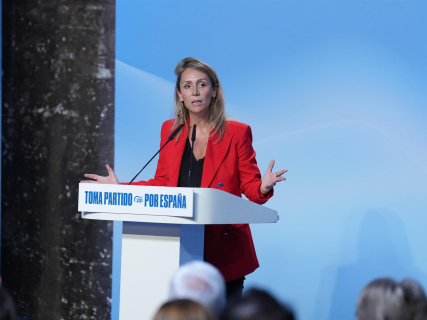
"All Spaniards have the right to doubt the intentions of Pedro Sánchez's government," stated the deputy secretary for Sectoral Coordination of the PP, Alma Ezcurra, who defends the opposition's right to demand explanations about the nationalization process promoted by the Executive through the so-called 'Law of Grandchildren', the designation of the eighth additional provision of the Democratic Memory Law approved in 2022.
Requests to the Government and Foreign Affairs
Firstly, the PP has registered a request for an urgent appearance of the Minister of Foreign Affairs in the plenary session of Congress so that he can detail the functioning of the consular civil registries, the appointment system, the resolution deadlines, as well as the number of nationality applications received, approved, denied, and pending within this process.
At the same time, the party requests a report from the General State Legal Service on "the outsourcing carried out by the Government to carry out support tasks for consulates in the procedure promoted by the Government for the processing of nationality applications", as officially communicated.
The PP also demands to know which consulates are the most saturated, what human, material, and budgetary resources each one has, what legal and administrative criteria are applied in processing, and what documentary, registration, and census guarantees the Executive has established for this process.
Along these lines, it demands that the minister explain what measures the Government foresees "given the saturation of consular services derived from the high volume of applications, especially in the most affected Hispanic American countries."
In addition, the 'popular' party requests a full copy of the three contracting files of Grupo Palco, a public company linked to the Cuban dictatorship, for a total amount of 1,602,217 euros, for the incorporation of support personnel to the Consulate of Spain in Havana, both in general tasks and in the reinforcement of the processing of Spanish nationality files.
Likewise, they demand the complete contracting file of the public company Ineco to support the management of these files, as stated in the same press release.
Parliamentary Interrogation and Resource Allocation
In parallel, the Popular Group will register a battery of around twenty parliamentary questions so that the Government provides, among other data, disaggregated information on the number of nationality applications by each consular office.
The PP also wants to know what criterion is followed to set the order of resolution of applications, clarifying whether they are attended to by appointment date, by initiation of the file, by complete submission of documentation in each consulate, or by some other system.
Likewise, it demands details on the criteria of the Ministry of Foreign Affairs for distributing personnel reinforcements among the different consular offices and what forecasts it has for increasing resources in those districts with more applications, longer waiting times, and more pending files.
"The largest naturalization process" and doubts about guarantees
Ezcurra maintains that "the largest naturalization process in our history" is being developed, with "2.6 million applications." "And this has not been done solely with a law, it has been done thanks to an order from a director general in the Ministry of Justice," he stated, referring to Sofía Puente.
He questioned that "a single signature in an office" has "opened immigration to almost two centuries of history, with hardly any documentation or guarantees required." He assures that the PP defends "of course" nationality for the grandchildren of Spaniards, a demand that he recalls they have maintained "since 2007", but insists that "this right should be granted properly, with a law, with rigor, with parliamentary agreement and with guarantees."
In his opinion, Pedro Sánchez's government "has been weakening one by one each of the links that should protect something so serious," starting with the concession. "As of today, so little is required that having a Spanish ascendant is enough without real proof and almost without a filter. Only two out of every hundred applications are rejected. Where are the guarantees?", he asked.
Change of the electoral body and "absolute" oversight
Ezcurra has stressed that the second link is legality, since an administrative order "cannot go further" than the Democratic Memory Law approved in the Courts. The third link, he added, is the vote: "Each new national is a new voter. Massively expanding who can vote is not a formality. It is changing the electoral body. Where is the control?". He also alluded to the government's "haste" as a fourth element of concern.
For all these reasons, he announced that the PP will initiate "an absolute oversight process" to ensure that "what is granted complies with the law" and that "each vote belongs to whoever claims to be." "That is why we are going to ask about each naturalization. How many, where, with what controls, and to which province they will end up in the census," he pointed out.
He reiterated that his party will demand explanations on "why civil servants have been sidelined to give it to external companies." "Let's see what the State Attorney General's Office says," he stressed.
Finally, Ezcurra indicated that they will call on the Minister of Foreign Affairs "to show his face in Congress" because "suspicion is justified by the accuser, but the guarantee must be provided by the one who governs." "The opposition asks and now it is Sánchez's turn to respond," he concluded.