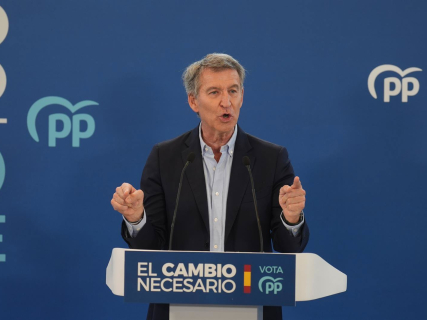

The president of the PP and candidate for the Presidency of the Government, Alberto Núñez Feijóo, has insisted this Monday that, if he manages to reach La Moncloa, he will push for the repeal of the amnesty law because, as he has emphasized, it is a "political commitment". At the same time, he has cast doubt on the word of the head of the Executive, Pedro Sánchez, when he says that he will not accept a referendum in Catalonia even if he needs the support of Junts or ERC to remain in power, pointing out that before the 2023 general election he also said there would be no amnesty.
In an interview broadcast last night on 'Salvados', on La Sexta, Sánchez reiterated that he will not authorize an independence referendum in Catalonia after the elections, even in the case that he needs the backing of the pro-independence parties to continue governing, arguing that the Constitution prevents it and that it would go against the "coexistence" policy that he says he has promoted in Catalonia.
During an interview on Antena 3, collected by Europa Press, Feijóo has underlined that Sánchez said that, if "it depends on Junts again" to "make him president", "he will not hold the self-determination referendum". Immediately after, he mocked that statement: "Confirmation. He would hold a self-determination referendum because he said at the time that he would not approve the amnesty law and the first thing he did was to approve the amnesty law".
Repeal of the amnesty as a "political commitment"
Asked explicitly whether he will annul the amnesty law even if its effects can no longer be reversed, Feijóo has reaffirmed that he will remove it from the legal framework if he reaches the Government. He has also recalled that the PP has promoted several mobilizations on the street against that measure over the last three years.
"Am I going to repeal the amnesty law? Yes, because it is a political commitment and political commitments are fulfilled. I understand that in sanchista Spain the political commitment is what is said and precisely you are not going to do it," he said.
For Feijóo, it is not only "a political change", but also "a change in the ways of understanding politics" and "in the substance of the exercise of power". In his view, the goal is "to restore the independence of the institutions, the rule of law".
He has defended that his proposal entails "turning back once again to the Spain of the agreement, to the Spain of divergence, but to the Spain of agreements and to the Spain of respect. This is going back once again so that Spain is Spain and so that here they will not decide those who do not believe in our country".
Along these lines, the PP leader has insisted that he intends to recover "once again institutional Spain, the Spain of the Rule of Law, democratic Spain, the Spain that approves budgets".
Criticism of the TC and the possible pardon for García Ortiz
Feijóo has also assured that, if he reaches the Executive, "there will be no minister of the PP Government who is a magistrate of the Constitutional Court" nor "there will be any Moncloa adviser who is a magistrate of the Constitutional Court", in reference to the cases of Juan Carlos Campo and Laura Díez. "We are not going to do the same thing as the Socialist Party," he has guaranteed.
In this context, he has advanced that, if he governs, "he will pass a law that says two things": "in the Constitutional Court, to be a magistrate, as a minimum you need five years outside politics of any kind" (local, provincial, regional or national); "and second, the Constitutional Court will not be a review chamber of the Supreme Court".
In addition, the PP leader has emphasized that the former Attorney General of the State, Álvaro García Ortiz, "has been disqualified and convicted" and he has criticized the President of the Government for leaving the door open to a possible pardon.
"I ask you. You did not deny the pardon. I am not going to pardon any member, any senior official of my Government, if he turns out to be convicted, and much more so, by a Supreme Court", Feijóo has said.
In that same line, he has warned that, in the event that the Attorney General of the State is indicted, "he will immediately cease his post". "I am sorry, but a General prosecutor does not have a presumption of innocence to carry out the General Prosecutor's Office and prosecute crimes when he is being investigated," he has concluded.