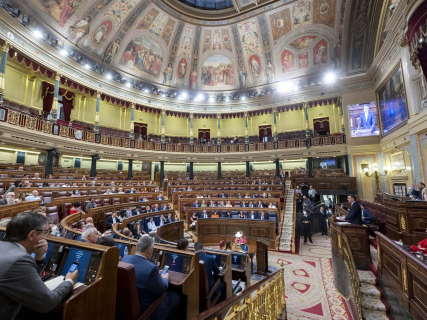

Before a law reaches the Plenary Session of the Congress or the Senate for its final vote, it goes through a discreet and decisive phase that rarely makes headlines: the working group. This is a small group of parliamentarians, appointed within the competent Committee, that works behind closed doors on the text and amendments submitted by the groups, and whose report ultimately conditions the final wording of the regulation.
The Link Nobody Sees
The Spanish legislative procedure includes several phases before a bill or a legislative proposal becomes law: presentation, general debate, amendment period, working group, Committee report, and finally, Plenary vote. Of all these, the working group is the least visible. Its meetings are not public and are not broadcast, unlike what happens in Committee or in the Plenary Session.
Article 113 of the Rules of Procedure of the Congress of Deputies —amended by the regulatory reform of July 2025— establishes that, after the amendment submission period, "the Committee shall appoint within its body a Working Group composed of one or more persons" to, in view of the text and the amendments submitted to the articles, draft a report within a period of fifteen days, extendable if the complexity of the bill so justifies.
Technical and Political Negotiation
In practice, the working group fulfills a dual function. On the one hand, it is the space where the most refined political negotiation is concentrated: representatives of the different groups seek compromise amendments, that is, intermediate texts that allow reconciling opposing positions before the debate moves to a more formal and visible arena.
On the other hand, it acts as a technical filter: it purges inconsistencies in the articles, reviews the legal terminology, and checks the fit of the new regulation with the rest of the legal system.
When any of the amendments imply an increase in spending or a reduction in public revenue, Article 111 of the Rules obliges the working group to submit it to the Government, through the Presidency of the Congress, to obtain its conformity. The Executive has fifteen days to respond; if it does not, it is understood to give its approval.
A Report That Does Not Decide, But Guides
The result of the work of the committee is a report that proposes an articulated text and indicates which amendments are accepted, rejected, or partially incorporated. That document lacks decisive value: it is not yet the will of the Chamber, but a proposal that is transferred to the Commission.
It is there, according to Article 114 of the Regulations, where the formal article-by-article debate begins, with the possibility of admitting new transactional amendments or last-minute technical corrections.
The Commission can fully adopt the committee's work, modify it, or depart from it, and its decision is reflected in an opinion that does express the official position of the body. This opinion is, in turn, the basis for the debate and vote in the Plenary, the only instance with the capacity to definitively approve or reject the text in that Chamber.
The Senate reproduces an equivalent scheme: the competent Commission can designate a committee —being able to dispense with it if it does not consider it necessary— which also has fifteen days to prepare its report before the text goes to debate in Commission, as established by Articles 110 and 111 of the Regulations of the Upper House.
A figure that is repeated in other procedures
The Congress Regulations resort to the same formula —a small group that prepares a text for a higher instance— in other procedures: Commissions of Investigation can appoint committees within them, and the reform of the Statutes of Autonomy contemplates a joint committee between the Constitutional Commission and the delegation of the corresponding autonomous assembly.
In all cases, the underlying logic is the same: to negotiate, refine, and seek agreements in a small and reserved space before submitting the result to the public light of parliamentary debate.
how to start using fren:
To start using Fren, users can create an account and access a 15-day free trial, no card and no commitment.
Registration is available from Fren's own page, where you can also find out how the tool works and access its different usage options.

In addition, Fren has applications for mobile on iOS and Android, available on the App Store and Google Play, allowing you to consult political and regulatory information from anywhere.
The approval of the budgetary stability path (which includes the spending ceiling) will be the first major hurdle. For the 2025 budgets, the Government lost the vote on this budgetary stability path in July 2024. It presented a new one in September, which it withdrew two days before the vote to avoid another defeat.
There is no deadline for the vote on this spending ceiling, although María Jesús Montero has already stated that it will be "shortly."
In November 2024, the Cortes Generales gave the go-ahead to the Basic Law Project for Forest Firefighters. A regulation that, as stated in its explanatory memorandum, is the result of the need to strengthen and coordinate all operations related to forest fires. Nine months later, and in the midst of a wave of fires that are devastating Spain from north to south, this law is once again taking center stage.