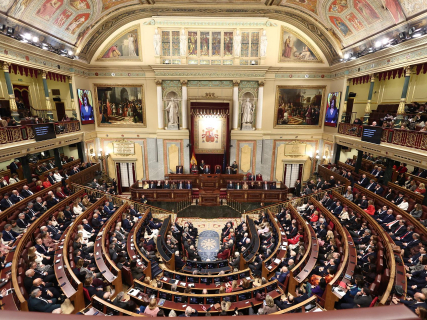

The Congress of Deputies is going through a procedural bottleneck. Of the legislative initiatives currently advancing through the final stages of processing in committee, none have yet reached the opinion stage, the formal agreement that a committee submits to the Plenary. The 23 initiatives that remain active in this stage of the procedure are, without exception, in the working group phase: the small group of deputies responsible for negotiating the articles and amendments before the committee makes a decision.
The breakdown, with data as of today, reveals an almost balanced distribution between the two types of legislative initiative: 12 are bills submitted by the Government and 11 are legislative proposals presented by parliamentary groups.
What is the difference between the working group and the opinion stage?
The working group is an internal working body of each committee: a small number of deputies, proportional to the weight of each group, which studies the text article by article and negotiates which amendments are incorporated, compromised, or discarded. Its result is a report, that is, a proposal that does not bind the committee as a whole.
The opinion stage, on the other hand, is the formal agreement that the committee approves by vote based on that report. It is the text that is published in the Official Gazette of the Cortes Generales and serves as the basis for the final debate in the Plenary of the Chamber. While the working group operates behind closed doors, the opinion stage represents the official position of the committee before the rest of the Congress.
The fact that the 23 initiatives analyzed are all still in the working group phase, with none having yet reached the opinion stage, points to a bottleneck in the amendment negotiation work, even before the committees can debate and vote on their opinions.
Bills: the Government's block
Among the 12 bills awaiting a working group report are texts of very different scope. Long-processing files coexist —such as the measures for the war in Ukraine and the drought, in the working group since March 2024— with much more recent additions, such as the Law on Cinema and Audiovisual Culture, whose last parliamentary move dates back to late June 2026.
| File | Title | Commission |
| 121/000003 | Measures regarding the conflicts in Ukraine and the Middle East and the drought | Finance and Public Administration |
| 121/000008 | Transposition of Directive (EU) 2019/1152 on working conditions | Labor, Inclusion and Social Security |
| 121/000013 | Creation of the Spanish Office of Copyright and Related Rights | Culture |
| 121/000018 | Independent Authority for the Defense of the Financial Customer | Economy and Digital Transformation |
| 121/000026 | Law on Cinema and Audiovisual Culture | Culture |
| 121/000031 | Public Service of the State Administration | Finance and Public Administration |
| 121/000034 | Modification of the Law on State Ports and Maritime Navigation | Transport and Sustainable Mobility |
| 121/000046 | Transparency and integrity of interest groups | Finance and Public Administration |
| 121/000052 | Protection of minors in digital environments | Justice |
| 121/000059 | Strengthening of the judicial and fiscal careers | Justice |
Legislative Proposals: Initiatives from the Groups
In the area of legislative proposals, driven by parliamentary groups, two initiatives with the rank of Organic Law stand out: the reform on the statute of limitations for sexual offenses against minors and the proposal for the protection of liberties and citizen security.
Both will require, due to their organic nature, a final vote as a whole by an absolute majority once their parliamentary processing is completed and they reach the Plenary Session of the Congress.
| File | Title | Commission |
| 122/000072 | Spanish nationality for Sahrawis | Justice |
| 125/000007 | Statute of limitations for sexual offenses against minors (Organic) | Justice |
| 122/000124 | Regulation of "Redito Ad Libitum" clauses in mortgages | Social Rights and Consumer Affairs |
| 122/000130 | Information on litigation in the electricity and hydrocarbon sector | Ecological Transition |
| 122/000131 | Protection of liberties and citizen security (Organic) | Interior |
how to start using fren:
To start using Fren, users can create an account and access a 15-day free trial, no card and no commitment.
Registration is available from Fren's own page, where you can also find out how the tool works and access its different usage options.

In addition, Fren has applications for mobile on iOS and Android, available on the App Store and Google Play, allowing you to consult political and regulatory information from anywhere.
The approval of the budgetary stability path (which includes the spending ceiling) will be the first major hurdle. For the 2025 budgets, the Government lost the vote on this budgetary stability path in July 2024. It presented a new one in September, which it withdrew two days before the vote to avoid another defeat.
There is no deadline for the vote on this spending ceiling, although María Jesús Montero has already stated that it will be "shortly."
In November 2024, the Cortes Generales gave the go-ahead to the Basic Law Project for Forest Firefighters. A regulation that, as stated in its explanatory memorandum, is the result of the need to strengthen and coordinate all operations related to forest fires. Nine months later, and in the midst of a wave of fires that are devastating Spain from north to south, this law is once again taking center stage.