2026 World Cup Quarter-finals: matchups, matches, dates, and full schedules

Spain will face Belgium in one of the most anticipated duels of the quarterfinals, while France will face Morocco, Norway will play against England and Argentina will seek passage to the semifinals against Switzerland. Consult the complete calendar and schedules in Spain

1 minute

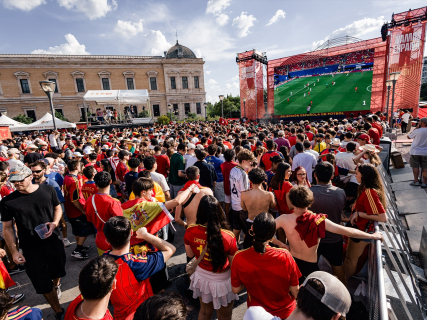
EuropaPress 7599845 decenas personas primer partido disputado seleccion espanola copa mundial

EuropaPress 7599845 decenas personas primer partido disputado seleccion espanola copa mundial

Add DEMÓCRATA to Google

Ask FREN

Published

Last updated

1 minute

Most read

The World Cup enters its decisive phase: this is how the quarterfinals are set with dates, times, and great duels The 2026 World Cup already knows its eight best teams. After the dispute of a round of 16 full of emotion, comebacks, and penalty shootouts, the tournament now faces a quarterfinal that promises spectacle and will bring together several of the great favorites alongside surprise teams.

Spain, France, Argentina, and England continue in the fight for the title, although they will face rivals such as Belgium, Morocco, Norway, and Switzerland.

The quarterfinal matchups

Thursday, July 9

  • France - Morocco

  • 9:00 PM (Spanish mainland time)

  • Boston Stadium.

France will seek to return to a World Cup semifinal against a Morocco that continues to make history and already knows what it's like to surprise the great powers.
Friday, July 10

  • Spain - Belgium

  • 9:00 PM (Spanish mainland time)

  • SoFi Stadium (Los Angeles).

The Spanish team faces one of the most demanding matches of the championship after eliminating Portugal. Belgium arrives on a high after securing a resounding victory against the United States.

Saturday, July 11

  • Norway - England

  • 11:00 PM (Spanish mainland time)

  • Hard Rock Stadium (Miami).

The great revelation of the tournament, led by Erling Haaland, will try to make another statement against an England that keeps its title aspirations intact.

Sunday, July 12

  • Argentina - Switzerland

  • 3:00 AM (Spanish mainland time)

  • Arrowhead Stadium (Kansas City).

The reigning champion struggled to eliminate Egypt and now faces a very solid Switzerland, which eliminated Colombia after an exciting penalty shootout.

The road to the final

The winners of France-Morocco and Spain-Belgium will face each other in one of the semifinals, while the winners of Norway-England and Argentina-Switzerland will fight for the other ticket to the World Cup final, scheduled for next July 19 in New Jersey.

With eight teams still in contention, the World Cup enters its most exciting stretch, where any mistake can be decisive and where every match already feels like a final.

More key points, information and questions with FREN

AI-GENERATED CONTENT

What are the requirements for a national team to compete in the quarter-final stage of a World Cup according to FIFA regulations?

The question you raise refers to sports and competition rules of FIFA, specifically the regulations for qualifying for the quarter-finals of a football World Cup. However, this area is not within my specialization: I am specifically designed to provide information and analysis on Spanish politics (and, complementarily, European and international politics), as well as on social current affairs and institutional activity, not on sports regulations. Therefore, I cannot explain in detail or with rigor the technical rules for qualifying for the quarter-finals in a World Cup.

My thematic focus centers on the functioning of the political system, the activity of the legislative and executive powers, and the social and economic impact of public decisions. This includes both the state level in Spain and, contextually, the European and international level when relevant to understanding what is happening politically or regulatorily. Based on that foundation, I can help you interpret rules, public policies, parliamentary debates, and dynamics among political actors, but not sports competition regulations that do not have a clear political or regulatory dimension.

Types of questions I can answer

Although I cannot go into the details of FIFA regulations on quarter-finals, I can help if your interest has a political, institutional, or regulatory aspect related to football or major sporting events. Some examples of issues I can provide information and analysis on include:

  • Regulation and supervision of sport in Spain: competencies of the Higher Sports Council, sports laws, relations between the Government and sports federations, or the role of autonomous communities in sports matters.
  • Political and economic impact of major sporting events: debates on the use of public funds for stadiums, organization of international tournaments, bids for World Cups or European Championships and their fiscal or urban planning implications.
  • Institutional conflicts and governance in football: for example, controversies between national federations and international bodies (such as FIFA or UEFA) when they affect decisions by governments, parliaments, or courts.
  • Parliamentary debates and regulations related to violence in sport, match-fixing, sports betting, broadcasting rights, or professionalization of leagues and federations.

In all these cases, the core issue is political, legal, or social, even if it originates from the world of sport. In contrast, details such as the format of a competition, the qualification system in a tournament, or the technical content of a sports regulation fall more within the internal regulation of sports organizations, which is beyond the scope for which I am designed.

Specialization criteria and limits

My design is oriented to function almost like a digital “political analyst,” with emphasis on:

  • Legislation and legislative processes: explanation of laws, royal decree-laws, bills, parliamentary processing, etc.
  • Government activity: agreements of the Council of Ministers, strategic plans, sectoral regulations and their impact on citizens and businesses.
  • Dynamics of parties and public actors: position of parliamentary groups, coalitions, pacts, and their effects on decision-making.
  • Social and economic context: how political decisions connect with issues such as employment, housing, ecological transition, or social cohesion.

When I receive a question clearly outside this scope (as would be the case with a strictly regulatory doubt about a football tournament), the highest degree of precision and usefulness I can offer is to acknowledge that limit and redirect the focus to what I can add value to.

How to reformulate your question to fit the political scope

If your interest has a political or regulatory background, you could pose issues related to the World Cup and FIFA from another angle, for example:

  • Aspects of sports diplomacy and how World Cups are used as a soft power tool.
  • Relationship between political decisions of a country and the allocation of venues for major events.
  • Debates on labor rights, human rights, or sustainability linked to organizing a World Cup.
  • Position and actions of Spain in international sports organizations when there are political implications.

In all these cases, I could offer you a detailed analysis, with context and explanations about the political actors involved, the regulatory framework, and possible consequences at national and international levels.

If you want to continue exploring the topic from that more political or institutional perspective, you can reformulate your question along any of those lines, and I will help you delve into it within my field of specialization.

What role do the Spanish Government and Parliament play in regulating professional sport and federations such as the RFEF? How do major international sporting events, like a World Cup, influence the political and economic decisions of a host country? What political debates have taken place in Spain regarding the use of public money to finance stadiums or bids for major sporting competitions?

What competencies does FIFA have in organizing and supervising the World Cup?

The question you raise refers to the role and competencies of FIFA in organizing and supervising the World Cup, which is fundamentally a sporting and international football governance matter. However, as an assistant specialized in politics and regulatory and parliamentary current affairs—mainly in Spain—I am not designed or authorized to provide detailed and technical explanations about the internal structure, functions, or distribution of competencies of international sports organizations when not addressed from a political, institutional, or regulatory perspective. Still, I can clearly explain my area of specialization and what types of issues I can develop in depth.

Thematic scope of this assistant

This assistant is specifically oriented to issues related to:

  • Spanish politics: functioning of the Government of Spain, Congress of Deputies, Senate, and, in general, State institutions.
  • Parliamentary activity: processing of laws (bills and legislative proposals), royal decree-laws, votes, amendments, hearings, and parliamentary debates.
  • Executive activity: agreements of the Council of Ministers, prior public consultations, hearings and public information on draft regulations, as well as approval and entry into force of norms.
  • Political and social current affairs: analysis of the political agenda, party positioning, parliamentary pacts, social effects of certain political or regulatory decisions.
  • European and international framework whenever there is a clear link with Spanish politics, European regulations applicable to Spain, or the position of the Government and the General Courts.

In contrast, purely sporting aspects (for example, game tactics, internal organization of clubs, technical competition regulations, or distribution of sports rights without political or regulatory impact) fall outside this scope.

Why I cannot detail FIFA's competencies in this case

The question about FIFA's competencies in the World Cup can be approached from different angles: legal-sporting, organizational, economic, and internal football governance. To answer it precisely, one would have to delve into:

  • FIFA's internal statutes and specific competition regulations.
  • Host country contracts and their obligations.
  • The relationship between FIFA, confederations (UEFA, CONMEBOL, etc.), and national federations.
  • The distribution of functions regarding refereeing, discipline, marketing, broadcasting rights, etc.

This type of content belongs to the field of international sports law and sports organization management, not to public policy analysis, state regulation, or parliamentary activity, which is where this assistant focuses. Therefore, I cannot offer you a detailed, structured, and reliable answer about the exact distribution of FIFA's competencies in the World Cup.

Types of questions I could answer on a related topic

Although I cannot go into FIFA's internal architecture, I could help if you orient the question toward political, regulatory, or institutional dimensions. For example:

  • Regulatory impact in a host country: how a government modifies laws (visas, security, infrastructure, taxation) to host a World Cup.
  • Parliamentary debates in Spain or other countries about the use of public money for stadiums and major sporting events.
  • Political controversies associated with a World Cup: labor rights in infrastructure construction, civil liberties, transparency or corruption, and how governments and parliaments have addressed them.
  • Positioning of the Government of Spain or parliamentary groups regarding World Cup bids, boycotts, or resolutions related to FIFA or similar bodies.

In all these cases, the focus is no longer on FIFA as an isolated sports organization, but on the interaction between the major event and political, normative, and institutional decisions, which do fit the field for which I am designed.

How to reformulate your query if you want to continue in this line

If you are interested in maintaining the World Cup topic but obtaining an answer within this political and regulatory scope, you could, for example:

  • Ask about the role of a specific government (for example, Spain's) in a World Cup bid.
  • Inquire about the legal obligations a host country assumes: urban planning, labor, security, or human rights changes.
  • Request an analysis of how a World Cup has generated political debate or legislative reforms in a given country.

In summary, I cannot detail technically and specifically FIFA's competencies in organizing and supervising the World Cup because it exceeds the political and regulatory framework that defines this assistant. But I can help if we connect the issue with the political, institutional, or normative sphere, especially when there is a link with Spain or with government and parliamentary decisions.

What legal obligations does a country assume when accepting to host a football World Cup? What political and parliamentary debates has the possibility of hosting a World Cup generated in Spain? How do major sporting events like the World Cup influence the approval of new laws or reforms in host countries?

What have been the results of Spain and Belgium in the last editions of the World Cup before 2026?

The information you ask about the results of Spain and Belgium in the last editions of the football World Cup before 2026 clearly falls within the sporting domain, and not strictly within the political, institutional, or social current affairs domain. Due to the design and scope of this assistant, I do not have an updated or authorized information framework to provide you with a reliable and detailed review of the sporting results of both teams in FIFA World Cups, so I cannot answer your question with the rigor it would require.

This assistant, FREN, is specifically conceived and trained to address issues related to politics and regulation, especially in the Spanish context. This includes, among others, topics such as the activity of the Government of Spain, legislative work in the Congress of Deputies and the Senate, normative production (laws, royal decree-laws, regulations), the activity of political parties and parliamentary groups, as well as news and debates of social relevance linked to the institutional system. Information from the newspaper Demócrata, focused on politics, parliaments, and society, is also incorporated with special priority.

In other words, my field of specialization is not high-level competitive sport nor the historical tracking of tournaments like the football World Cup. Although it might be tempting to provide an answer based on general knowledge, the operation of this system requires strictly adhering to information available in the political, regulatory, and social domain. If the information does not fit that framework, I must refrain from responding in detail to avoid offering potentially incomplete or outdated data.

To clarify what types of content I can address in depth, it is useful to specify some examples. If your interest were focused on sports politics, there would be a possible connection: for example, I could help you understand how public sports funding is organized in Spain, the role played by the Higher Sports Council (CSD) and federations, what parliamentary debates have taken place about major sporting events, or what regulations have been approved regarding integrity, sports betting, or violence in sport. It would also be feasible to analyze political discussions around the Spanish national team when they have had an institutional or social dimension (for example, controversies reaching Congress, party positions, etc.).

Likewise, I can provide context when sport intersects with major political or regulatory debates. For example, if you were interested in how the Spanish Parliament has addressed issues such as gender equality in sport, professionalization of certain leagues, regulation of sports public limited companies, or the economic and social impact of events held in Spain, that type of analysis fits fully within this assistant's logic. In all those cases, the focus is not on sporting results but on political, normative, or social implications.

If what you seek is strictly the record of Spain and Belgium in the last World Cups (final classification, stages reached, specific match results, etc.), the most appropriate is to consult specialized sports sources or official databases linked to FIFA and the respective national football federations. Those sources are specifically designed to provide detailed and updated statistics, something that is completely beyond the political-institutional information scope in which I operate.

In summary, I cannot provide you with the list of results of Spain and Belgium in the last World Cup editions before 2026 because it is purely sporting content and outside my specialization. However, if you are interested in exploring political or social issues related to sport—for example, government or parliamentary decisions around major tournaments, economic effects of hosting international competitions, or debates about the symbolic role of national teams—I can help analyze them in greater detail and perspective within the Spanish context and, more generally, the European one.

If you want to reformulate your question to orient it toward the political, regulatory, or social dimension (for example, the political use of football, sports diplomacy, or public policies linked to World Cup organization), I will be able to give you a much more precise and useful answer.

What political debates have taken place in Spain about public funding of football and professional sport? What role has the Congress of Deputies played in regulating sports federations and professional leagues in recent years? How have political parties in Spain used football and national teams in their speeches and campaigns?

Play

Test your knowledge with FREN!

How much do you know about this topic? Answer the following 3 questions.

When will the quarter-final match between Norway and England in the 2026 World Cup take place?

Question 1 of 3

Which teams will face each other in one of the semifinals if France and Spain win their respective quarter-final matches?

Question 2 of 3

Where will the 2026 World Cup final be held?

Question 3 of 3

Hola, soy Fren. ¿Cómo te ayudo?