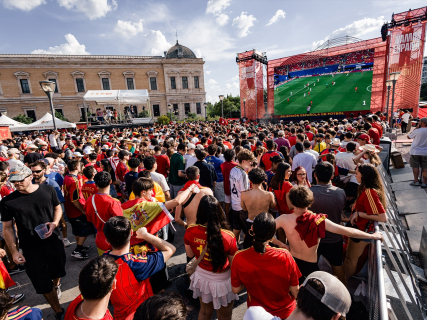
Spain eliminates Portugal and will play in the 2026 World Cup semifinals: rival, date, and time of the next match

The Spanish selection overcomes Portugal in an intense round of 16 duel and now awaits its rival in the semifinals of the 2026 World Cup, where it will seek a place in the grand final

2 minutes

EuropaPress 7599845 decenas personas primer partido disputado seleccion espanola copa mundial

EuropaPress 7599845 decenas personas primer partido disputado seleccion espanola copa mundial

Add DEMÓCRATA to Google

Ask FREN

Published

2 minutes

Most read

Spain is already in the quarterfinals of the 2026 World Cup. The Spanish team overcame Portugal in a highly tense duel and continues its path to the title after defeating one of the tournament's favorites.

The match, played in Dallas, lived up to all expectations. Two teams destined to compete for the World Cup offered a match of maximum intensity, with back-and-forth action and moments of great football, although it was Spain that ultimately imposed its rhythm to secure qualification.

The victory also has enormous symbolic value. Spain eliminates Portugal, led by Cristiano Ronaldo, who may have played one of the last major matches of his career with the Portuguese national team.

Spain is already in the World Cup quarterfinals

The Spanish team thus confirms its candidacy for the title.

After decisively eliminating Austria in the round of 16, the team has taken another step by overcoming Portugal, one of the most talented squads in the championship and managed by Roberto Martínez. The triumph allows Spain to continue advancing in a bracket that gets tougher as the knockout stages progress.

A match of maximum demand

The Spain-Portugal match was one of the great encounters of the 2026 World Cup.

The Iberian rivalry, the presence of Cristiano Ronaldo, and the level of both teams made the clash one of the most anticipated matches of the tournament.

Spain responded with personality, maintained its composure in the moments of greatest pressure, and knew how to compete against an opponent with enormous offensive capability.

Cristiano Ronaldo says goodbye to the World Cup

Portugal's elimination provides one of the most emotional images of the championship.

Cristiano Ronaldo leaves the World Cup after once again being one of the tournament's protagonists. The Portuguese forward had scored in the round of 16 against Croatia and entered the duel against Spain as the main reference for his team.

His departure from the championship likely marks the definitive end of one of the most extraordinary careers in the history of world football.

Spain continues to grow

The Spanish national team once again shows the image of a solid team.

After the resounding victory against Austria, the Spanish squad has managed to overcome a much more demanding test against Portugal, confirming the evolution shown during the championship.

The team combines defensive solidity, speed in transitions, and a growing dominance of matches, arguments that place it among the main contenders for the title.

Who will be Spain's opponent in the quarterfinals and when will it be played

With a ticket to the quarterfinals secured, Spain is now awaiting to know its next opponent in the 2026 World Cup.

The team to beat will emerge from the match between United States and Belgium, which will take place early Tuesday morning at 02:00. Thus, the next match will be on Friday, July 10 at 21:00.

The Spanish team will face the next knockout stage with renewed morale after eliminating one of the tournament's biggest favorites and after stringing together two highly prestigious victories in the knockout stage.


More key points, information and questions with FREN

AI-GENERATED CONTENT

What are the remaining procedures and deadlines for organizing the 2026 World Cup semifinals?

The publicly available information about the exact schedule of pending procedures and deadlines for organizing the 2026 World Cup semifinals is limited and very fragmented, and moreover, it is a global competition, outside the main scope of Spanish politics. It is not possible to rigorously detail specific dates or a “closed list” of official milestones yet to be met. However, from the perspective of public and regulatory management, it is possible to describe the types of procedures that usually remain pending in this advanced phase of organizing a major international sporting event. What follows is, therefore, a general and indicative outline, not an official legal description of the 2026 World Cup.

1. General framework and information limitations

The 2026 World Cup is organized by FIFA together with the organizing committees and administrations of the three host countries. The key procedures combine private sports rules (FIFA regulations and host contracts) with public law (urban planning licenses, security, health, borders, etc.). Many specific deadlines are set in contracts and internal manuals that are not published in detail, so only the major work blocks usually managed in the last 12–18 months before the tournament are generally known.

Additionally, this is a North American event, while this assistant’s specialization focuses on politics and regulation in Spain. Therefore, a detailed breakdown of specific administrative procedures for each host country or city, or a closed official timeline, cannot be provided.

2. Common administrative procedures in the final phase

2.1. Construction permits, stadium and infrastructure use

At this stage of the cycle, it is usual that major structural works are already advanced or completed, but the following remain:

– Final authorizations for stadium use after technical inspections (structural safety, accessibility, capacity, emergency exits).
– Permits for temporary installations: additional stands, VIP areas, hospitality, press centers, “fan zones,” etc.
– Certifications of compliance with fire, electrical, and evacuation regulations.

2.2. Security, public order, and civil protection

In the phase prior to an event of this magnitude, the Interior Ministries and local and national police finalize:

– Comprehensive security plans in stadiums and surrounding areas, with control perimeters, capacities, and access protocols.
– Crowd control devices and coordination with civil protection for possible emergencies or evacuations.
– Rules on demonstrations, traffic closures, and temporary restrictions around the venues.

Although much of the planning is designed years in advance, detailed operational plans are usually finalized and approved in the months immediately before the matches.

2.3. Mobility, transport, and borders

Another key block of pending procedures usually includes:

– Final adjustments in public transport plans (reinforcements of trains, buses, metro) coordinated by transport authorities.
– Temporary regulation of parking, park & ride, and taxi or rental vehicle zones.
– Specific migration measures: simplified visas, special corridors at airports, and reinforced border controls for peak influx.

2.4. Health, consumer affairs, and environment

For semifinals and final phases, the following are usually finalized:

– Specific health devices in stadiums and fan zones: ambulances, field hospitals, protocols for medical emergencies.
– Public health and food safety controls at food stalls, catering, and drinking water.
– Environmental authorizations for mass events: waste management, noise, emissions, and enhanced street cleaning.

2.5. Commercial activity, rights, and public spaces

In parallel, local authorities usually process:

– Public space occupation licenses for terraces, giant screens, fairs, and parallel events.
– Authorizations related to outdoor advertising and restrictions on unauthorized commercial use of World Cup trademarks.
– Specific rules for street vending, commercial hours, and alcohol consumption in certain areas.

3. Deadlines: what to expect

Without access to FIFA’s internal documents and those of the host administrations, it is not possible to provide specific dates for each procedure. In general terms, the major regulatory elements (host contracts, exceptional legal frameworks, main works) are closed several years in advance. In the last year and especially in the last 3–6 months, operational approvals concentrate: final security, mobility, emergency plans, effective stadium use licenses, and authorizations for parallel events.

To obtain precise and updated information on the specific procedures and deadlines for the 2026 World Cup semifinals, the most reliable reference will be the official communications from FIFA and the authorities of the host countries and cities, as well as the rules and agreements they publish in their official bulletins or institutional websites.

What functions and competencies does the Spanish national team coach have according to the regulations of the Royal Spanish Football Federation?

I do not have the capacity to respond specifically and in detail to your question about the functions and competencies of the national team coach according to the internal regulations of the Royal Spanish Football Federation (RFEF). My scope is focused on Spanish politics, institutional activity, and social issues linked to public authorities, and not on the technical analysis of private sports or statutory regulations of federations such as the RFEF. Therefore, I cannot break down article by article what their Statutes or Regulations say about the national team coach.

Thematic scope in which I can assist you

My design is oriented to provide information and context about:

First, Spanish politics in a broad sense: Government, General Courts, regional parliaments, and the network of political parties (PSOE, PP, Vox, Sumar, nationalist and regionalist forces, etc.). This includes parliamentary struggles as well as political negotiation, government formation, investitures, or motions of no confidence.

Second, legislative and regulatory activity: bill projects and proposals, royal decree-laws, regulations, and other normative instruments promoted by the Executive or debated in the Chambers. I can explain contents, processing stages, amendments, votes, and practical effects of the rules, as long as they belong to the Spanish legal system (or, in some cases, European when directly affecting Spain).

Third, the action of the Government and public administrations: decisions of the Council of Ministers, sectoral policies (health, education, housing, energy, digitalization…), strategic plans, fund distribution, relations between central Government and autonomous communities, as well as interaction with the European Union when it has institutional translation in Spain.

I also systematically cover social and economic news with a political component: general or sectoral strikes, labor conflicts with institutional dimension, debates on pensions, labor market, education system, public health, or housing, as long as there is a relation with decisions or omissions of public authorities.

Sport and politics: how far I can go

In the sports field, my capacity focuses on aspects where sport intersects with public policy. For example:

I can analyze the Sports Law, parliamentary debates on regional teams, legal criteria for the recognition of federations, or decisions of the Higher Sports Council that have institutional impact. I can also explain the distribution of public funds to sport, regulation of sports betting when dependent on government royal decrees, or the diplomatic dimension of major events (World Cups, European Championships, Spain’s candidacies and their political implications).

However, I am not designed to interpret in detail the internal regulations of a private federation, such as the RFEF Statutes or its Selection Regulations, beyond what may have an evident political derivative (for example, if there were an intervention by the CSD, a parliamentary investigation commission, or a legal-political conflict with the Government).

Why I cannot go into detail about the national team coach

What you ask —the functions and competencies of the national team coach according to the RFEF regulations— requires a very specific legal-sports analysis: locating the current text of the Statutes, identifying the articles referring to the coach, reviewing technical or selection regulations, and breaking down that content. That work lies outside the scope of politics and public action that I am mandated to cover.

For such matters, the most appropriate is to go directly to the official sources of the RFEF itself (institutional website, published Statutes and Regulations) or to specialists in sports law who can precisely interpret the federation’s internal regulatory framework and its fit with the general sports legislation in Spain.

If you reformulate your question towards the political-institutional plane —for example, the relationship between the Government and the RFEF, the role of the Higher Sports Council in supervising federations, or how state sports laws affect the functioning of the Spanish national team— I could provide a detailed and contextualized analysis.

What has been Roberto Martínez’s professional career and main achievements as a coach before leading the Portugal national team?

I do not have specific or updated information about Roberto Martínez’s detailed professional career as a football coach before taking charge of the Portugal national team, because I am not designed to cover in depth sports content or biographies of sports figures. My area of specialization is focused on politics —especially in the Spanish context—, institutional activity, and social issues linked to public decisions and regulations. Therefore, I cannot offer you a reliable chronology or a detailed analysis of his achievements at clubs or previous national teams.

Specialization scope of this assistant

This assistant is specifically oriented to the analysis and explanation of:

1. Spanish politics: functioning of the Government of Spain, the Congress of Deputies, the Senate, regional governments and their parliaments; composition and strategies of parties (PSOE, PP, Vox, Sumar, PNV, EH Bildu, Junts, Republican Parliamentary Group, etc.); as well as political alliances and parliamentary dynamics.

2. Legislative and regulatory activity: processing of laws (bill projects and proposals), royal decree-laws, regulatory development, prior public consultations, hearings and public information, Council of Ministers agreements, and publication of rules in the Official State Gazette (BOE). I can also explain the full path of a draft bill from its consultation phase to its conversion into binding law.

3. Political and social current affairs: parliamentary debates, relevant votes (for example, investitures, labor reforms, tax changes, housing laws, equality, ecological transition, etc.), as well as the social and economic impact of public decisions. This also includes monitoring the agenda of the Government, the opposition, and main social actors (unions, employers’ associations, civil organizations).

4. Comparative politics and European or international context: although more limited, I can offer general political context about the European Union or other countries when linked to Spain (for example, negotiation of European funds, stability pacts, migration or climate policy). In these cases, my approach remains political-institutional, not sports or exclusively cultural.

Why I cannot answer in detail about Roberto Martínez

Roberto Martínez’s career as a coach —his stages at clubs, sports results, titles, playing styles, statistics, or tactical decisions— belongs to the field of sports journalism and football analysis. That information requires databases and sources specialized in professional sport, which are not part of the main field for which this assistant has been designed.

Furthermore, to answer rigorously a question like yours it would be necessary to provide very specific data: seasons, league positions, campaigns in European competitions, records of wins and losses, impact on the teams he has coached, etc. Since my function is to prioritize information related to politics, institutions, and regulations, I cannot guarantee precision or updating in those sports details, and I must avoid giving you an incomplete or potentially inaccurate answer.

What kind of questions I can answer

If you want to keep asking, I can help you, for example, with:

1. Sports politics: regulations on financing professional and amateur sport in Spain, structure of the Higher Sports Council, debates on sports public limited companies, criteria for distribution of audiovisual rights, or public policies to promote grassroots sport.

2. Relations between sport and politics: how Spain’s candidacies for major events (World Cups, European Championships, Olympic Games) are managed, the role of the Government and federations, or political debates arising around sports decisions (for example, use of public funds, sports diplomacy, impact on host cities).

3. Institutional issues in Spanish football: regulatory frameworks of the RFEF and LaLiga insofar as they relate to public decisions, legal reforms affecting them, or parliamentary investigations and commissions that have addressed issues related to professional football.

4. Any aspect of current Spanish political affairs: ongoing legal reforms, coalition Government situation, pacts with other parties, economic, social, territorial or international policies, as well as the specific parliamentary process of a law that interests you.

Suggestion to find information about Roberto Martínez

To obtain a reliable and detailed overview of Roberto Martínez’s achievements before leading the Portugal national team, I would recommend consulting specialized football media and databases: official pages of federations, clubs where he has worked, statistical reports of competitions, and reference sports press. Those sources are designed to accurately collect his match history, titles, personal recognitions, and career evolution.

Play

Test your knowledge with FREN!

How much do you know about this topic? Answer the following 3 questions.

Who did Spain eliminate to qualify for the semifinals of the 2026 World Cup?

Question 1 of 3

Who was the standout player of the Portugal team in the match against Spain?

Question 2 of 3

From which matchup will Spain's next opponent in the semifinals come?

Question 3 of 3

Hola, soy Fren. ¿Cómo te ayudo?