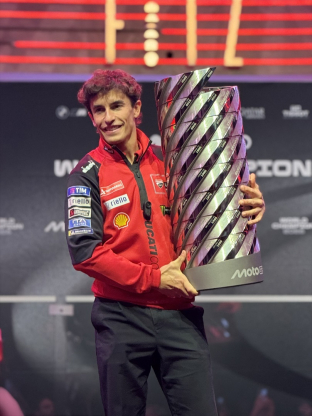
Marc Márquez retires: chronology of his 10 World Championships and place in the ranking of the best drivers in history

Cervera’s rider will contest his last Grand Prix in Valencia. He says goodbye at 33 years old as the reigning MotoGP champion, with eight titles in the top category and the third-best record in the Motorcycle World Championship.

EuropaPress 7937550 marc marquez rueda prensa celebrada espacio fitz 23 noviembre 2026 madrid

EuropaPress 7937550 marc marquez rueda prensa celebrada espacio fitz 23 noviembre 2026 madrid

Add DEMÓCRATA to Google

Ask FREN

Published

Last updated

7 minutes

Most read

Hasta el día de las elecciones (29 de noviembre) se muestran los resultados de las elecciones generales anteriores, las del 23 de julio de 2023.

Resultados de las elecciones generales del 29N en directo

Elecciones generales del 23 de julio de 2023 · Congreso de los DiputadosSenado

Escrutado: 100,00 %Votantes: 24.952.447Participación: 66,59 %

Votos

PartidoEscañosVotosPorcentaje
PP1378.160.83733,06 %
PP: 137 escaños. Se presenta con estos nombres:
  • PARTIDO POPULAR (PP)131 escaños
  • PARTIDO POPULAR / PARTIT POPULAR (PP)5 escaños
  • PARTIT POPULAR / PARTIDO POPULAR (PP)1 escaño
PSOE1217.821.71831,68 %
PSOE: 121 escaños. Se presenta con estos nombres:
  • PARTIDO SOCIALISTA OBRERO ESPAÑOL (PSOE)85 escaños
  • PARTIT DELS SOCIALISTES DE CATALUNYA (PSC-PSOE)19 escaños
  • PARTIDO DOS SOCIALISTAS DE GALICIA-PSOE (PSdeG-PSOE)7 escaños
  • PARTIDO SOCIALISTA DE EUSKADI-EUSKADIKO EZKERRA (PSOE)5 escaños
  • PARTIDO SOCIALISTA DE ISLAS BALEARES-PSOE (PSIB-PSOE)3 escaños
  • PARTIDO SOCIALISTA DE NAVARRA-PSOE (PSN-PSOE)2 escaños
Vox333.057.00012,38 %
Sumar313.044.99612,33 %
Sumar: 31 escaños. Se presenta con estos nombres:
  • SUMAR10 escaños
  • SUMAR - EN COMÚ PODEM (SUMAR - ECP)7 escaños
  • SUMAR ANDALUCÍA (SUMAR)5 escaños
  • COMPROMÍS - SUMAR: SUMEM PER GUANYAR (SUMAR - COMPROMÍS)4 escaños
  • SUMAR GALICIA (SUMAR)2 escaños
  • SUMAR CANARIAS (SUMAR)1 escaño
  • SUMAR ARAGÓN1 escaño
  • SUMAR MÉS (MÉS PER MALLORCA-MÉS PER MENORCA-SUMAR)1 escaño
ERC7466.0201,89 %
Junts7395.4291,60 %
EH Bildu6335.1291,36 %
EAJ-PNV5277.2891,12 %
BNG1153.9950,62 %
CCa1116.3630,47 %
UPN152.1880,21 %
PACMA0169.2370,69 %
PACMA: 0 escaños. Se presenta con estos nombres:
  • PARTIDO ANIMALISTA CON EL MEDIO AMBIENTE (PACMA)0 escaños
  • PARTIT ANIMALISTA AMB EL MEDI AMBIENT (PACMA)0 escaños
CUP-PR099.6440,40 %
FO046.2740,19 %
NC-bc045.5950,18 %
PDeCAT-E-CiU032.0160,13 %
RECORTES CERO023.4210,09 %
PUM+J023.2900,09 %
PUM+J: 0 escaños. Se presenta con estos nombres:
  • POR UN MUNDO MÁS JUSTO (PUM+J)0 escaños
  • POR UN MUNDO MAIS XUSTO (PUM+J)0 escaños
  • BIDEZKO MUNDURANTZ (PUM+J)0 escaños
U.P.L.023.2010,09 %
EXISTE020.4400,08 %
EXISTE: 0 escaños. Se presenta con estos nombres:
  • TERUEL EXISTE - COALICIÓN EXISTE (EXISTE)0 escaños
  • ARAGÓN EXISTE - COALICIÓN EXISTE (EXISTE)0 escaños
PCTE013.3820,05 %
GBAI099380,04 %
SY096970,04 %
Adelante091910,04 %
JM+082930,03 %
ESCAÑOS EN BLANCO079860,03 %
XAV073620,03 %
BQEX058070,02 %
CJ056200,02 %
FE de las JONS046830,02 %
PAR041730,02 %
PCTC038750,02 %
ESPAÑA VACIADA031580,01 %
PH029020,01 %
ASTURIAS EXISTE EV023140,01 %
XH019310,01 %
VP019170,01 %
Zsi018430,01 %
VB017740,01 %
POR MI REGIÓN016980,01 %
AHORA CANARIAS-PCPC016740,01 %
PARTIDO AUTÓNOMOS014460,01 %
EVB014420,01 %
CpM012980,01 %
JxG012180,00 %
EV-PCAS-TC011840,00 %
PREPAL09640,00 %
Somos Cc09630,00 %
ALM08740,00 %
PCTG07020,00 %
F.I.A.05060,00 %
3e04840,00 %
Ud.Ca04630,00 %
ESCONS EN BLANC04620,00 %
GITV03660,00 %
PUEDE02690,00 %
EVC02650,00 %
LB02630,00 %
PCTE/ELAK02590,00 %
UNIDOS SI02530,00 %
+RDS+01650,00 %
CCD01530,00 %
FUERZA CÍVICA01150,00 %

Los partidos que se presentan con varios nombres van juntos: pasa por encima del ? para ver el detalle. Porcentajes sobre votos válidos. Resultados definitivos del 23J de 2023.

Escaños (350)

Mayoría: 176
PP: 137 escaños en 2023 (PARTIDO POPULAR: 131; PARTIDO POPULAR / PARTIT POPULAR: 5; PARTIT POPULAR / PARTIDO POPULAR: 1)PSOE: 121 escaños en 2023 (PARTIDO SOCIALISTA OBRERO ESPAÑOL: 85; PARTIT DELS SOCIALISTES DE CATALUNYA (PSC-PSOE): 19; PARTIDO DOS SOCIALISTAS DE GALICIA-PSOE: 7; PARTIDO SOCIALISTA DE EUSKADI-EUSKADIKO EZKERRA (PSOE): 5; PARTIDO SOCIALISTA DE ISLAS BALEARES-PSOE: 3; PARTIDO SOCIALISTA DE NAVARRA-PSOE: 2)Vox: 33 escaños en 2023Sumar: 31 escaños en 2023 (SUMAR: 10; SUMAR - EN COMÚ PODEM: 7; SUMAR ANDALUCÍA: 5; COMPROMÍS - SUMAR: SUMEM PER GUANYAR: 4; SUMAR GALICIA: 2; SUMAR CANARIAS: 1; SUMAR ARAGÓN: 1; SUMAR MÉS: 1)ERC: 7 escaños en 2023Junts: 7 escaños en 2023EH Bildu: 6 escaños en 2023EAJ-PNV: 5 escaños en 2023BNG: 1 escaño en 2023CCa: 1 escaño en 2023UPN: 1 escaño en 2023137121333120232023
  • PP 137
  • PSOE 121
  • Vox 33
  • Sumar 31
  • ERC 7
  • Junts 7
  • EH Bildu 6
  • EAJ-PNV 5
  • BNG 1
  • CCa 1
  • UPN 1

Simulador de Pactos

Pulsa los partidos para sumar sus escaños.Abrir el Simulador de Pactos

Los escaños más ajustados

Quién tiene el último escaño, quién le sigue y los votos que le faltan
  1. GironaJxCAT - JUNTSyPP285 votos

    El último escaño de Girona (el 6.º) es para JxCAT - JUNTS. Le sigue el PP, que necesitaría 285 votos más para quitárselo. Ver Girona ›

  2. CantabriaVOXyPP403 votos

    El último escaño de Cantabria (el 5.º) es para VOX. Le sigue el PP, que necesitaría 403 votos más para quitárselo. Ver Cantabria ›

  3. TarragonaJxCAT - JUNTSyPSC1247 votos

    El último escaño de Tarragona (el 6.º) es para JxCAT - JUNTS. Le sigue el PSC, que necesitaría 1247 votos más para quitárselo. Ver Tarragona ›

  4. AlbacetePSOEyVOX1412 votos

    El último escaño de Albacete (el 4.º) es para el PSOE. Le sigue VOX, que necesitaría 1412 votos más para quitárselo. Ver Albacete ›

  5. SalamancaPPyPSOE1495 votos

    El último escaño de Salamanca (el 4.º) es para el PP. Le sigue el PSOE, que necesitaría 1495 votos más para quitárselo. Ver Salamanca ›

Ver todas las provincias y el mapa

Provincias donde el último escaño cambiaría de manos con menos votos, con lo escrutado hasta ahora. Pulsa una para ver el detalle.

Senado

100,00 % escrutado
PartidoSenadores
PP120
PSOEPSOE: 73 senadoresSe presenta con estos nombres:
  • PSOE48
  • PSC12
  • PSdeG-PSOE4
  • PSE-EE (PSOE)4
  • PSN-PSOE3
  • PSIB-PSOE1
  • PSOE-SUMAR-EUIB-ARA EIVISSA1
73
EH Bildu4
EAJ-PNV4
ERCERC: 3 senadoresSe presenta con estos nombres:
  • ERC-ESQUERRES PER LA INDEPENDÈNCIA2
  • ERC1
3
Junts1
UPN1
A.H.I.1
ASG1

Los partidos que se presentan con varios nombres van juntos: pasa por encima para ver el detalle. Baleares y Canarias eligen sus senadores por islas.

Senadores (208)

Elegidos en las urnas
PP: 120 senadores en 2023PSOE: 73 senadores en 2023 (PSOE: 48; PSC: 12; PSdeG-PSOE: 4; PSE-EE (PSOE): 4; PSN-PSOE: 3; PSIB-PSOE: 1; PSOE-SUMAR-EUIB-ARA EIVISSA: 1)EH Bildu: 4 senadores en 2023EAJ-PNV: 4 senadores en 2023ERC: 3 senadores en 2023 (ERC-ESQUERRES PER LA INDEPENDÈNCIA: 2; ERC: 1)Junts: 1 senador en 2023UPN: 1 senador en 2023A.H.I.: 1 senador en 2023ASG: 1 senador en 20231207320232023
  • PP 120
  • PSOE 73
  • EH Bildu 4
  • EAJ-PNV 4
  • ERC 3
  • Junts 1
  • UPN 1
  • A.H.I. 1
  • ASG 1

Los senadores designados por los parlamentos autonómicos no se eligen en las urnas.

Mapa

Ganador por provincia

    CanariasCeutaMelillaAraba/Álava: PSE-EE (PSOE) 27,7 %Albacete: PP 39,9 %Alicante/Alacant: PP 36,7 %Almería: PP 40,9 %Ávila: PP 43,3 %Badajoz: PSOE 39,2 %Illes Balears: PP 35,6 %Barcelona: PSC 35,7 %Burgos: PP 40,6 %Cáceres: PSOE 38,9 %Cádiz: PP 34,8 %Castellón/Castelló: PP 35,2 %Ciudad Real: PP 40,5 %Córdoba: PP 37,9 %A Coruña: PP 43,1 %Cuenca: PP 39,8 %Girona: PSC 28,9 %Granada: PP 37,0 %Guadalajara: PP 36,3 %Gipuzkoa: EH Bildu 31,2 %Huelva: PP 36,4 %Huesca: PP 38,2 %Jaén: PP 37,3 %León: PP 36,9 %Lleida: PSC 29,5 %La Rioja: PP 45,6 %Lugo: PP 50,2 %Madrid: PP 40,6 %Málaga: PP 38,3 %Murcia: PP 41,2 %Navarra: PSN-PSOE 27,4 %Ourense: PP 50,0 %Asturias: PP 35,7 %Palencia: PP 42,0 %Las Palmas: PSOE 33,2 %Pontevedra: PP 39,7 %Salamanca: PP 46,9 %Santa Cruz de Tenerife: PP 35,4 %Cantabria: PP 42,1 %Segovia: PP 45,0 %Sevilla: PSOE 36,6 %Soria: PP 37,2 %Tarragona: PSC 32,9 %Teruel: PP 35,0 %Toledo: PP 37,8 %Valencia/València: PP 33,6 %Valladolid: PP 40,8 %Bizkaia: EAJ-PNV 26,9 %Zamora: PP 44,7 %Zaragoza: PP 36,0 %Ceuta: PP 38,8 %Melilla: PP 49,2 %

    Pulsa una provincia para ver sus resultados y elegir municipio.

    Mapa

    Partido con más senadores por provincia

    CanariasCeutaMelillaAraba/Álava: PSOE, 3 de 4 senadoresAlbacete: PP, 3 de 4 senadoresAlicante/Alacant: PP, 3 de 4 senadoresAlmería: PP, 3 de 4 senadoresÁvila: PP, 3 de 4 senadoresBadajoz: PSOE, 2 de 4 senadoresIlles Balears: PP, 3 de 6 senadoresBarcelona: PSOE, 3 de 4 senadoresBurgos: PP, 3 de 4 senadoresCáceres: PP, 2 de 4 senadoresCádiz: PP, 3 de 4 senadoresCastellón/Castelló: PP, 3 de 4 senadoresCiudad Real: PP, 3 de 4 senadoresCórdoba: PP, 3 de 4 senadoresA Coruña: PP, 3 de 4 senadoresCuenca: PP, 3 de 4 senadoresGirona: PSOE, 3 de 4 senadoresGranada: PP, 3 de 4 senadoresGuadalajara: PP, 3 de 4 senadoresGipuzkoa: EH BILDU-INDEPENDENTZIA EZKERRETIK, 3 de 4 senadoresHuelva: PP, 2 de 4 senadoresHuesca: PP, 3 de 4 senadoresJaén: PP, 3 de 4 senadoresLeón: PP, 3 de 4 senadoresLleida: PSOE, 3 de 4 senadoresLa Rioja: PP, 3 de 4 senadoresLugo: PP, 3 de 4 senadoresMadrid: PP, 3 de 4 senadoresMálaga: PP, 3 de 4 senadoresMurcia: PP, 3 de 4 senadoresNavarra: PSOE, 3 de 4 senadoresOurense: PP, 3 de 4 senadoresAsturias: PP, 3 de 4 senadoresPalencia: PP, 3 de 4 senadoresLas Palmas: PSOE, 4 de 5 senadoresPontevedra: PP, 3 de 4 senadoresSalamanca: PP, 3 de 4 senadoresSanta Cruz de Tenerife: PSOE, 3 de 6 senadoresCantabria: PP, 3 de 4 senadoresSegovia: PP, 3 de 4 senadoresSevilla: PSOE, 3 de 4 senadoresSoria: PP, 3 de 4 senadoresTarragona: PSOE, 3 de 4 senadoresTeruel: PP, 3 de 4 senadoresToledo: PP, 3 de 4 senadoresValencia/València: PP, 2 de 4 senadoresValladolid: PP, 3 de 4 senadoresBizkaia: EAJ-PNV, 3 de 4 senadoresZamora: PP, 3 de 4 senadoresZaragoza: PP, 3 de 4 senadoresCeuta: PP, 2 de 2 senadoresMelilla: PP, 2 de 2 senadores

    Pulsa una provincia para ver sus senadores y candidatos.

    Resultados definitivos de las elecciones generales del 23 de julio de 2023 (Ministerio del Interior). Mapas: Instituto Geográfico Nacional (es-atlas, CC BY 4.0). Demócrata.

    Marc Márquez announced his retirement this Friday, November 27, from the Ducati pit during the first day of practice for the Gran Premio de la Comunitat Valenciana.

    Five days earlier, in Portimão, he had won his in the premier class.

    The ten World titles of Marc Márquez

    2010–2026 · 1 in 125 cc, 1 in Moto2 and 8 in MotoGP

    Swipe to go through the ten titles →

    1. 125 cc · Derbi

      First world title.

    2. Moto2 · Suter

      Champion in the intermediate category.

    3. MotoGP · Honda

      Champion of the premier category in his debut.

    4. MotoGP · Honda

      Wins the first ten grands prix.

    5. MotoGP · Honda

      Recovers the title and starts a streak of four.

    6. MotoGP · Honda

      Settles the duel with Dovizioso in Valencia.

    7. MotoGP · Honda

      Third consecutive crown.

    8. MotoGP · Honda

      12 wins and 18 podiums in 19 grands prix.

    9. MotoGP · Ducati

      Recovers the crown six years later.

    10. MotoGP · Ducati

      In Portimão, matches Agostini's record of eight titles.

    Source · MotoGP

    Who is Marc Márquez

    Born in Cervera (Lleida) in 1993, Márquez won the World Championship of 125 cc in 2010 and that of Moto2 in 2012. In 2013 he debuted with Honda in MotoGP and at 20 years old became the youngest champion in the premier class. He won six titles with the Japanese brand between 2013 and 2019. In his last season as champion with Honda he added 12 wins and 18 podiums in 19 grands prix.

    A fall in Jerez in 2020 fractured his right humerus and led to four operations on that arm. In 2024 he left Honda to race with a Ducati from the Gresini team and finished third in the World Championship. Already in Ducati's official team, he became champion again in 2025 and defended the title in 2026 after overturning a 102-point deficit with respect to Marco Bezzecchi, the biggest recorded in MotoGP.

    Is Marc Márquez the best rider in history?

    If the criterion is titles in the top category, Márquez shares first place with Agostini. Both have eight, one more than Valentino Rossi. If all categories are added together, Agostini keeps the record with 15, followed by Ángel Nieto with 13 and Márquez with 10. Agostini also chained seven consecutive crowns in 500 cc. The calendars and the possibility of competing in multiple engine capacities in the same season condition the comparison between eras.

    The strongest argument in favor of Márquez combines precocity, mastery, and the ability to win again. He was champion in his debut, strung together four titles with Honda, regained the crown with Ducati after six years of drought, and successfully defended it again. Between his first and his last title in the top category, nearly 13 years passed, the longest interval for a champion. His bid for the all-time top spot among riders is supported both by that run and by the tie with Agostini in titles in the top category.

    The riders with the most world titles

    Márquez is third in the all-time standings and shares the record of the premier class with Agostini.

    All categories

    1. 1.Giacomo Agostini15
    2. 2.Ángel Nieto13
    3. 3.Marc Márquez10
    4. 4.Mike Hailwood9
    5. 4.Valentino Rossi9
    6. 4.Carlo Ubbiali9

    Premier class · 500 cc and MotoGP

    1. 1.Giacomo Agostini8
    2. 1.Marc Márquez8
    3. 3.Valentino Rossi7
    4. 4.Mick Doohan5
    5. 5.Geoff Duke4
    6. 5.Mike Hailwood4
    7. 5.Eddie Lawson4
    8. 5.John Surtees4

    The first ranking adds up the categories of the Grand Prix World Championship. The second covers 500 cc up to 2001 and MotoGP from 2002. Ties share the place and each chart has its own scale. Data as of November 27, 2026.

    MotoGP sources · Historical record · Records of the premier class · 2026 title balance.

    More key points, information and questions with FREN

    AI-GENERATED CONTENT

    What is the process for a rider to change teams in MotoGP and what procedures does it require according to current regulations?

    I cannot provide you with a detailed and reliable explanation about the process for a rider to change teams in MotoGP nor about the specific procedures required by the applicable sporting and contractual regulations, because my field is specialized in politics and public institutions in Spain (laws, parliaments, governments, administrative regulations, elections, parties, etc.), not in the internal regulation of the MotoGP World Championship nor in its private contractual practice.

    Nevertheless, to give you a very general reference framework (not specific to MotoGP nor based on a concrete regulation), professional sports usually involve at least these elements:

    • Rider's contract with their current team, where the duration, termination conditions (exit clauses, penalties, notices) and mutual obligations are set.
    • New agreement with the destination team, which can only be fully effective if the rider is free (because the contract ends or a termination/transfer is agreed) or if the current contract allows certain exits.
    • Sporting rules of the organization managing the championship (in this case, Dorna/FIM), which may establish time windows, registration requirements, limits on the number of riders, authorizations to change teams during the season, etc.
    • Disciplinary and eligibility rules of the sports federation (FIM in motorcycling), which determine which licenses, authorizations and registrations must be valid and what happens if there are contractual conflicts.
    • Labor and commercial law of the applicable country, which may set rules on maximum contract duration, compensations, competition, confidentiality or non-compete clauses, but whose specifics depend on the jurisdiction and the actual content of the contract.

    In practice, a team change usually combines:

    • A private negotiation between rider, original team and destination team (often through representatives) about dates, compensations and conditions.
    • The signing of a new contract and the termination or expiration of the previous one, respecting the agreed clauses.
    • The communication to the championship organization and the federation to update licenses, registrations and the official list of riders and teams.
    • Compliance with the internal rules of the championship regarding timing of announcements, transfer periods, possible restrictions on mid-season changes, etc.

    However, all these points are only a generic description of how contractual changes usually work in professional sports. They do not equate to saying "this is the official process in MotoGP" nor to detailing the procedures established by its sporting regulations or by FIM rules, because those specific texts are not part of the scope I am designed to work with nor do I have their updated content here.

    Where I can help you rigorously is in matters such as:

    • Spanish regulations on professional sports, labor law, contracts or competition, viewed from the perspective of state laws and parliamentary and governmental activity.
    • How laws and regulations are approved and processed in Spain related to sports, work or public shows.
    • Which public institutions intervene (Higher Sports Council, competent ministries, parliaments) when aspects of professional sports are regulated.

    If you reformulate your question towards these areas (for example, about what Spanish legislation says about professional sports labor, or how the labor relationship of elite athletes is regulated in Spain), I can give you a much more precise answer supported by public norms and procedures.

    What are the specific functions of Ducati's technical team in MotoGP and how do they contribute to their riders' success?

    I am specialized in Spanish politics and institutions, not in motor sports or the internal workings of MotoGP teams, so I cannot provide you with a technical and detailed explanation, with rigor, about the organization and specific functions of Ducati's technical team.

    What I can do is briefly explain the type of issues I can help you with, in case you want to reformulate your question in that direction:

    • Sports policy and regulation: for example, how public subsidies to sports are regulated in Spain, what competencies the Higher Sports Council or autonomous communities have, or how laws related to professional sports activity are structured.
    • Sports economy and the public sector: issues such as taxation of sports clubs, participation of public companies or institutional sponsorships, or the regulatory impact of certain rules on the sports and entertainment sector.
    • Actions of Spanish institutions in the sports field: parliamentary resolutions on sporting events, debates in the Congress or Senate related to sports, or political initiatives on sports infrastructures.

    If you are interested, you could reformulate your question towards something like:

    • “How does Spain regulate high-level sports competition and what role does the State play in supporting elite athletes?”
    • “What types of aid or regulatory frameworks exist for professional sports teams and competitions in Spain?”
    • “How does industrial policy or public sponsorship relate to major sports championships?”

    On those types of topics I can offer you detailed, structured answers based on official and journalistic sources about politics and institutions.

    What role do Spanish public administrations play in the financing and regulation of professional sports? How is the system of public aid and scholarships for high-level athletes organized in Spain? What recent parliamentary debates have taken place in Spain about sports policy and support for professional sports?

    How many riders have managed to overcome more than 100 points deficit in MotoGP history and in which seasons did it happen?

    I do not have my own sports database nor am I designed to provide a complete statistical history about competition results such as MotoGP. I am specialized in Spanish politics and institutions (Congress, Senate, governments, regulations, elections, parties, public actors, sector regulation, etc.), and not in detailed historical sports statistics. Therefore, I cannot rigorously answer how many riders have managed to overcome more than 100 points deficit in MotoGP history nor in which specific seasons it happened, because that would be speculation without access to specialized sources in that field.

    Although I could attempt an approximate explanation based on general knowledge, that would go against two important rules I must follow:

    • Do not invent data or figures: I cannot provide lists of riders, seasons or point differences that I do not have verified in my reference sources. In a statistical context like MotoGP, a single error in name, year or number of points makes the answer misleading.
    • Stick to my domain of specialization: I am oriented to provide verified information about politics, institutions, regulations and public actors in Spain, not about detailed sports histories.

    To obtain the precise answer you seek about comebacks of more than 100 points in MotoGP, the most reliable is to turn to specifically sports sources. Some useful avenues could be:

    • Official championship statistics: the official MotoGP website usually has season-by-season historical standings, both overall and partial, which allow reconstructing point differences throughout the year and checking who came back and by how much.
    • Databases and portals specialized in motorcycling: there are websites and platforms dedicated to advanced MotoGP statistics, where records of comebacks, winning streaks, point differences, etc. are collected. These resources usually include filters by season, rider and championship moment.
    • Sports press: specialized motor or sports media often publish contextual reports when a great comeback occurs, comparing it with previous historical milestones. In those types of articles you are most likely to find phrases like “only N riders in history have managed to overcome more than 100 points…”, along with names and seasons.

    Where I could help you, if you want to keep the conversation closer to my field, is in analyzing the institutional and regulatory environment surrounding a sport like MotoGP in Spain. For example:

    • Economic and political impact of grand prix events in Spain: how grand prix events are negotiated at Spanish circuits, what role public administrations play, what aids or agreements are signed, and what effects it has on tourism, employment or country image.
    • Relationship between motor sports and regulation: how safety is regulated at circuits, what competencies the Higher Sports Council has, what role federations play, or how subsidies and public infrastructures related to motor sports are managed.
    • Public debates linked to motor sports: for example, discussions about sustainability, emissions, noise or reconversion of motor infrastructures, and how these debates are transferred to parliaments, governments or local ordinances.

    If you reformulate your question around any of these angles — for example, “what institutional support do motorcycle grand prix events receive in Spain” or “what Spanish regulations affect the holding of MotoGP races at Spanish circuits” — I can go into detail, relying on official sources and the political and regulatory structure.

    In summary, your original question is fully legitimate and interesting from a sports point of view, but it is outside the scope for which I am designed: I do not handle, nor should I reconstruct from memory, the exact list of comebacks of more than 100 points in MotoGP nor their specific seasons. To obtain an exact answer about riders and years, it is better to consult the official championship website, motor statistics databases or specialized media reports. If, instead, you want to explore the political, institutional or regulatory side linked to motorcycling in Spain, I will be happy to help you in detail.

    Play

    Test your knowledge with FREN!

    How much do you know about this topic? Answer the following 3 questions.

    On what date did Marc Márquez announce his retirement from motorcycling?

    Question 1 of 3

    With how many MotoGP titles did Marc Márquez tie Giacomo Agostini's record?

    Question 2 of 3

    At which circuit did Marc Márquez win his tenth World Championship?

    Question 3 of 3