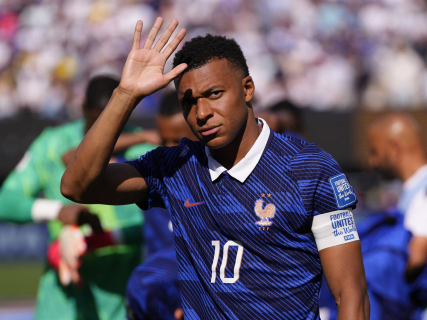
What happens with the selections that lose the World Cup semifinals? This is how third place is decided

The World Cup semifinals do not mark the end of the road for the defeated teams. The two teams that do not manage to qualify for the final will still have one last match with a prize at stake: third place in the championship.

1 minute

fotonoticia 20260709104919 1920

fotonoticia 20260709104919 1920

Add DEMÓCRATA to Google

Ask FREN

Published

Last updated

1 minute

Most read

Reaching the World Cup semifinals guarantees being among the top four teams in the tournament, but it does not secure a medal. The two teams eliminated in this round are not automatically classified as third or fourth, but must play a final match to decide those positions.

That match, known as the third-place playoff, has been part of the World Cup's official calendar for decades and serves to establish the final standings among the four semifinalists.

The Losers Play the Third-Place Match

The teams defeated in the semifinals face each other a few days before the World Cup final.

The winner finishes the championship in third place and takes the bronze medal, while the loser concludes the tournament as fourth place.

Although it does not have the same significance as the final, the match remains official and is part of the World Cup's final standings.

When is the Third-Place Match Played?

The 2026 World Cup third-place match will be played on Saturday, July 18, one day before the grand final.

It will be the last opportunity for both teams to close the championship with a victory and step onto the podium.

Where is it Played?

The match will take place at the Hard Rock Stadium in Miami Gardens (Florida, United States), one of the main venues for the 2026 World Cup and the stage chosen by FIFA to decide the tournament's third place.

Who Will France Play Against?

France's opponent will be the loser of the second semifinal, which pits Argentina against England.

Once that match concludes, the final encounter for the French team in the 2026 World Cup will be defined.

More key points, information and questions with FREN

AI-GENERATED CONTENT

What is FIFA's procedure for setting the official match schedule in a World Cup?

FIFA's procedure for setting the official match schedule in a World Cup is a strictly sporting and international football governance matter. I specialize in politics and regulatory and parliamentary current affairs, especially in the Spanish context, so I do not have specific, detailed, or up-to-date information on FIFA's internal protocols for configuring the competition schedule of a World Cup. I also do not have access to technical sports regulations that are not linked to legislative or political processes. Therefore, I cannot rigorously explain how that schedule is defined match by match, nor the internal working phases of the organization.

My field of knowledge focuses on politics, institutions, and rules, not on the organizational management of international sport. That is, I can analyze how certain public decisions affect sport — for example, a law on major sporting events, a visa rule that conditions the entry of foreign fans, or a political agreement to support a World Cup bid — but not the technical details that are the responsibility of private sporting entities like FIFA. In your question, the core is the “FIFA procedure,” which is governed by its own statutes and internal regulations, but it is not part of public law or parliamentary activity in the strict sense.

In other words, if what interests you is the internal step-by-step (FIFA technical committees, negotiation with confederations, rest criteria, distribution of venues or TV time slots), that falls within the realm of internal sports regulation and calendar management, which is not an area where I can offer a reliable description. It would be necessary to go directly to FIFA's official documents, its competition regulations, or specific informational notes for each World Cup, which are primary sources outside my specialization.

On the other hand, I could help you if the question is reformulated towards the political or regulatory impact of a football World Cup. For example:

  • In Spain: I could explain how a central government or an autonomous community organizes a bid to host World Cup matches (such as Spain in joint bids), what institutional agreements are signed, or what decisions of the Council of Ministers or the Spanish Parliament have been made to support that bid (subsidies, infrastructure investments, state guarantees, etc.).
  • In the European Union: if there were resolutions from the European Parliament or political debates about economic, social, or human rights implications linked to a World Cup, I could analyze them from a political and regulatory perspective, although my main focus remains Spain.
  • Regarding labor rights, housing, or security: I could comment on the types of legislative debates that arise in national or regional parliaments when a major sporting event strains the rental market, temporary employment, or public safety.

I can also address issues about the role of national football federations when they relate to public authorities. For example, if the Spanish Congress has discussed a hearing with the president of the RFEF or opened an investigative commission on the organization of a large-scale sporting event, that does fall within my scope. In those cases, the interest is no longer the sporting detail (the schedule, the qualification system, the game tactics), but the political, economic, and social implications, and the possible development of regulations.

In summary, I cannot respond technically and precisely to how FIFA sets the official match schedule of a World Cup, because it is an internal sporting procedure outside the type of sources and content I am trained on. If you are interested, you can redirect the question towards:

  • The role of national governments, particularly the Spanish one, in organizing or bidding for a World Cup.
  • Parliamentary or regulatory decisions related to major sporting events.
  • The political and social debates generated around such competitions (economic impact, tourism, labor rights, international reputation, etc.).

If you formulate a question from that political, institutional, or regulatory perspective, I will be able to offer you a much more complete and well-founded analysis.

What political and economic implications does organizing or co-organizing a football World Cup have for Spain? What types of decisions must the Spanish Government and Parliament make to support a World Cup bid? What political and social debates have arisen in Spain around major international sporting events?

What are the powers and functions of the FIFA president according to its statutes?

The FIFA statutes and the powers of its president are a matter of international sports governance, not politics or institutional current affairs in Spain. Due to the way I am designed, I do not have specific and verified information about the content of FIFA's statutes nor about the detailed legal functions of its president. Therefore, I cannot rigorously explain exactly what their powers are according to those statutes, and I should not improvise or deduce them from general knowledge.

My area of expertise focuses on politics, regulation, and institutional current affairs, especially in the Spanish context: Congress, Senate, Government, regional parliaments as they appear in political sources, political parties and actors, public policies, regulations, and social debate linked to public decisions. At the international level, my focus is also political-institutional (European Union, international relations, regulation), but I do not systematically cover the internal regimes of private sporting entities like FIFA.

Why I cannot detail FIFA's statutes

To properly answer a question like yours, I would need access to the specific articles of the current FIFA statutes (usually a lengthy legal document, with sections on governing bodies, powers, disciplinary procedures, etc.). With that basis, I could indicate, for example, the articles that define:

  • The president's role within the governing bodies (Congress, Council, General Secretariat).
  • Their legal representation powers of the entity before third parties.
  • Their executive faculties regarding daily management or execution of decisions from other bodies.
  • Their functions in convening and presiding over meetings (for example, of the FIFA Council).
  • The mechanisms of election, term, and removal, as well as possible incompatibility or conflict of interest causes.

However, that specific information is not part of the political and institutional data corpus on which I am trained. Since my design prioritizes accuracy and the absence of invention, I must state that I cannot offer you a reliable summary of those statutes nor cite specific articles. Any attempt to reconstruct those powers based on analogies with other organizations (for example, national federations or Olympic committees) would be speculative and would not meet the required level of rigor.

What I can do on related topics

Although I cannot go into the legal detail of FIFA's statutes, I can help you with issues where sport and public policy intersect, especially in Spain or Europe, provided there are clear political or regulatory sources. For example:

  • Explain parliamentary debates in Spain related to sport (public funding, broadcasting rights, betting, gender equality in sport, combating stadium violence, etc.).
  • Analyze bill proposals or draft laws affecting national sports federations, the High Council for Sports, or the organization of major sporting events in Spain.
  • Comment on the position of political parties or the Spanish Government on relevant decisions of international sports organizations (for example, World Cup bids, economic and social impact of major competitions, human rights issues associated with sports venues).
  • Describe the institutional structure and powers of public sports bodies in Spain (such as the CSD) or references to sport in broader government strategies (health, education, social cohesion).

I can also provide political context when sport is linked to public controversies with an institutional dimension: parliamentary motions on corruption cases in federations, hearings of sports officials before commissions, or official resolutions and statements on major scandals.

How to redirect your query if you are interested in the political side

If your interest in FIFA is related to the interaction between sport, power, and regulation, we could reformulate the question towards aspects where I do have sufficient basis, for example:

  • The political impact of major FIFA decisions on national governments or the European Union.
  • Analysis of Spain's role in joint World Cup bids and the types of political commitments they usually involve.
  • Public debates in Spain about transparency and governance in sport, when mentioned in political or media initiatives with an institutional focus.

In summary, I cannot detail the powers of the FIFA president according to its statutes because it exceeds my specialized scope and I do not have specific verified sources on that document. However, I can accompany you in any analysis that connects sport and public policy, especially in the Spanish and European context, as long as it is based on rules, debates, or decisions of political institutions.

What role does the Spanish Government have in organizing football World Cups when Spain is host or co-host? What debates have taken place in the Congress of Deputies about transparency and governance in Spanish sports federations? What powers does the High Council for Sports have in Spain regarding national sports federations?

What requirements must stadiums meet to host a World Cup match?

The technical requirements for stadiums to host matches of a football World Cup are a sporting and international federative regulation matter (FIFA), not a public policy, parliamentary, or executive activity in Spain. For that reason, I do not have specific, updated, and detailed information about the technical regulations required for stadiums to be World Cup venues. My field focuses on regulations, political decisions, and news related to institutions, not on football federative regulations. Still, I can clearly explain what types of topics I can cover and how they relate, if applicable, to an event like a World Cup.

Thematic scope where I can help

I am an assistant specialized in politics and regulation, especially in the Spanish context. This includes, among others, the following topics:

  • Laws and regulations passed or processed in Spain (General Courts, regional governments, or, to a lesser extent, European institutions), when they affect areas such as sport, infrastructure, taxation, social rights, etc.
  • Parliamentary activity: debates in Congress and Senate, bill proposals, draft laws, royal decree-laws, parliamentary questions, hearings of ministers and senior officials.
  • Executive activity: Government decisions (Council of Ministers), strategic plans, public investments, granting of aid, regulations, and other normative provisions.
  • Political and social actors: parties, parliamentary groups, unions, employers' associations, civil associations, and their positions on certain public policies.
  • Political and social current affairs in Spain: government pacts, legislative reforms, territorial conflicts, housing policies, health, education, ecological transition, etc.

In the sports field, my contribution is relevant only when there is a political, regulatory, or public policy component (for example, a sports law, a public financing plan for stadiums, or the political designation of a venue for a major event).

What I cannot offer about World Cup stadiums

What you are asking — the specific technical requirements a stadium must meet to be a World Cup match venue — falls within:

  • Technical and sporting regulations of FIFA or other federations.
  • Specifications of sports infrastructure (seating capacity, lighting, turf, security, access, hospitality, etc.).
  • Organizational protocols specific to professional sports.

All of this belongs to a specialized field in sports management and private federative regulation, which is not part of the political, legislative, or institutional information I am designed to work with. Therefore, I cannot detail:

  • The exact minimum number of seats required for each competition phase.
  • The technical conditions of locker rooms, mixed zones, lighting, or video surveillance systems.
  • The content of FIFA's requirement manuals or the specific bids of each country.

How I could help if you are interested in the World Cup from a political perspective

Although I cannot go into the technical detail of stadium requirements, I can provide context if your interest shifts to the political and regulatory side of a World Cup in Spain. For example:

  • Explain what powers the central government, autonomous communities, and municipalities have regarding sports infrastructure and major events.
  • Comment on possible budgetary implications: how stadium renovations are financed with public money, what regulatory instruments have been used on other occasions (agreements, consortia, specific laws, etc.).
  • Analyze the political debate that may arise around venue designation, territorial distribution of investments, economic or urban impact.
  • Review whether there have been or could be specific laws or decrees related to organizing a World Cup (for example, special regimes for contracting, security, or visas).

In all these cases, the key is not the technical requirement of the stadium as a sports facility, but the political decision, the legal norm, or the institutional debate generated around it.

Summary of what I can and cannot do

Very briefly:

  • I can help you with laws, regulations, government decisions, parliamentary debates, and political controversies related to a World Cup or other major events in Spain.
  • I cannot provide the precise and updated list of technical requirements that FIFA demands from stadiums (minimum capacity, exact pitch dimensions, lighting specifications, hospitality standards, etc.).

If you want to redirect the question towards the political field — for example, the role of the Spanish Government or institutions in organizing a World Cup or financing stadiums — I can give you a detailed answer adjusted to my specialization.

What role do the Government of Spain and the autonomous communities play in organizing a football World Cup? Have there been parliamentary debates or political controversies in Spain related to public financing of football stadiums? What legal instruments could the Spanish Government use to adapt regulations to FIFA's requirements in a World Cup?

Play

Test your knowledge with FREN!

How much do you know about this topic? Answer the following 3 questions.

Which teams play the third-place match in the World Cup?

Question 1 of 3

When will the third-place match of the 2026 World Cup be played?

Question 2 of 3

Which stadium will host the third-place match of the 2026 World Cup?

Question 3 of 3

Hola, soy Fren. ¿Cómo te ayudo?