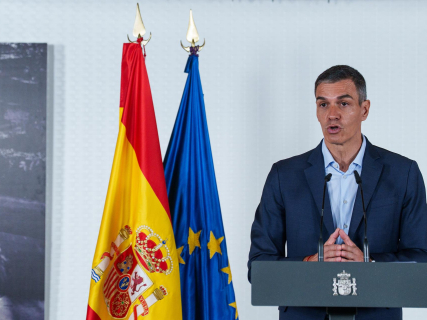

The President of the Government, Pedro Sánchez, announced this Monday the State Fertilizer Plan, a strategy that the Executive expects to have completed in the first quarter of 2027 and which incorporates financing, a defined timeline, and specific actions so that Spain can produce more and better, decrease its external dependence, and strengthen food security.
"We are launching this plan, which is very important for the sector, so that Spain, hand in hand with the other authorities and hand in hand with the sector, produces more and better, but also does so by reducing its dependence and we can more effectively support those who guarantee our food security," Sánchez assured at an event in San Martín de la Vega (Madrid).
As detailed by the head of the Executive, an interministerial working group is already operating and, in the coming weeks, a dialogue process will be opened with all administrations with competencies in this matter, as well as with sector agents, with the aim of having the plan "ready" in the first quarter of 2027.
The design of the plan pivots on three priority axes. The first is the promotion of precision agriculture, aimed at cutting costs and improving the profitability of farms. The second focuses on strengthening strategic autonomy to reduce external dependence. "We are not going to close ourselves off, but we must reduce dependence on energy sources that are not ours; it is about choosing to transform agricultural transformation to gain strategic autonomy and be sovereign from an agricultural point of view," he explained.
The third pillar is price transparency, through the creation of an information system on the fertilizer market that allows anticipating problems, detecting tensions, and reacting quickly to inflationary episodes like those recently experienced.
In this context, Sánchez announced that the first list of 425,000 beneficiaries of aid for the acquisition of fertilizers, amounting to more than 600 million euros, has been disseminated today, as part of the package of measures linked to the war in Iran. In addition, he recalled that last Monday the Council of Ministers approved an increase of 165 million euros in the fund allocated to the purchase of fertilizers.
"In total, we have mobilized more than 1.1 billion euros in aid to the primary sector to alleviate this crisis, a figure that is more than double the European average. Furthermore, we continue to support measures that are already working. With the second Royal Decree of response, we practically double the aid per hectare, maintain the discount of 20 cents per liter of gasoil A, and consolidate the specific ICO Line, with up to 300 million euros for financing," he recalled.
The President of the Government emphasized the need to offer a "structural response to conjunctural challenges, with transformations towards a more sustainable, more efficient, and less externally dependent agriculture." "I believe this is how we protect the primary sector, farmers, and ranchers with actions and not just with words," he indicated.
He also stressed that "it is a plan about a transition that we must face together and that must be fair, thinking above all about farmers and ranchers so that we have fair prices and, of course, also more vibrant towns, because rural Spain is not a periphery of progress, it is one of its backbone, because it is what produces, feeds, and protects our territory, preserving our diversity."
Planas backs the Spanish fertilizer strategy
For his part, the Minister of Agriculture, Fisheries and Food, Luis Planas, pointed out that the agricultural sector faces a "very important challenge" regarding fertilizers, whose prices have soared by 60% since the start of the war in Ukraine and have increased by more than 30% with the conflict in the Middle East.
The minister valued that the Government has already made a "very important sum" available to the sector to compensate for the increased cost and defended the need to move towards a more efficient use of fertilizers. "There is no sustainability if there is no profitability, and we agree that this profitability gives us the guarantee of the future of production," he stressed.
Planas insisted that this state fertilizer plan constitutes the "Spanish contribution to European action." "This fertilizer plan perfectly designs the short, medium, and long term. The European Commission has fallen short in the short term, but the Government of Spain has been there to carry out this task, which is absolutely necessary for the future," he reiterated.