
The negotiation of the European Union budgets continues in Brussels, a debate that always coincides with the reform of the Common Agricultural Policy, since, traditionally, this has been the policy that has received the largest slice of the budgetary pie.
Facing the next period 2028-2034, the European Commission has guaranteed the amount allocated to direct aid received by farmers (with 302,000 million euros), but not for the rest of the measures, such as support for eco-schemes (aid for agri-environmental practices), aid to fruit and vegetable organizations (one of the most powerful sectors in Spanish agriculture, which in 2025 reached exports worth 7,293 million euros), and other support for modernization and development.
In this regard, the European Commission proposes that in order for the European, and Spanish, agricultural sector not to lose the economic support of recent decades, the member states co-finance those measures that the Single Fund does not cover 100%.
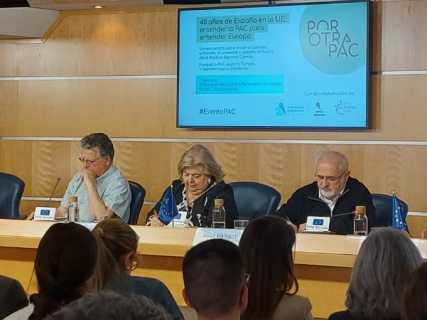
“The CAP is the only policy that manages to maintain the budget for direct agricultural aid. Other rural development, cooperation, and training measures are not at that level, which is why greater co-financing from member states will be needed,” pointed out the deputy head of unit of the Environmental Sustainability Unit of the European Commission, Gregorio Dávila, at the conference “40 years of Spain in the EU: understanding the CAP to understand Europe” organized by the organization Por Otra PAC in Madrid.
To date, the public administrations of the member states (both national and regional) had co-financed the Leader Programme for the promotion of rural development, but now they go further because it is opening up to many more.
“It is necessary to extend the protection that direct CAP aid has to other types of support, such as investments in modernization or generational renewal,” has pointed out the popular MEP Esther Herranz, to which she added “There is a risk of renationalization of the CAP, and there an space for unfair competition opens up among the member states themselves.”
Aid to fruits and vegetables and environmental
On the other hand, the former PSOE MEP, Clara Aguilera, has asked that aid to fruit and vegetable producer organizations also be included in that protection, since otherwise Spain could lose a lot in the sector where it is strongest. "The financing of POFFVs (Producer Organizations of Fruits and Vegetables) must be included in European financing, we cannot rely on co-financing," she stated.
For their part, the head of the Food Programme at WWF Spain, Celsa Peiteado, insisted that the environmental aid for eco-schemes also form part of this ring-fenced amount.
Strategic Autonomy
Several participants in the meeting highlighted that agriculture and food are strategic for a society, even in periods of uncertainty like the current one. In this regard, they pointed out that it should be one of the priorities of Strategic Autonomy proposed by the European Union alongside defense, technology, or competitiveness.