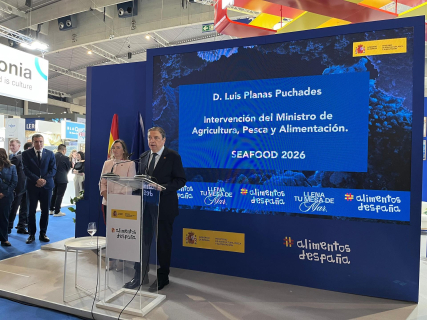

The Minister of Agriculture, Fisheries and Food, Luis Planas, has pointed out that in Spain the impact of the conflict in the Middle East is mainly manifested in the increase in the price of food and not in supply problems. Therefore, he has called on the business community for an effort "to limit and cap these increases" to ensure that citizens have sufficient and quality products, but also at "reasonable prices".
Planas made these statements this Wednesday during the 32nd edition of Seafood Expo Global 2026, which is being held from April 21 to 23 at the Gran Vía venue of Fira de Barcelona, in L'Hospitalet de Llobregat (Barcelona). The Ministry is participating with an institutional stand of 248 square meters, which brings together 20 key companies and entities in the fishing sector.
The minister pointed out that the war is generating strong increases in the costs of diesel and fertilizers, as well as specific tensions in the fishing sector. He stressed that the conflict "constitutes an element of disruption, apart from those relating to freight and the functioning of maritime traffic".
Faced with this scenario, it has detailed that the Government has launched a global aid of 25 million euros intended to compensate for the increase in the price of fishing diesel, which accounts for around 30% of the cost of inputs for each vessel. It has added that the Executive is also working with the new European Union fertilizer plan to reduce Spain's dependence on fossil fuels for fertilization.
"The Government has assumed its responsibility by providing these supports in the face of an overcost, but each of the links in the food chain must also assume theirs," he stressed.
Possible VAT reduction and price monitoring
Questioned about whether the Executive is considering a reduction in food VAT to curb the price escalation, Planas has assured that the Government keeps all options open and that a nearly daily monitoring of the situation is being carried out. He specified that not only the general economic evolution and energy costs are being analyzed, but also how all this is transferred to the prices of the shopping basket.
"Evidently the package we approved is for the months of April, May, and June and I believe that, if we make that effort, today prices are contained at quite reasonable levels, within what can be considered reasonable in this context," he added.
Strength and economic weight of the Spanish fishing sector
In relation to the Seafood Expo Global, Planas has remarked that the presence of more than 250 Spanish companies at the fair demonstrates the solidity of the fishing sector and its essential role in food security. He has described "a sector that provides employment, creates wealth, and is also, for a country like Spain, which has more than 8,000 kilometers of coastline, a fundamental structuring element for all our coastal communities".
He recalled that Spanish fishing activity generates a turnover of more than 8 billion euros and more than 25,000 direct jobs, with a wide presence that covers extractive fishing, fresh fish, frozen products, the processing industry, preserves, and aquaculture. All of this, he indicated, configures "a very powerful presence and reality" in the country.
Planas has insisted that Spain practices sustainable fishing, adjusted to available stocks according to scientific evidence, and has highlighted that the country is a pioneer in the fight against illegal, unreported, and unregulated fishing, "which is undoubtedly one of the major future problems for the extractive fishing sector."
Barcelona, world showcase of the fishing world
During his stay in Barcelona, the minister has held bilateral meetings with the Minister of Fisheries of Canada, the Minister of Fisheries of Brazil, and the executive secretary of the General Fisheries Commission for the Mediterranean of the FAO. Likewise, he has scheduled meetings with the ministers of Norway, the United Kingdom, and Iceland, as well as with the deputy minister of Oman.
In his opinion, the celebration of this exhibition consolidates Barcelona as "the reference and the capital of the Spanish fishing world" on an international scale. He has considered that it is a strategic opportunity to project Spain as an agri-food and fishing power and to strengthen ties with other countries through new institutional and business contacts.