
The Minister of Agriculture, Fisheries and Food, Luis Planas, has said this Thursday that there is "a positive maintenance production" of olive oil after the withdrawal of about 188,000 tonnes, equivalent to 12%, applied for the past around 20 days for the 2026/2027 campaign, with the aim of regulating supply in a scenario of possible overproduction, while he also noted that "the price at source is rising slightly".
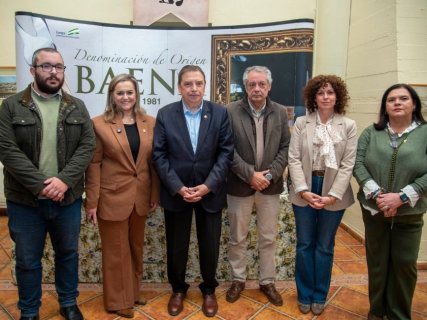
Planas made these statements on World Olive Day, after his visit to the Baena Town Hall (Córdoba), accompanied by the mayor, María Jesús Serrano, and the acting government deputy in the province, Raquel Casado. He then met with the Regulatory Council of the Protected Designation of Origin (DOP) Baena, which markets the largest volume of extra virgin olive oil, with 39,500 tonnes in 2025, a figure whose value represents more than half of that generated by the entire set of the sector's geographical indications (33 DOP and three IGP).
Regarding the withdrawal of oil, he detailed that "in the first days of implementation of the rule, normal monitoring has been carried out", within "a stability and regulation rule", emphasizing that no "disruptive effects" are intended. Thus, he has advanced that "on 31 December it will be seen what the situation is, and depending on this, it will be seen whether the amount stored is reduced or maintained over the coming months until the end of the campaign".
The head of Agriculture recalled that, when the measure was adopted, he already warned that "no one should be worried that it would have a direct effect on inflation", noting that "three years ago, with the rapid rise in prices, it logically meant that households had greater difficulties in purchasing and consumption decreased by around 15%".
Planas referred to the latest data released by the International Olive Council, which place this year's global production at around 3.7 million tonnes, with an increase of 6%, while in Spain the increase reaches 24%. Based on these figures, and considering an approximate outflow of 520,000 tonnes in the domestic market and 1.07 million tonnes in foreign markets last year, he has defended that "this is the reason" that has led to establish "the mandatory storage of 12%, approximately 188,000 tonnes of the sector".
With this, the minister has insisted on the need to “stabilize the markets, supply and demand” and, above all, “to avoid, above all taking into account the scale of the figures announced, that, as has happened on other occasions, a collapse in prices should occur that would affect first and more seriously traditional olive growing, such as that of this region, which has higher production costs than intensive or super-intensive olive groves”.
He has also specified that “this year the campaign is particularly important, the fourth most important of the last 20 years, which sets capacity at 1.6 million tons, which added to the 354,000 of the linking ‘stock’ brings us to figures very close to two million tons in Spain”.
This reality he has addressed with the 19 cooperatives integrated in the DOP Baena, which he has defined as “an excellent example of the best that our entire olive-growing sector has, and particularly the olive growing that produces extra virgin olive oil, which is the most important product from the point of view of the reference internationally”.
Mandatory withdrawal of production from November
The regulations establish that each mill must apply a 12% mandatory withdrawal on its accumulated monthly production, regardless of the oil category. Facilities have freedom to decide what type of oil to immobilize and whether storage is carried out in their own tanks or in facilities belonging to third parties.
The percentage is calculated from the entry into force of the resolution, so it affects the production declared from November and not that of October, the first month of the campaign. Both monthly production and final stocks must be communicated through the usual channels of the SIMO.
To ensure compliance with the measure, a technical group has been formed tasked with approving a control plan coordinated by the Ministry and carried out by the autonomous communities. Operators are required to provide the requested documentation and to allow “on-site” inspections.
CAP and the financial horizon up to 2028
In another matter, and regarding the Informal Council that is being held this Thursday in Brussels to analyze the evolution of the Common Agricultural Policy (CAP), as well as the December Formal Council, in which the aim is to "close the financial perspectives for 2028," Planas has emphasized that "Spain's positions are very clear," calling for "a CAP that is genuinely European and, in turn, flexible in order to be able to apply it in the autonomous communities."
As he noted, "the European character of the policy has been safeguarded by the agreement adopted about a month ago in the Council in Luxembourg and now moves to the European Parliament for the decision-making procedure," while "the second part is the one referring to the funds," where the Spanish Government intends to "maintain the same funds during this period" and the minister considers that "this is very important for the future, because it is necessary for our farming and livestock sector."
He stressed that "food security implies not only having food in quantity and quality, but also having it at prices that are reasonable," so that "the CAP plays a very important role, because it effectively is support for the primary producer, but by supporting the primary producer, families, households, citizens are also being supported, and it is a fundamental element."
He has also reiterated that his objective for the next CAP is to "maintain support for the specific olive grove," recalling that "cereals and olive groves are the first two sectors receiving CAP aid."
He has also focused on generational renewal, ensuring that this is "the CAP of generational renewal," due to "demographic need" and "productive characteristics, which is what is happening in relation to irrigated agriculture and its modernization, with precision agriculture and digitization," which "implies new trades, attitudes, and a different way of doing things."
As a third "very important" pillar, he cited "competitiveness, the need for farms to be larger or else that they be grouped," highlighting that "cooperatives play a fundamental role there."
Protests in Brussels over cuts to the CAP
Regarding the mobilizations called for this Thursday in Brussels by the agricultural sector in protest against the cuts in the CAP, Planas has considered that "it is absolutely legitimate" and said he shares "the sector's concern," although he has stressed that "what matters is the final outcome."
In this sense, he has pointed out that "the professional agricultural organizations and cooperatives are calling for fair treatment for the agricultural and livestock sector within the framework of the upcoming CAP", something that "is correct" and with which he is "in agreement", adding that "surely the demonstrations will be peaceful and respectful, as they have to be, but you have to mark the point", in defense of "food security".