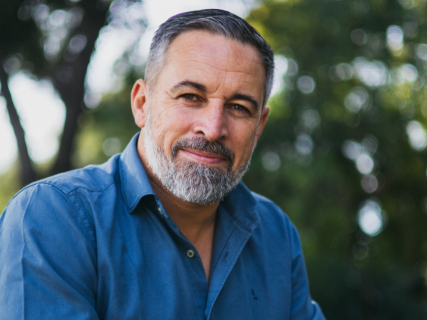










Five days before the general elections of 29N, Santiago Abascal, candidate of Vox for Prime Minister, distrusts the polls, accuses the head of the Executive of being able to "manipulate" the elections, and leaves it in the hands of the PP to consider the possibility of an agreement: "It is Mr. Feijóo whom you have to ask whether he is willing to reach an agreement with me or whether he prefers the wreckage of the Sánchez.".
Over the last few weeks, Vox leader has traveled across Spain from one end to the other. The strategy was clear: to fix the mistakes of 2023, when thousands of votes in the smallest regions did not translate into seats. Along the way, he answers the questions posed by DEMÓCRATA.
Abascal defends his economic and social proposals, hardens his migration rhetoric, and avoids judging the actions of Felipe VI, with whom he hopes to maintain a relationship of "loyalty and institutional normality" if he comes to Government. He also does not hide that for some time he has been thinking about who would occupy Vox ministries if they join with the PP after 29N.
QUESTION: At the start of the campaign, he warned his supporters that his greatest enemy was overconfidence and asked them not to trust the polls. What is the thing that worries him the most in these last days of the campaign?
ANSWER: I am worried about traps, of course. I don't believe there is anyone in Spain who doesn't know that Sánchez is capable of manipulating the elections if he has the chance. We have seen it with the grandkids law. But I hope that a massive mobilization makes any manipulation pointless.
P: We move on to the electoral program. In terms of housing, Vox advocates eliminating taxes for the purchase of a first home. How would you prevent that cut from ending up making prices more expensive?
I think we have, without a doubt, the best housing program. The only one that guarantees a drop in prices that will allow Spaniards to access a home. But none of the measures will succeed on its own.
It is a matter of supply and demand, of elementary math. In five years, six million people have entered, and fewer than half a million homes have been built. We must expand supply by building social housing, on the one hand, and on the other hand by deregulating and freeing up land to bring down the cost of construction in general. And we must reduce demand by protecting borders and accompanying to the airport those foreigners who are in Spain without permission, those who commit crimes, and those who live on social aid that does not reach Spaniards.
But it is true, and this is what we denounce, that the administrations collect 52 billion euros a year in taxes related to housing. In fact, one in every three euros that a young person pays for their first home goes to taxes and bureaucracy. .
Q: Another of the campaign promises they have made is to repeal the Government of Sánchez’s labor reform. What specific aspects do you consider the most harmful? Would you reinstate contracts for works and services? What would you change in terms of dismissals?
A: We want to repeal practically everything that this Government has done. This Government has managed to ensure that wage earners have less and less purchasing power and that, in addition, they have to compete with millions of newly arrived people who are being regularized at full speed. Meanwhile, the unions have been silent. We will have to seek a broad agreement to reform the labor market and that there are no more wage earners on the road to ruin.
Q: Changing the subject, in energy policy for this 29N they defend keeping nuclear power plants open, studying the construction of new facilities and reversing the restrictions derived from the European Green Deal. What role would you reserve for renewable energies and how would you guarantee compliance with Spain’s climate commitments within the European Union?
A: The European Union is changing course after years of political bulldozing that put ideology ahead of prosperity. In fact, now they say that nuclear is green. Most of the renewable energies that you call renewable energies are intermittent energies. We have to make use of them. Spain has light, water, elevation changes and wind.
But adapting to those energies cannot be at the expense of prosperity, of the competitiveness of our industry, and even of the security of Spaniards. I remind you that the unprecedented national blackout to which Sánchez’s climate fanaticism drove us caused deaths.
Q: In another point of the program, they advocate promoting Artificial Intelligence, but data centers are not mentioned. Amid the controversy over the royal decree with which the Government wants to regulate these facilities and that has provoked the rejection of the sector, what position does Vox have?
R: Artificial Intelligence, and everything that entails, including data centers, is the train of a future that Spain cannot afford to miss. Energy, water, rare minerals and sensible regulation. Those four concepts are key for future development. The first thing to do is to stop prohibiting ourselves from exploring and exploiting our resources and possibilities. All of this is necessary to reindustrialize Spain, to attract investment and create quality jobs.
P: Another of your commitments is to repeal three regulations for every new law that is approved. Do you consider this measure viable in practice? How would it be decided which regulations?
R: I am sure that Spain can reduce paperwork and bureaucracy, which are a burden on freedom and the economy. Overregulation amounts to an invisible tax of 70,000 million euros per year. It is what it costs to navigate the legal and regulatory labyrinth where thousands of opportunities and business and life projects are lost.
P: In terms of immigration, they propose "facilitating the return of foreigners who do not contribute economically or depend on public aid". What does "facilitating" imply? Would this measure include immigrants with legal residence who have become unemployed or need, temporarily, a social benefit?
R: It seems pure common sense to send the message that you cannot come to Spain to live off of others. Another thing is that immigrants who are working and contributing have generated certain rights and, of course, those rights have to be respected. But that does not mean that they have acquired the right to stay permanently in Spain living on aid. If someone goes to a country to work and the work ends, the logical thing is to return. Yes, with respect for their acquired rights.
P: In this regard, they also defend deporting foreigners who try to impose customs or cultures incompatible with our way of life. What specific behaviors would justify an expulsion and who would determine that a custom is incompatible with Spanish society?
R: Common sense. If there is a gentleman, for example in a mosque, saying 'women are impure beings', then he has to go. I am talking about intolerance, about Islamist fanaticism, about the burka, about the conception of women as second-class citizens and an endless number of behaviors that have been gaining ground in our country and that we should not tolerate.
Q: After the controversy about pensions, you went out to reassure pensioners and you said they would be safe with Vox. Now several LGTBI groups have expressed their concern about the proposals of your party. Do you understand their fears?
A: Those groups you are talking about most of the time do not represent people, but ideological and economic interests. I think most gay people are going to end up voting for Vox, because it is the only party that defends them against the growing homophobia in Spain, which is fully imported from abroad.
Q: Continuing on the social level, they have shown support for repealing the laws on abortion and euthanasia. What alternatives would you offer to women who want to voluntarily end their pregnancy and to patients who request medical help to die?.
A: For either case, information, assistance, support, and alternatives. 370,000 people need palliative care every year and only 40% receives attention from a specific team. You cannot talk about voluntary choice when there are no alternatives. The same happens with unwanted pregnancies or with complexities, which makes it easier to point to abortion as the solution instead of offering them assistance.
"We want to repeal practically everything this Government has done"
We will support any initiative that protects more the right to life of the most vulnerable, whether they are sick or unborn. And we will oppose any law that continues to leave that right unprotected.
Q: Looking beyond, your election program calls for recovering an international position that "prioritizes Spain's interests," but it hardly outlines what relationships it wants to maintain with the great powers. What would the foreign policy of a Vox Government be like?
A: We have worked on a vast network of allies around the world, both in Europe and in America. Spain has natural allies and they are not the terrorists of Hamas, who dream of Al Andalus. That said, Spain's international policy must first meet the interests of the Spanish people, as we effectively say.
That is the guiding principle and from there it is developed with common sense: we will get along with governments that respect our sovereignty and our interests, even if they do not share them completely, and we will get along worse with those who do not respect one or the other.
Q: Next year will be the 50th anniversary of the first democratic elections. You have questioned the cleanliness of the polling and have recommended not voting by mail. Don’t you think these statements could undermine Spaniards’ trust in the process?
A: I think the vast majority of Spaniards do not have confidence in the government of Pedro Sánchez. The example I gave at the beginning of the law of grandsons is clear. Sánchez and his have tried to adulterate the census, and they have managed to do so in part.
I don’t think there is any responsible democratic position that does not involve denouncing those abuses. Denouncing these irregularities and restoring neutrality to institutions is something that favors democracy and transparency in the process.
Q: In recent months, you and other Vox leaders have expressed your displeasure with some actions by Felipe VI; for example, not congratulating María Corina Machado. Do you consider that the King is adequately fulfilling his constitutional role? What relationship do you expect to maintain with the Crown if you come to Government?
A: It’s not up to me to judge the King’s work, who is the head of State. And, as with all Spaniards, we’ll like some things more and others less. Of course, I hope to have a relationship of loyalty and normal institutional conduct.
Q: You and Alberto Núñez Feijóo have maintained major disagreements throughout the legislature. Do you trust him as a possible Government partner? Do you think they could get along in order to govern together?
A: We have maintained and we continue to maintain major disagreements. Another thing is that we are aware of the very serious moment Spain is going through under a corrupt and treacherous government that is against Spain’s interests. Because that corruption and that betrayal ruin and kill.
"It’s not up to me to judge the King’s work"
That said, we have shown our ability to reach agreements. We have done it in four regions. In others, the Partido Popular has not wanted to reach an agreement with us and has preferred the socialists or the regionalists, as in Ceuta or in Cantabria... Therefore, it is up to Mr. Feijóo to be asked whether he is willing to reach an agreement with me or whether he prefers to reach an agreement with the remains of Sánchez’s shipwreck.
Q: In the United Kingdom there is the tradition that the opposition has its own Shadow Cabinet, a shadow cabinet in which each leader follows a government area. Do you already have in mind who would occupy the main ministries if you were to reach the Moncloa?
R: That folder I’ve been working on for a long time. But I won’t open it until we manage to evict from the Moncloa the criminal organization that is now occupying it.
In detail:
Santiago Abascal faces next 29 November his sixth general elections at the helm of Vox, a decade after his first attempts to enter Congress.
In December 2015, the party barely gathered 57,733 votes, 0.23% of the total national. Six months later, in the electoral repeat of June 2016, support fell to 46,781 ballots, 0.2%. In both calls, it was left out of the Cortes.
The story began to change in April 2019, when Vox burst into Congress with 24 deputies. Just seven months later, in November, it secured 52 seats, its best result to date.
However, in July 2023 the party retreated to 33 deputies, although it retained its position as the third parliamentary force.
Now, the polls published in the final stretch of the 29N campaign attribute to the far-right formation around 19% of the votes. If confirmed, it would be its best result to date and the key to reaching the Moncloa.