
The Minister of Agriculture, Fisheries and Food, Luis Planas, has said this Thursday that there is “a positive maintenance production” of olive oil after the removal of about 188,000 tonnes for the 2026/2027 campaign, equivalent to 12% of production, applied for about 20 days in order to regulate supply in view of the forecast of surpluses, while “the price at origin is growing slightly”.
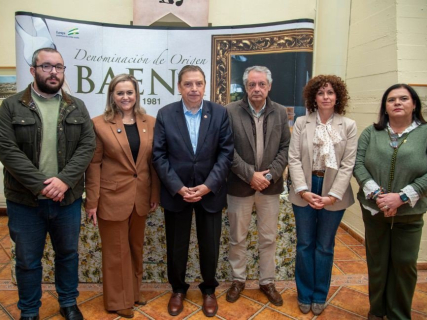
Planas made these remarks on World Olive Day, after his visit to the Baena Town Hall (Córdoba), accompanied by the mayor, María Jesús Serrano, and the acting government sub-delegate in the province, Raquel Casado. He later met with the Regulatory Council of the Protected Designation of Origin (DOP) Baena, the one that markets the highest volume of extra virgin olive oil, with 39,500 tonnes in 2025, a value that represents more than half of that generated by all the sector’s geographical indications (33 DOP and three IGP).
Regarding the withdrawal of oil, he indicated that “in the first days of implementation of the rule, normal monitoring was carried out”, within the framework of “a stability and ordering rule”, emphasizing that it is not intended “to produce disruptive effects”. Thus, he specified that “on 31 December it will be seen what the situation is and, depending on that, it will be seen whether the stored quantity is reduced or maintained over the coming months until the end of the campaign”.
The minister recalled that, when the measure was adopted, he had already warned that “no one should be worried that it would have a direct effect on inflation”, remembering that “three years ago, with the rapid rise in prices, it logically made it more difficult for households to buy and reduced consumption by about 15%”.
He also referred to the latest data released by the International Olive Council, which place this year’s global production at around 3.7 million tonnes, with an increase of 6%, while in Spain the increase reaches 24%. In this context, he explained that “this is the reason”, taking into account the approximate outflow of 520,000 tonnes in the Spanish domestic market and the 1.07 million tonnes exported last year, “to make the decision on the mandatory storage of 12%, approximately 188,000 tonnes from the sector”.
Planas has thus defended the need to “stabilize the markets, supply and demand” and, given the volume of production forecast, to prevent “a collapse in prices that would affect first and most seriously traditional olive growing, like that of this region, which has production costs higher than intensive or super-intensive olive groves”.
He has also specified that “this year the campaign is particularly important, the fourth most important of the last 20 years, which sets the available capacity at 1.6 million tonnes, to which are added the 354,000 of the ‘link stock’, placing us in figures very close to two million tonnes in Spain”.
This situation has been analyzed with the 19 cooperatives integrated into the Denominación de Origen Baena, “which are an excellent example of the best that our entire olive sector has and particularly of the olive groves that produce extra virgin olive oil, which is the most important product from the point of view of reference at an international level”.
Mandatory withdrawal of production from November
The regulations establish that each oil mill must apply 12% of mandatory withdrawal to its accumulated monthly production, regardless of the oil category. The facilities may choose what type of oil to withdraw and decide whether storage is carried out in its own premises or in facilities belonging to third parties.
The percentage is calculated from the entry into force of the resolution, so it affects the production declared from November onward and excludes that of October, the first month of the campaign. Both monthly production and final stocks must be reported through the usual channels of the SIMO.
To ensure compliance, a technical group has been formed tasked with approving a control plan coordinated by the Ministry and carried out by the autonomous communities. Operators must provide the required documentation and allow “in situ” inspections.
CAP and the financial framework up to 2028
In relation to the Informal Council that is held this Thursday in Brussels on the development of the Common Agricultural Policy (CAP) and the Formal Council of December, in which it is hoped to “close the financial outlook to 2028”, Planas has emphasized that “Spain’s positions are very clear”, calling for “a CAP that is truly European and, in turn, flexible so that it can be applied in the autonomous communities”.
As he has detailed, "the character of European politics has been safeguarded by the agreement adopted about a month ago at the Council in Luxembourg and now it moves to the European Parliament for the decision-making procedure", while "the second part is the one referring to the funds", where the Spanish Government intends to "maintain the same funds during this period" and the minister considers that "this is very important for the future, because it is necessary for our agricultural and livestock sector".
He added that "food security implies not only having food in quantity and quality, but also having it at prices that are reasonable", and that in this respect "the CAP plays a very important role, because in effect it is support for the primary producer, but by supporting the primary producer, families, households, citizens are also being supported, and it is a fundamental element".
Planas also reiterated that his objective for the next CAP is "to maintain support for the specific olive grove", recalling that "cereals and olive groves are the first two sectors to receive CAP aid".
He also put the focus on generational renewal, assuring that this is "the CAP of generational renewal", both due to "demographic need" and "productive characteristics, which is why what is happening in relation to irrigation and its modernization, with precision agriculture and digitization", processes that "implies new trades, attitudes, and a different way of doing things".
As a third axis "very important", he has cited "competitiveness, the need for farms to be larger or else to be grouped together", highlighting that "cooperatives play a fundamental role there".
Protests in Brussels over the CAP
With regard to the mobilizations of the agricultural sector this Thursday in Brussels over cuts to the CAP, Planas has pointed out that "it is absolutely legitimate" and that he shares "the concern of the sector", although he has insisted that "what is important is the final result".
In this regard, he indicated that "the professional agricultural organizations and cooperatives are demanding fair treatment for the agricultural and livestock sector within the framework of the next CAP", something that "is correct" and with which he is "in agreement", to add that "surely the demonstrations will be peaceful and respectful, as they have to be, but you have to mark the point", with reference to the objective of guaranteeing "food security".