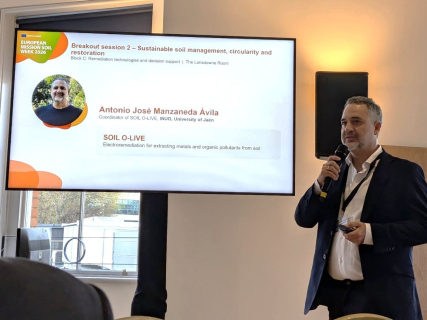

The Soil O-Live project, focused on olive grove soil health, has released part of its progress in the fourth edition of the European Mission Soil Week, held in Dublin (Ireland).
Representatives from political bodies, researchers, farmers, companies and administrations from different European countries attended the event to analyze progress toward the goal of having healthy soils by 2030.
This annual event is the main forum of the EU Mission 'A soil deal for Europe', promoted by the European Commission’s Directorate-General for Agriculture and Rural Development, with Teagasc and the Irish presidency of the Council of the EU as organizers, according to the University of Jaén (UJA).
Soil O-Live, coordinated by Professor Antonio J. Manzaneda, from the University Institute for Research in Olive Groves and Olive Oils (INUO), was one of the projects selected for this Wednesday’s 'pitching' session. In this space, the initiatives funded by the Mission presented to the Commission and the European soil community those results with the greatest potential for practical application.
The European Research Executive Agency selected the results based on the proposals submitted by the Mission projects and, finally, only 32 of them were able to present their progress in this session. The work led by the UJA was one of those chosen, with the possibility of showcasing two key achievements: a European protocol to produce oil while respecting the soil and a portable system that makes it possible to clean the soil without the need to excavate.
"That the Commission has selected Soil O-Live among so many Soil Mission projects and, in addition, with two results, is recognition of the work of the entire consortium and places olive groves at the center of the European debate on soil health," Manzaneda highlighted.
The researcher also stressed that "the olive grove is an early warning system", so that "what is happening with its soils anticipates what may occur in a large part of Mediterranean agriculture".
A European protocol with 235 practices for a more sustainable olive grove
The first result, included in the block 'Practices for healthier soils', is CWA 18346, a Workshop Agreement of the European Committee for Standardization (CEN) on sustainable production of extra virgin olive oil, published in February 2026.
This document has been prepared within the framework of Soil O-Live together with the Spanish Association for Standardization (UNE) and the company Deoleo, and was agreed upon with producers, the International Olive Council, research centers, universities, and certification entities.
The protocol includes 235 practices grouped into eight areas. Soil management occupies a central place, with requirements relating to erosion control, the use of cover crops, the increase of organic carbon, and the reduction of contamination from copper and other agrochemicals.
Portable technology to clean olive grove soil without digging
The second result, presented in the block 'Remediation and decision-support technologies, consists of a portable electremediation system, powered by solar energy, that removes copper and pesticide residues from olive grove soil in situ, without the need to excavate.
This development is led by a team from the University of Castilla-La Mancha, with the collaboration of the UJA and the Institute of Sustainable Agriculture (IAS-CSIC). After its validation in the laboratory, in 2026 it was tested for the first time on an olive-growing farm in the province of Jaén. The problem it addresses is clear: the project’s analyses found the presence of copper in all 494 soil samples taken from 53 olive groves in five countries.
Soil O-Live (Soil biodiversity and functionality of Mediterranean olive groves) is part of the Mission 'A soil deal for Europe' of the Horizon Europe program (grant agreement 101091255), is coordinated by the University of Jaén, and has funding from the European Union.
The initiative aims to understand how olive grove management influences biodiversity and soil functioning, as well as the quality and safety of oil. To do so, it brings together universities, research centers, and companies from various European and Mediterranean countries.