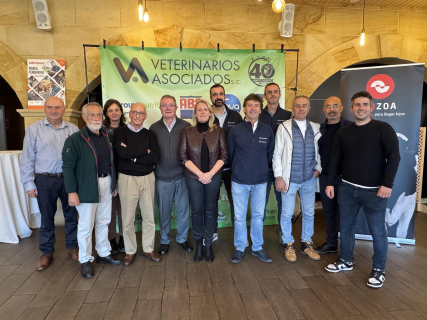

The Counsellor for Rural Development and Livestock, María Jesús Susinos, has underscored the "key and essential" role played by the Association of Veterinarians in animal health and in the development of livestock farming in Cantabria, during the closing ceremony of the celebrations for the entity’s 40th anniversary.
As the regional Executive has stated in a press release, this commemoration has made it possible to highlight four decades of dedication to the service of the community’s livestock sector, animal health, and the rural environment as a whole.
In her remarks, Susinos reviewed the evolution of the veterinary profession from the eighties to today, recalling a clinical practice in the rural setting which, forty years ago, required full availability, had fewer technological tools, and demanded a high capacity for observation and solid experience in professional practice.
She also highlighted the mutual trust between veterinarians and livestock farmers, a relationship which, in her view, "continues to be one of the sector’s main assets".
The head of Rural Development also emphasized "the importance of passive health monitoring", a task in which field veterinarians assume a "fundamental" role.
Along these lines, she detailed that the early detection of abnormal signs, the identification of possible emerging diseases, and the immediate communication of any suspicion "constitute the first line of defense against increasingly complex health threats".
She likewise stressed that "the first barrier against a disease is often in the gaze of a veterinarian who enters a stable", and therefore she reiterated that what is needed is their "experience, closeness to the livestock farmer, and the ability to identify any health suspicion at an early stage".
In this context, she reiterated that animal health is a shared responsibility between the Administration, veterinary professionals, and the livestock farmers themselves.
To conclude, Susinos conveyed her congratulations to all the veterinarians who have been part of the Association during these four decades and highlighted that the main legacy of its founders has been to build an organization capable of standing the test of time and continuing to provide service to livestock farming in Cantabria.
The counselor also had words of recognition for the four veterinarians who promoted the creation of the Association forty years ago: Juan Carlos Abascal, Ignacio Abascal and Ismael and Federico Aja.