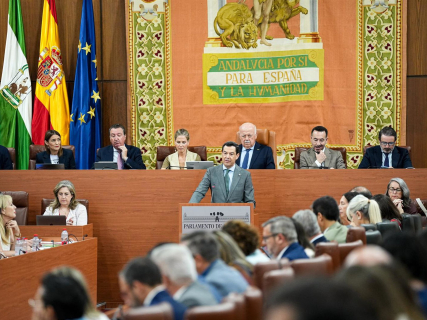

The Andalusian Parliament had to resort to more than one vote to designate the person who would occupy the Presidency of the Board in 1994, when the candidate was Manuel Chaves, and in 2015, with the also socialist Susana Díaz as aspirant.
Thus, in the trajectory of the regional Chamber, there are two direct precedents to what happened this Tuesday, June 30, 2026, when the first vote to which the candidacy of the leader of the PP-A, Juanma Moreno, has been submitted for investiture as president of the Board has concluded without success for the candidate, failing to achieve the absolute majority required to be elected in that first round.
On this occasion, the aspirant was defeated in the vote, which resulted in 53 supports in his favor --those of the Popular Group-- and 56 votes against, the result of the sum of the negative supports from the PSOE-A (28), Vox (15), Adelante Andalucía (8) and Por Andalucía (5).
Following this outcome, and in application of the provisions of the Statute of Autonomy, the President of the Parliament, Jesús Aguirre, has set a second vote 48 hours after the one held this Tuesday, that is, from 7:00 p.m. on Thursday, July 2. In this new session, confidence would be considered granted to Moreno if he achieves a simple majority, that is, more affirmative votes than negative ones.
The Statute of Autonomy specifies that, in case of "not obtaining said majority" in that second vote, "successive proposals" of candidates for the Presidency of the Board "will be processed in the foreseen manner", and if, "after the period of two months from the first vote, no candidate has obtained the simple majority, the Parliament will be automatically dissolved and the acting President of the Board will call new elections".
Investitures in the history of the Andalusian Parliament
Since the first Andalusian regional elections in 1982, only on two previous occasions to 2026 was it necessary to repeat the vote for the proposed aspirant to be invested president of the Board, according to parliamentary documentation consulted by Europa Press.
The first time was in 1994, when the then socialist president, Manuel Chaves, needed three votes to be re-elected, after the PSOE-A won 45 seats in the elections on June 12, ten below the absolute majority.
From that investiture, the fourth legislature began, known as the one of the "clamp" between PP and Izquierda Unida (IU) against the socialist Executive of Chaves, which ended up leading to the call for early elections on March 3, 1996, less than two years after the regional elections of 1994.
Until then, the Andalusian Chamber had always invested the president of the Junta in a single vote and by an absolute majority. This happened on July 15, 1982, with Rafael Escuredo, and in that same first legislature, on March 8, 1984, with the election of José Rodríguez de la Borbolla, who replaced Escuredo after his resignation.
In the second legislature, José Rodríguez de la Borbolla was again invested in the first vote after the 1986 regional elections, in the session held on July 25. Similarly, in the third legislature, Manuel Chaves was elected for the first time as president of the Andalusian Government in a single vote held on July 24, 1990.
Already in the fifth legislature, after the Andalusian elections of March 3, 1996 – which coincided with the general elections won by José María Aznar's PP – Manuel Chaves was again invested president of the Junta in a single vote, held on April 11 of that year.
The socialist leader repeated investiture on three other occasions – in 2000, 2004, and 2008 – always in the first vote and by an absolute majority, after the corresponding regional elections.
However, Chaves did not complete his sixth term, as he resigned in April 2009, one year after the start of the VIII Andalusian legislature, to join José Luis Rodríguez Zapatero's Government as third vice president and minister of Territorial Policy.
His replacement at the head of the Junta was assumed by José Antonio Griñán, who was invested in the first vote on April 22, 2009. For a second term, the same socialist leader was re-elected again in the first vote in Parliament after the March 2012 regional elections; specifically, on May 3, 2012, thanks to a government agreement between the PSOE-A and IU, given that in those elections Javier Arenas' PP-A was the most voted force with 50 seats, three more than the socialists.
Griñán also did not conclude that second term, as he resigned in 2013 and was replaced by Susana Díaz, who was invested in the first vote on September 5, 2013.
Four votes for the investiture of Susana Díaz in 2015
In 2015, on the other hand, the then Secretary General of PSOE-A required up to four votes -- the largest number of investiture rounds registered so far in the Andalusian Parliament -- to be elected President of the Junta, after failing to achieve the necessary support in three previous attempts, according to the distribution of seats resulting from the regional elections of March 22, 2015.
In those elections, PSOE-A emerged as the most voted party with 1,411,755 votes and 47 seats, eight short of the 55 that mark the absolute majority in the Andalusian Chamber.
The investiture of Susana Díaz as President of the Junta in the tenth legislature was possible thanks to the agreement that PSOE-A finally reached with Ciudadanos (CS), a party that ended up supporting the socialist leader's candidacy in the fourth vote held in Parliament between May and June 2015.
Already in January 2019, in the eleventh legislature, Juanma Moreno was invested for the first time as President of the Junta in the first vote and by absolute majority, after the elections of December 2, 2018, as a result of a government pact with Ciudadanos and an investiture agreement with Vox that guaranteed him the necessary support.
In the legislature immediately preceding the current one -- the twelfth of Andalusian autonomy -- the investiture deadlines were much shorter, since the PP-A had an absolute majority of 58 seats. The investiture debate of Juanma Moreno was held between July 20 and 21, 2022, barely a week after the constitution of the Parliament of the XII legislature, which took place on the 14th.
In this way, throughout the history of the Andalusian Parliament, there have been repeated investiture votes, but it has never been necessary to call new elections due to the impossibility of investing a candidate for the Presidency of the Junta.