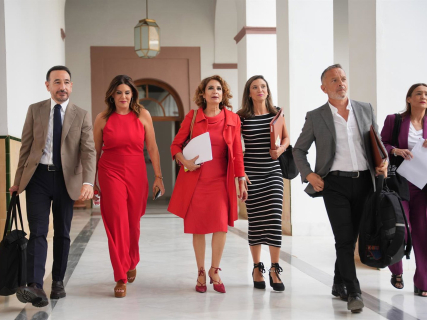

The Socialist Group has registered in the Andalusian Parliament a non-legislative proposal (PNL) for debate in the Plenary with which it intends for the autonomous Chamber to express "its rejection of the statements made by the president of the Popular Party, Alberto Núñez Feijóo," in which he referred to absenteeism as "a cancer that we cannot afford," statements made on July 7.
This approach is included in the first of the five points that make up this PNL "related to the defense of the rights of workers during temporary incapacity processes and recognition of healthcare professionals," consulted by Europa Press, which has already been favorably qualified and admitted for processing by the Parliament's Board.
The initiative, signed by the deputy spokesperson of the Socialist Group, María Márquez, initially proposes that the Andalusian Parliament, "in defense of the public healthcare system of Andalusia and the rights of workers," express its "rejection" of Feijóo's words "as they question the right to temporary incapacity of workers, stigmatize those who fall ill, and unjustifiably cast doubt on the professionalism and independence of the healthcare personnel responsible for issuing medical leaves."
Likewise, the PSOE-A proposes that the Parliament urge the Andalusian Government to "reaffirm that temporary incapacity constitutes a labor and social protection right recognized by the legal system, ensuring that its exercise does not entail any stigmatization for workers nor undermine their dignity or rights, so that no worker's dignity or rights are questioned due to suffering an illness or an accident."
In a third point, the PNL proposes that the Chamber demand the Andalusian Government Council to "express its recognition and support for all healthcare professionals, reaffirming its full confidence in their professionalism, independence, and actions according to exclusively clinical and scientific criteria in the issuance of temporary incapacity reports."
Likewise, it is requested to "explicitly reject the statements and public manifestations that, without any basis, cast doubt on their professional ethics, question the veracity of their actions or sow suspicions of fraud in the issuance of medical leave, as they constitute an unjustified attack on the prestige of healthcare professionals and on the trust of citizens in the public health system."
Another point of the initiative demands that Parliament urge the Board to "assume its responsibility for the deterioration of public healthcare in Andalusia and to urgently adopt an extraordinary plan to reduce waiting lists that includes strengthening staffing, providing the necessary human and material resources, and recovering the healthcare capacity of the public health system of Andalusia."
The PNL emphasizes that it is about putting "an end to a situation that is causing unjustified delays in consultations, diagnostic tests, and surgical interventions, unnecessarily prolonging temporary incapacity processes and harming the health, labor rights, and quality of life of thousands of working people in Andalusia."
In its last point, the Socialist Group proposes that Parliament urge the Andalusian Executive to "defend social dialogue and collective bargaining as essential pillars of labor relations, as well as to reject any initiative or proposal that implies cutting labor rights and social protection for working people, particularly those aimed at reducing economic protection during situations of temporary incapacity, blaming those who fall ill, or shifting the burden of the deficiencies of the public health system onto working people."
REASONS OF PSOE-A TO JUSTIFY ITS PNL
In the statement of reasons, the Socialist Group starts from the statements made by Feijóo on July 7, when "he stated during a meeting with businessmen that absenteeism 'is a cancer that we cannot afford,'" and "questioned whether working people maintain their economic rights when they are on medical leave."
The PSOE-A PNL reproaches that the president of the PP "went so far as to state that 'it is very difficult for a doctor not to give a leave to a colleague or for a nurse not to give a leave to a doctor,' sowing the suspicion that behind temporary incapacities there is widespread fraud."
For the PSOE-A, "these are not unfortunate statements," but "the expression of an ideological model that always looks with distrust at those who work and with indulgence at those who concentrate economic power," and they maintain that Feijóo was talking about "cutting rights," that "being ill costs the worker more," and about "turning illness into a suspicion and the sick worker into a presumed defrauder."
In contrast, the socialist initiative emphasizes that "temporary incapacity is not unjustified absenteeism," but "a recognized right" by the "Spanish legal system" "to protect workers when an illness or an accident prevents them from carrying out their work activity."
Furthermore, it is highlighted that "medical leave is not granted by the worker's decision, but by doctors who act according to clinical criteria and under the control mechanisms provided by current legislation," so that "to insinuate that the medical personnel who process such leaves regularly participate in fraud constitutes a serious disqualification towards thousands of professionals who support our healthcare system every day."
The PSOE-A frames Feijóo's words about absenteeism in the "process of radicalization that the Spanish right is experiencing," and argues that "it is becoming increasingly difficult to distinguish the economic and labor proposals of the Popular Party from those defended by the far right and international ultraliberal references."
In the PNL it is added that "the permanent questioning of labor rights, the distrust towards collective bargaining, the stigmatization of those who receive social protection, and the criminalization of illness are part of the same political conception."
Likewise, the Socialist Group considers "especially serious" that these accusations are made "while the autonomous communities governed by the Popular Party accumulate significant waiting lists for healthcare," and criticizes that, in Andalusia, the Junta "keeps hundreds of thousands of people waiting for a consultation, a diagnostic test, or a surgical intervention," so that "many temporary incapacities are prolonged precisely because the public healthcare system takes months to provide the necessary care."
"Before pointing fingers at those who fall ill, the Popular Party should explain why it deteriorates public health and forces so many workers to wait to be able to recover," conclude from the PSOE-A in the statement of reasons for this PNL, which they demand be debated in the Plenary of the Andalusian Parliament.